Friday, November 19, 2010

Tom Horn Phoenix Roping Revised

November 19, 2010
I have told the story of Tom Horn winning the roping contest in Phoenix where he beat out Arizona Charlie Meadows and how it was on the same weekend that the Apache Kid escaped being transported from Globe to the train station at Casa Grande. The conventional wisdom has long been that because Horn went to Phoenix instead of escorting Sheriff Glenn Reynold's prisoners on November 1, 1889, the Apache Kid probably wouldn't have escaped. Actually, I think Horn claims this in his autobiography.

I went home for lunch today and whipped out a scratchboard of Tom Horn to go along with my Phoenix Roping True West Moment.


Here is my tentative copy which is culled from the best books on the subject:

Tom Horn Ropes A Record
On the first of November, 1889, cowboy and Apache scout, Tom Horn, traveled from Globe to the small town of Phoenix to participate in a new sport—Cowboy Competition (it wasn’t until the 1920s that it would become known as rodeo). Going head to head with Arizona Charlie Meadows, Horn roped a steer in the record time of 58 seconds. Although the steer had a 50 yard head start, everyone present predicted this would be a record that would stand for a very long time. The arena was way out of town (most likely an empty field at McDowell Road and Central Avenue).

To be safe, I sent off my copy to esteemed author and historian Larry Ball, who is writing a new biography of Tom Horn. I asked him to clarify if any of this was not true. When I got back to the office, I got this reply:

"I received your message and am happy that you are using Horn's rodeo experiences in the magazine. Of his various talents, steer roping was one of his most notable.

"Horn competed against Arizona Charlie Meadows at the Payson "rodeo" in November 1888. Meadows beat him out, with Horn coming in second in steer tying. Horn then performed at the Fourth of July 1889 celebration in Globe and won with the remarkable time of fifty-eight seconds. His success persuaded his friends that he should enter the competition at the territorial fair in Phoenix, which took place on 16-18 October 1889. Horn beat Meadows with the time of one minute, nineteen seconds. Apparently, the performances of Horn and Meadows persuaded Buffalo Bill Cody to ask them to join his show. However, I have been unable to document an invitation for Horn. The invitation to Meadows is more substantial.

"At this time, Horn was serving as a deputy to Gila County Sheriff Glenn Reynolds. His assignment was in Pleasant Valley, and he listed his residence as Pleasant Valley when he entered the competition at Phoenix.

"Regarding Horn's boast that he could have saved Reynolds' life had he been with the escort that was taking Apache Kid to prison, this is one of Horn's many exaggerations. Reynolds was killed on 2 November, or two weeks after the territorial fair. Just what he was doing in this intervening time is not known. Had Reynolds wanted Horn as part of the escort, it could have been arranged. A report later stated that the Gila County Board of Commissioners refused to make adequate funds available for a larger escort.

"I hope this helps you with some of the details in your Horn item. Good luck, and I look forward to seeing it."

—Larry Ball

Wow! Just goes to show you how wrong conventional wisdom can be (i.e. all the books I have on Horn and the Apache Kid). So Horn competed in the first Payson "rodeo" in 1888. This is the event that gives Payson the claim that they, and not Prescott, are entitled to be called the oldest rodeo in the country. Then Horn goes to Globe and then Phoenix to the territorial fair. And he lived in Pleasant Valley, not Globe. Hmmmm. Today the fair is held at 19th Ave. and McDowell. I wonder if that was the location then? Have a hunch I'll find out, and I better since this copy and artwork is due at the Arizona Republic on Monday. Ha.

This sure is humbling, in fact I feel rather stupid. Gee, I wonder what old Bertrand has to say about this?

"The trouble with the world is that the stupid are cocksure and the intelligent are full of doubt."
—Bertrand Russell

The sad state of cowboy hats in movies

November 19, 2010
Now that we've seen the trailers for the two new Westerns coming out of Hollywood (True Grit, Cowboys & Aliens), I have to get something off my chest: the hats in both are dreadful, at least on the leads, Jeff Bridges' Raymond Chandler styled chapo in True Grit and Daniel Craig's in C&A. Both are wearing twentieth century style fedoras and it really grinds me. Here's the catch. I don't blame Hollywood, I blame us. Yes, you and me. The buffs and re-enactors who instituted this hard and fast rule, that the cowboy hat with the winged brim did not exist in the Old West. The reality is that in the twentieth century, as Westerns proliferated, everyone eventually starts wearing that style of hat, and that is ridiculous as well, but now we have gone too far the other way. And while it's true, you don't see cowboys wearing that style of hat in the photos of the 1870s and 80s, BUT, you certainly do see hats with swept up sides on all sorts of characters in the Old West photos from the same era.

We have gotten so ridiculous about this that the consultants to movies (in most cases dudes from our tribe) have successfully limited and thwarted the styles of hats costumers can sport in a modern Western. This has resulted in two developments: costumers have resorted to big brimmed hats with the front up, or at least flat with undented crowns, and in many cases these are worn by everyone. This too, is only half right (see Billy the Kid's only known photo), and when they can't have a so-called cowboy hat, they resort to, well, Elliot Ness fedoras.

What we have here is one cliche trying to get away from another cliche and it's ruining Westerns.

Just to prove my point, I am going to run a photo of "cowboy styled" hats in old photographs, every day, until I run out. You say there are no photos of winged cowboy styled hats in the real Old West?

Okay, What About This?


There are at least five hats that I see in this New Mexico scene that would be banned from a Western movie set by Hat Nazi consultants (like you and me).

I say, cease and desist! Let Westerns breath a little bit. Let's get back to the fun of it.

"If everybody is wearing a big hat, ain't nobody wearing a big hat."
—BBB

Thursday, November 18, 2010

Vaquero Joe vs. Tom Horn

November 18, 2010
Last night at the Buffalo Chip, Vaquero Joe Freedman rode a bull. Yes, a real sized-rodeo bull. The Chip has been having these bull riding sessions out back of the saloon and Joe told me he was going to ride. Now I had mixed feelings about this because, yesterday was Joe's best day ever at True West. He sold a ton of ad space, more than he has ever sold, IN ONE DAY! I thought to myself, finally, after a year, Joe gets untracked and then he gets trampled by a bull and comes in on Thursday a vegetable.

Well, he did hurt his wrist from the, ahem, dismount, but he survived.

Speaking of bull, working on another True West Moment about Tom Horn coming to Phoenix in November of 1889 to participate in a Cowboy Competition (it wouldn't be called rodeo until the 1920s). He turned in a record time of 58 seconds and the locals all agreed it was a record that would stand for a very long time.


Yes, that's Camelback Mountain in the background. My hunch is the arena was way out of town, probably at McDowell and Central in a vacant field. Also, the steers got a fifty yard headstart, and there were no fences. The cowboys were adamant that it had to mimic cowboy life in the wild.


My, how that has changed.


"The art of living is more like wrestling than dancing."

—Marcus Aurelius


Cowboys And Aliens Trailer

November 18, 2010
Here it is, the Cowboys & Aliens trailer. Check it out:

Cowboys & Aliens

Wednesday, November 17, 2010

George Warren: The Man Who Thought He Could Outrun A Horse

November 17, 2010
Worked most of the day on our January cover. Or, I should say, our art director, Dan The Man Harshberger, worked on it and then we picked it to pieces and started over. More than once. Had a group of classic cowgirl photos from our vast collection and hit a dead end with the first one. The cowgirl's funky smile and the hand tinted color clashed, ending up with not quite right effects, or, as one staffer commented, "She looks like the Joker." She did. That was last Friday. This morning we started on another image, this time with three cowgirls, hugging. Went through at least three versions and finally got what we all wanted at about five this afternoon. We all called Dan to rave about it.

Concurrent with this, I worked on a new True West Moment. Arizona prospector George Warren, bet a friend he could outrun a horse and lost his stake in Bisbee's Copper Queen Mine as a result.


He lost everything, became an alcoholic, and was finally judged insane before he died. If he looks familiar, it's because that's George on the seal of the great state of Arizona:


Come to think of it, he's the perfect specimen to be on our seal, don't you think?


"History is a gallery of pictures in which there are few originals and many copies."

—Alex de Tocqueville


Tuesday, November 16, 2010

Geronimo Revisited

November 16, 2010
Had lunch today with a former employee. Took along Joe Freedman, who enjoyed the scuttlebutt and the inspiring attitude of this excellent person. Went to Keg Steakhouse at Desert Ridge, one of my fave hangouts ($64.32 biz account).

While laying out the rough for the upcoming Bascom-Cochise feature, I asked editor Meghan Saar to find my 1994 Geronimo timeline. I had a full blown timeline, edited by Charlie Waters, ready to go for a book, and then got sidetracked by a radio show and house payments. The material is quite strong. Here is a taste:

Child of the Water
Each day he is awakened before sunrise and bathes in the creek, even when ice has formed. Goyahkla and his fellow apprentice braves are systematically trained for war by learning the skills of shooting, dodging,hiding, tracking and mapping the terrain to find their way back to camp. They are also required to race up a mountain carrying water in their mouths, pick up a pine cone (to prove they went to the top) and then spit out the water when they return to show they had breathed properly through the nose.
They learn Apache rules of survival:

* Have the women pound enough meat and fat for a week’s rations and take along a supply of water.

* Cross open flats by night to reach a mountain, and hide in the brush by day.

* Locate water holes by climbing to a high place and looking for green spots; do not go by day, only at night.

* Do not sleep under a tree—that is the first place the enemy will look.

* If lost, make a fire and send a smoke signal, but put it out and run away to a place where you can watch and see if anyone comes.

The rigorous apprenticeship culminates in four raids—the Apaches regard four as a sacred number— where the youths serve as a support group, holding and caring for the horses, getting water and wood, cooking, serving guard duty. Each apprentice is called Child of the Water and, if he shows courage and dependability, he will be accepted into the council of warriors.


“War is a solemn religious matter.”
—Goyahkla

Monday, November 15, 2010

Hog Ridin' Fools & Blakely Tumblers

November 15, 2010
In the S. Clay Wilson classic biker tale that ran in the first Zap Comic (1968), the Checkered Demon gets into it at the end of the first (and apparently last) installment of "Hog Ridin' Fools" over a set of tumblers at a gas station.

In real life, the best example of gas station tumblers (a free glass with every fill-up!) was Blakely's Arizona Cactus Tumbler set. And this was when gas was 19 cents a gallon!


I have had at least five sets of these classic suckers. Unfortunately, I keep 'em on a tray on a shelf in the kitchen and the cleaning lady keeps breaking them. Still, very cool, no?

"A man should be upright, not kept upright."
—Marcus Aurelius

Steampunk Arrives In The West

November 15, 2010
Had a speech in downtown Phoenix yesterday morning at the Sheraton Hotel. Spoke to about 35 attendees at an ACAAI convention. Really successful. Funny how it can be small, only 35 people, but they were the RIGHT 35 people. Very engaged, asked for information on how to subscribe to True West, how to find more of my work, etc. I have spoken to many, larger groups and not gotten a blip of interest. Always amazes me.

Afterwards, met my son T. Charles and his main squeeze Pattarapan at the Matador for huevos rancheros. Our waitress, Olivia, has been at this cafe since 1980, when they opened, and she worked for the owner at their other location since 1971. AND, she hasn't aged a day. I mean it. My son bought breakfast.

There's a movement called steampunk that is really, ahem, picking up steam. Have you heard about it? It's bit like a Renaissance Faire, only crossed with a Western and Mad Max. Enthusiasts dress in elaborate costumes featurinig goggles, jewelry fashioned from watch parts and cogs and gears, and structured garments such as corset. The technology is advanced but not in the ways we are accustomed, for example, there are computers, but they run on 1800s technology. It has been around for some time. Wild, Wild West with Will Smith featured a giant spider machine that ran on steam. They love taking modern inventions like the internet, weaponry, clocks and re-imagining how they would look had they been created with Victorian tech and materials.

Read more: http://www.kansas.com/2010/11/13/1587714/steampunk-fans-descend-on-old.html#ixzz15NbvZVId

Friday, November 12, 2010

The Bascom Affair From Afar

November 12, 2010
Had an interesting encounter in Googleland. Wanted to do a drawing of Tom Horn, and rather than find it in one of my many books at home, I Googled Tom Horn and hit "images" and, of course a million images came up, but three of them were drawings I have done of Mr. Horn and published on this blog. They weren't too bad, either.

Meanwhile, worked today on a timeline for the so-called Bascom Affair at Apache Pass. Utilizing several documents from historian Douglas C. McChristian (recommended by Robert Utley), including a new find, a rare eyewitness report to the tragic fight by Sergeant Daniel Robinson, who was wounded in the fighting there. Culling from the report and McChristian's two accounts of the fight (one with Larry L. Ludwig) I came up with this basic timeline:

• January 27, 1861, an Apache raiding party (some say two parties) strikes John Ward's ranch in the Sonoita Valley stealing 20 head of cattle and kidnapping Felix Ward (Martinez), the 12-year-old son of Ward's Mexican common-law wife. (Hint: he later becomes Mickey Free)

• January 28, 1861, John Ward petitions Lt. Col. Pitcairn Morrison, the commanding officer at Fort Buchanan to recover Ward's stepson.

• January 29, 1861, Departing Fort Buchanan, 2nd Lieutenant George N. Bascom leads a 54-man infantry unit (Company C, 7th Infantry), mounted on mules to recover the boy. John Ward rides with them acting as an interpreter.

• After a three day march, Bascom's column reaches the Butterfield Stage station near Apache Pass on February 3, 1861

• Summoned several times, Cochise finally shows up at Bascom's camp on February 4 with his brother, three other males, his wife and two boys (one allegedly Naiche). When soldiers try to hold the chief and his entourage hostage, in exchange for Felix Ward, Cochise and his brother cut their way through the tent and, although slightly wounded, Cochise escapes, while one of the Apache males is killed, the others, six in all, are captured.

In the evening signal fires atop the peaks surrounding the station blaze a request for immediate assistance.

• On the morning of February 5, 1861 (a Tuesday), Cochise and several hundred Chirichahuas appear on a rise a couple hundred yards south of the station. After a brief demonstration, most of the warriors disperse and a white flag is unfurled. A handkerchief from the station returns the signal and a warrior bearing the flag approaches to within earshot and yells out in Spanish that Cochise wants to parlay with the soldier chief. Bascom steps out into the open along with Ward, Sgt. Smith and Sgt. Robinson. They walk forward to meet Cochise and White Mountain Chief Francisco, along with two others. Cochise demands the release of his relatives and Bascom responds they will be released when Felix is returned to his father. Defying Bascom's orders, three stage station men, Culver, Walsh and Wallace come out of the building. Enticed to the edge of a ravine, Wallace is embraced by a woman, Juanita, who had earlier been at the station and perhaps had a romantic relationship with Wallace. She holds him tight as several warriors leap out of the ravine and drag him and Culver down into the canyon. Culver is shot in the melee but manages to escape. Chief Francisco yells to the warriors, "Aqui! Aqui!" (Here! Here!) pointing at Bascom and imploring his men to capture them. Dropping their white flag, Bascom orders his men at the station to open fire and then they run out of the arc of fire towards the station. Walsh is shot dead (some speculate by friendly fire), while everyone else, save Wallace, makes it to safety.

• February 7, 1861, Cochise appears on a ridge and yells to Bascom that he now has three additional prisoners. His warriors had attacked five wagons filled with flour bound for the mines at Pinos Altos, New Mexico. The freighters went into camp about two miles west of the station and were attacked after dark, killing six of the Mexicans outright, while two others were lashed to the wheels and burned to death. Three Americans, Sam Whitfield, William Sanders and Frank Brunner were added to Cochise's barter and he left a note saying he would be back the next day to talk again (the note wasn't found until afterwards).

• An eastbound stage is also attacked in the dark, wounding the drive and killing two of the mules. Cutting loose the dead stock, the stage makes it to the stage station and the relative security of the mini-fortress.

• Snow falls during the night of the seventh, and by the morning of the eighth the ground is white as 15 soldiers guard the mules as they are taken from the station to the spring to be watered. As the men cover the springs from Overlook Ridge, they spy some 200 Apaches, jogging on foot and crouched low, singing a war song. The soldiers open fire and divert the attacks only slightly, who overtake the ridge, capture the herd and wound several of the soldiers in the process. Bascom sends out a relief party only after he is assured this attack is not a feint, or a ruse, and the soldiers, all on foot engage the Indians, killing five. It is believed Mangas Coloradas and Geronimo both fought in this battle. These killings of the warriors assured that the prisoners Cochise held were doomed. For it is Apache custom that the women of murdered warriors can inflict punishment on captives. It is doubtful Cochise could have stopped the grieving widows from torturing the four captives, which they no doubt did, running at them with lances and taking out their grief by stabbing and gouging the defenseless captives.

• On February 10, 1861 a relief column from Fort Breckenridge comes into the station with several Apache prisoners they encountered on their ride to the pass.

• February 14, 1861, 75 dragoons led by First Lieutenant Isiah N.Moore arrives at the station much to the relief of the besieged column.

• February 16, 1861, Moore, the ranking officer, sends out patrols to scour the hills. They search for three days and find nothing (the Apaches are believed to have fled to Fronteras, Mexico). Later the soldiers find the badly decomposed bodies of four human remains and the note Cochise had left on the bush. Wallace is identified only by the gold fillings in his teeth. Horrified at the gruesome torture of the corpses, the soldiers begin to talk of revenge on the Apache captives back at the station.

• On February 18, 1861 the two stage coaches feel safe enough to leave the station and continue their routes. The Apache prisoners are marched to the graves of Wallace and the others and the prisoners (the men) are hanged and left where Cochise will find them. The children and woman are let go, although Apache tradition claims their fate was decided in a card game.

This started a series of wars that didn't end for the next 25 years.

"Let other pens dwell on guilt and misery."
—Jane Austen

Wednesday, November 10, 2010

Geronomo's Cadillac Was Actually A Locomobile?

November 10, 2010
With the Source Book at the printer in Kansas City, I had a chance to work on a couple new True West Moments this morning. Abby sent via dropsend, the "Ay Chihuahua!" TWMoment this morning, and then after lunch I whipped out a drawing of Geronimo, the tycoon, behind the wheel of a roadster:


This is taken from a famous photo of Geronimo and other "chiefs" sitting in a car at the Miller Brothers' Ranch southwest of Ponca City, Oklahoma. The date of the photo is June 11, 1905 and is allegedly the inspiration for Michael Martin Murphy's song, "Geronimo's Cadillac." Although the online information says the car is actually a Locomobile, which seems almost too precious to be true. Really? Geronimo in a Locomobile? I want one of those!


Of course, I added the tux (however, he's actually wearing a top hat like this in the photo) and the cigar. This is to illustrate the fact that after his surrender in 1886 the G-Man became quite the celebrity (Robert Utley coined the phrase "Exiled into celebrity," which I poached for the TWMoment, with his permission). Geronimo charged for appearances, his autograph (soldiers at Fort Sill supposedly taught him how to sign his name), and even sold the buttons off his shirt and jacket at train stops on his way to fairs, expositions and inaugural parades. When he died in 1908 he had amassed $10,000 in the bank. I believe the bank was in Lawton, Oklahoma. Anybody know if that's where he had his merchant account?

"It's easier to change directions while you're still moving."
—Debra Winger

Tuesday, November 09, 2010

Source Book Out the Door, Finally

November 9, 2010
We were up against it this time. Two people leaving, one in the hospital, a new board and our giant, record breaking ninth annual Best of the West Source Book clogging up every bit of computer space we could find. Thanks to herculean effort by the sales crew, Sheri, Sue and Joe, and Abby in production and Meghan and Lauren in editorial, we were able to upload our final files about an hour ago.

Whew! Now on to our January issue, which will feature some pretty cool Apache stuff. It's the 150th anniversary of the Bascom-Cochise "Cut the Tent" affair and we've got big plans.

Went home for lunch and whipped out a gonzo Apache warrior:


"A saint does not dissolve the chaos; if he did, the world would have changed long ago. . .It is a kind of balance that is his glory. He rides the drifts like an escaped ski."
—Leonard Cohen

Thursday, November 04, 2010

Seine River Dance

November 4, 2010
In meetings all day. Ken Amorosano is in town. Board meeting tomorrow. John Langellier, the director at Sharlott Hall Museum came by at three and we went over several new articles he is doing, including a big package on the Cochise vs. Bascom at Apache Pass conflict, which, of course, was a direct result of the kidnapping of this guy:


One of the things I have taught my kids is you always appreciate musicians, and pay them respect especially at dinner places where musicians finish a song and no one applauds (I played enough gigs where the audience didn't even acknowledge your existence, much less the song you just finished). I trained them from an early age to clap like crazy.

Kathy also has a soft spot for musicians (she married a drummer: and what do you call a drummer without a girlfriend? Homeless.) so when we were in Paris recently, we always tipped the street musicians and occassionally Kathy even joined in a little River Dance treat.


This is by the bridge over the Seine River, behind the Notre Dame Cathedral, and about a block from our rented flat. When I threw three euros in the cup, the accordian player said, "American!" and when my wife started dancing he said, "Crazy Americans!" We took this as a high compliment.


"We are all travelers. From birth to death we travel between the eternities."
—Lillian Redman

Wednesday, November 03, 2010

Kingman Rodeo Memories

November 3, 2010
As mentioned I was cleaning in the garage this morning and found a stack of old drawings and New Times layout boards (actual paste-up flats done with exacto-knives and rubber cement!) and I hate to admit it but most of them were pretty awful.

However, a precious few actually had some sweet charm like this little ink wash of a Kingman Rodeo scene at the corner of Andy Devine and Fourth Street:


I could name everyone in this picture. Ha. Meanwhile, here is a very prescient illustration, done for a New Times doubletruck with the theme "Just Once," as in "Just Once I'd like to hear a bunch of old people at a dance say. . ."


And, this is almost exactly what happened on March 22, 2008 when the Exits had their reunion at the Old Elks Hall (just up Fourth Street in the above street scene) and a certain member of the band did the gator and went down for the count.

Here's another scene that actually works. This is Ghandi in Arizona, also a doubletruck illustration wondering what Ghandi would have encountered in pre-war Phoenix:


This was done on duo-tone Grafix paper and has a certain Old School charm, AND it looks like Mr. Peace Train himself there.

One last little gem, here's a group of eighties teenagers. I tried to make them really edgy and over the top, but somehow they just seem quaint by today's standards, no?


"For everything you gain you will lose something, and for everything you lose you will gain something."
—Coach Baca

French Humore Regret?

November 3, 2010
Another series of cartoons I found in the garage this morning were about visiting Europe, specifically France. Evidently thre was some concern, even back in 1986, about violence (I can't remember why, can you?):


In this same series (which ran in the Phoenix New Times) from June of 1986, I also poked fun at the snootiness of the French:


I wouldn't make fun of the French now, like this. Why?


"You can't have a thick passport and a narrow mind."
—Old Vaquero Saying

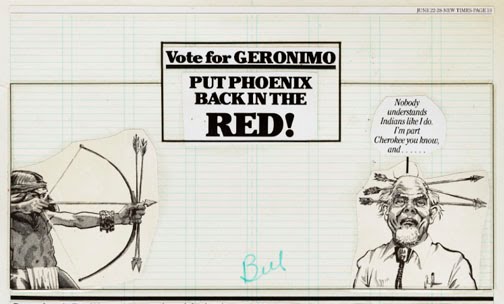
Geronimo for mayor of Phoenix

November 3, 2010
I was cleaning up in the garage this morning and stumbled upon a pile of layouts for old editorial cartoons I did for the Phoenix New Times back in the 1980s.

Now that we're all election-weary, I think it's time for a little levity, Apache style:


Here is a part of page two:


When asked about his reputation as "a savage" the candidate replied, "I don't know a savage way to top Hiroshima."


The G-Man had a couple catchy campaign slogans:


• A vote for Geronimo is a vote for an Anglo-free Arizona!


• Let's start a new Indian war to get Phoenix moving again!


• In your heart, you know he's dangerous.


"Bureaucracy, the rule of no one, has become the modern form of despotism."
—Goyathlay

Tuesday, November 02, 2010

Oscar Wilde Cheek to Cheek With Warren Earp

November 2, 2010
Voted this morning by absentee ballot. Went to the heart doctor and he told me not to do anything stressful, so I came home and whipped out a Toulouse-Lautrec inspired scene of Oscar Wilde, out West in 1882, dancing cheek to cheek with Warren Earp.


"I haven't seen this many sober Republicans since America lost the Ryder Cup."
—David Brooks

Monday, November 01, 2010

Toulouse & Wild Bill Share an Absinthe Moment

November 1, 2010
Went home for lunch and got inspired to do a Henri Toulouse-Luatrec rendering of the artist, out West, sharing an Absinthe moment with Wild Bill Hickok:


They seem rather morose but this was in Saloon Number 8, before they moved on to, well, you know.


"Wait for me, Wild Bill!"
—Toulouse-Lautrec getting on James Butler's case for hogging all the absinthe

French Connections

November 1, 2010
Had a number of insights and inspirations from our trip to Paris in early October. Among them:

• The most ubiquitous American brand I saw in Paris was the New York Yankees logo on baseball caps. All kinds of colors of caps, all over the place. Never seen red before (isn't that illegal since it's Boston's color?)

• Having been in Mexico and South and Central America where the Coca-Cola logo looms everywhere, like this wall logo from Samaipata, Bolivia:


But I don't remember seeing one Coca-Cola logo in Paris. And for that matter no Pepsi, even in cafes.


• I have never seen more size zero, jean wearing, boot strapping, scarf flapping, knocked-out French women walking and smoking in my life. Sitting and smoking for that matter as well, but after a while it was kind of shocking to see a French woman walking WITHOUT a cigarette.


• Our electrical plugs do not fit their sockets. They have some weird diagonal deal which seems designed to say, "Let's make this so anything American won't work."


• Some of the street musicians play really cool rock songs (on the bridge to San Louis Island two guys, one with a one-string-bass and a guitar player with a rockabilly hairdo were belting out The Everly Brothers), but virtually all the other music we heard on the street and in the restaurants was kind of bland pop. Here's a photo of the duo, jamming on the bridge:


• Besides the many sidewalk cafes which proliferate in alleys, especially and other nooks and crannys, the sidewalk crepe makers were quite good, costing usually 5 euros ($7 US), big tortilla type wrappings with cheese and mushrooms, tomatoes and stuff. Very, very good. This one was near our apartment within site of the bridge, above:


On the whole, the food in Paris is quite spectacular, and this extends to exotic foods. After our visit to the Centre Pomidou (the modern art museum) we walked down a blind alley across the street which meandered towards the Musee Carnavalet (The History of Paris Museum, which ended up being one of our favorites) and down one of these alleys we discovered a Thai cafe. Here's a soup I ordered:


And yes, it was delicious.

• In the U.S. we have basic wine distinctions like, cabernet, merlot and pinot noir as categories, but they don't do that in France. Very different names, all different, sometimes with cabernet in the title, but mostly not. It's more of a crap shoot, but I have to say the bar is higher and most of the wines are way above average.

• The dates on the buildings and the paintings is just mind blowing. We make a big deal about the Hohokam in Arizona being here in the 1400s and the mystery of who they were and why they left and you end up with this concept of the 1400s as being primal, stone age stuff. Well, in Paris the Notre Dame was started in the 900s and a huge beautiful church, the Sainte-Chapelle was started in 1238. AND there are paintings of these buildings from the 1200s that are mighty nice. That was the big take away for me. The French have been doing this for a very long time and we are so young, so wet behind the ears. Gee, I wonder what ol' Harry has to say about this?

"The only thing new in the world, is the history you don't know."
—Harry Truman

Friday, October 29, 2010

Toulouse Lautrec Goes West

October 29, 2011
Meghan Saar and I attended the Arizona Tourism Conference at the Orange Tree Resort on Camelback Road yesterday. Collected a couple big bags of goodies from all the resorts and had a very nice lunch talking to Meghan about editorial for 2011. Very excited about several new features we are working on.

Been noodling some sketches of Henri Toulouse-Lautrec:


Wondering what he would have painted if he had come West with Oscar Wilde in 1882. I have some ideas on paintings he might have done. Hmmmmmm.

It's not hard to imagine him doing portraits of Doc Holliday and Bat Masternon. Check out this painting by Henri—Dude, that could be Tombstone, no?


Meanwhile, my neighbors, the N's (they're very private) brought me back a sketch by Toulouse-Lautrec several years ago and I have it in my studio:


They told me that Henri had a theory about drawing: if your pen stops moving, the drawing dies. The horse is all wrong, the harness seems incorrect, and although it is very fluid and loosey goosey, it is alive.

"Make no little plans. they have no magic to stir men's blood. Make big plans: aim high in hope and work."
—Daniel Hudson Burnham

Thursday, October 28, 2010

Stoned Policeman

October 28, 2010
Sometimes you have cleanse your palette, Been drawing a ton of Old West characters and, of course French subjects, so, this morning, I thought I'd whip out a Stoned Policeman.


Just got a call from my step-father, Lou Cady, Jr. who lives in Cibolo, Texas. According to Lou Cibolo means buffalo in Spanish. He moved there to be with family after my mother passed in 2007 (they last lived in Cody, Wyoming). He's 89 and still shoots archery. He told me he takes the True Wests I send him down to a home where everybody watches the Westerns Channel. He told me they love the magazine and when I asked him if he wanted me to send them a complimentary subscription, he said, "No, I'll make sure it circulates." Ha.


"You can't cross the sea merely by standing and staring at the water."
—Rabindranath Tagore