Friday, May 08, 2015

Lady Luck Turns Her Back On Pancho

May 8, 2015
   I've been reading about Pancho Villa and the Mexican Revolution (The Life & Times of Pancho Villa by Friedrich Katz) and I'm up to the year 1914, which was the apex of Pancho's unlikely rise, from illiterate peon to sitting in the president's chair in Mexico City. He is wealthy, he is admired, he has power and then. . .

Daily Whip Out: "Lady Luck Turns Her Back On Pancho"

Thugs Rush In
   In June of 1914, officials estimated that Villa's Division del Norte (the name of his army: The Division of The North) was made up of 12,000 soldiers and 3,000 of those were directly under Villa's command. He called them The Dorados (The Golden Boys) and they were his elite fighters. At this point in his decade long career he had beaten almost everything the federals had thrown at him and he was untouchable. But that would change.

  The war had decimated the old order (the Hacendado elite) and unleashed many thugs (power abhors a vacuum), just as it had in France—who got Napoleon—and Russia—who got Stalin—and China—who got Mao. In Mexico it was the old thugs being replaced by the new thugs (as it probably is everywhere) and Pancho was just one of dozens of bold and mean sons of bitches. Speaking of which, the Aztecs derisively called the inhabitants of what became northern Mexico as chichimecas (sons of dogs). Another case, like with the Apaches, where a tribe of people, in this case the Chihuahuans, were named by their enemies.

   And speaking of the Apaches, the old guard in Chihuahua—that Pancho had defeated—was made up of the frontier fighters who fought off Geronimo, Victorio and Juh. The Terrazas, for example, were the bravest of the brave and saved many villages and now that the Apaches were on reservations—and in Florida!—these bad boys wanted their place in the sun. Sound familiar? Ah, Baby Boomers.

   Anyway, I digress. 

   Thugs assassinate President Madero, then Carranza refuses to embrace democracy, and sends General Obregon after Villa, and Obregon thoroughly kicks Pancho's ass in two battles. Pancho loses 4,000 killed and 6,000 captured. Two thirds of his forces! Pancho then goes into Sonora and gets his hat handed to him at Agua Prieta and he loses another 1,500 of his men who turn on Villa and accept Caranza's offer of amnesty.

   With a couple hundred men left, Villa attacks Columbus, New Mexico and now he has 10,000 Yankees on his trail led by "Black Jack" Pershing. Fighting his way through the mountains, Pancho is badly wounded in the knee (not by an American bullet but by Orosco Mexicans he and his remaining men were engaging at Cuidad Guerrero) resulting in Pancho not being able to ride a horse, so he hides out in a cave (see, Osama bin Laden at Bora Bora). Pershing doesn't get Villa but many of Pancho's top commanders are captured and killed by either the Americans or Caranza's troops.

   After Caranza is assassinated (the treachery on all sides is mind numbing) Villa sends a telegram to President Huerta requesting amnesty. Huerta agrees and gives Villa a huge hacienda and pensions for him and 200 of his soldiers. It lasts a little over three years, as Pancho becomes the very thing he fought to eradicate: a Hacendado. On July 20, 1923, Villa is ambushed by seven riflemen, which is ironic because his favorite horse was called "Seven Leagues" and he once claimed to a visitor he had killed 50,000 of his adversaries, only to end up on the receiving end of a firing squad himself. My guess is President Obregon (Yes, the general who defeated him, and who once was his comrade) didn't want to pay those pensions.

"If it wasn't for bad luck I would have no luck at all."
—Old Villista Saying


Thursday, May 07, 2015

The Many Wives of Pancho Villa

May 7, 2015
   Still amazed at the number of "wives" Pancho Villa married in his long career as a revolutionary. Got up this morning and grabbed one of them.

 Daily Whip Out: "Pancho's Wife Number Three." 

"Do you Pancho Villa, take this woman to be your lawful wedded wife for the next 12 hours?"
—The Bought Off Priest at Creel

Wednesday, May 06, 2015

Pancho Villa: Horndog Extraordinaire

May 6, 2015
     Born a peasant, orphaned at 15, an outlaw by 16, Doroteo Arnago, AKA Pancho Villa rose from the lowest rungs of the social ladder to become one of Mexico's greatest military chieftains. He commanded thousands of men, outmaneuvered and eluded 10,000 Americans led by Blackjack Pershing. A friend of the poor and a very macho Man. He is the he-man hero in the Mexican tradition of machismo—overpowering, dominant, and larger than life.


Daily Whip Out: Pancho's Horndog Patrol"

The number of alleged "wives" of Pancho Villa are unknown but we do know that at the time of his death there were four women who claimed to be his wife. Austreberta was Villa's "official wife." Soledad Seanez was the second wife and Manuela Casas was the mistress who bore Villa a son and ran a hotel in Parral (the town where he was assassinated) and he had also given her a house there. Luz Corral is the fourth wife and had been banished from his estate at Canutillo and was receiving no support from Villa at the time of his death. That she ended up with anything is amazing, since she had to go through Alvaro Obregon (who was charged with dealing with all the claimants), and, who had defeated Villa in battle in 1915 and according to Villa's biographer, Friedrich Katz, "probably played a part in his assassination."

   All four women would arrive at the cemetery in Parral honoring Villa's memory on the anniversary of his assassination, and each would lay a wreath on his grave, but not before removing the flowers placed by the other women. Ay-yi-yi.

Daily Whip Out: "One of Pancho's One-Night-Wives" 

Many of Pancho's best soldiers were vaqueros from Chihuahua and they were fighting men. These are the guys who took on Geronimo and the Apache raiders who came every year to pillage and destroy.


Daily Whip Out: "Pancho's Poco Loco"

   After the departure of Pershing's expedition in 1917, the character of Villa's army began to change. and the loyalty Villa enjoyed was due in part to the Carranzacista soldiers stealing the countryside blind, and also because Villa paid in Gold while Carranza paid in worthless paper money. Villa's army also attracted many out of work cowboys—vaqueros—who preferred to fight with Pancho rather than migrate to the U.S., where they feared being drafted into the U.S. Army once the U.S. entered World War I.

Daily Whip Out: "Mexican Vaquero"


"Cowboys we are, and cowboys we shall be."
—Pancho Villa, 1918


Tuesday, May 05, 2015

Weird Al and Chief of Dreams

May 5, 2015
   Woke up today and worked on a couple studies. Here's a board that has been lying around my studio for a couple years, at least.

Daily Whip Out: "Chief of Dreams"

   I also finished another study based n a memory.

Daily Whip Out: "Hualapai Sweeper"

Had a Design Review meeting at ten to go over our Pancho Villa coverage for the July issue. As a passing thought, Meghan Saar mentioned that Weird Al Yankovic is the guest editor of the current issue of Mad magazine. Went to lunch with Dan The Man Harshberger and Wonderful Russ at Pita Jungle down at Desert Ridge. Here's a photo of the three of us taken a couple days ago.

The Zane Bro Crew: BBB, Kathy Sue, Wonderful Russ, WR's ex, Darlene Harshberger, Dan The Man, circa 1978, at Pinnacle Peak Patio in North Scottsdale.

After lunch I went over to Barnes & Noble and bought something I haven't bought since before the above photo was taken:

Mad magazine featuring Weird Al Yankovic as guest editor

This stunt stuff must work, because I went and bought an issue of a magazine I haven't even thought about for two decades (okay, maybe five years, for sure).

Received the newest issue of Bridle & Bit and spread the doubletruck out on my desk:

The May issue of Bridle & Bit, along with some other subjects (and objects) on my mind.

"If the Bible proves that God exists then comic books prove Superman exists."
—Mad magazine logic


Monday, May 04, 2015

Rain, Rain, Don't Go Away!

April 4, 2015
   Woke up to rain this morning. When it gets soggy out, I get inspired. Did a couple studies about this:

Daily Whip Out: "Morning Storm Over Elephant Butte"


Worked on a couple of studies on Sunday, including this one:


 Daily Whip Out: "Cochise In His Prime."

   On my trip up to Mohave County I saw lots of big clouds, both coming and going. Got inspired to do a couple scenes:

Daily Whip Out: "Midnight On The Colorado"

   Grabbed a couple boards out of my reject file and gave them another go, like this one:

Daily Whip Out: "Death Stalks Billy the Kid"

A Serial Monogamist On The March

     We're working on a big Pancho Villa feature for the next issue of True West (July). One of the fascinating aspects of his long and bloody career is his rock star status and lifestyle. Basically, he would lead his army into a small village, find the prettiest young maiden, marry her in the church, have wild sex, then leave the next day and have the priest annul the marriage. He allegedly did this 60 times.

Daily Whip Out: "Mrs. Pancho Villa, I Presume"

"I'm hell on women."
—Pancho Villa, allegedly confessing his bad boy behavior to a friend


Sunday, May 03, 2015

Powerhouse Book Signing Then Powered Home

May 3, 2015
   Left the house yesterday at eight in the morning and drove to Wikiup for breakfast. Then on in to Kingman for a book signing at the Powerhouse Museum at noon.

   Of course, I can't make that trip up Highway 93 without being inspired by all the great scenery in Mohave County. Woke up this morning and did this little study after breakfast.


Daily Whip Out: "Midnight On The Colorado"


   The director of the Powerhouse Museum has been tweaking the BBB show with more lights and information, like this pull quote from Professor Paul Andrew Hutton:


Hutton quote that appears on the back of the book and in the Powerhouse Museum in Kingman.

Signed some books, laughed with friends and took off for home at three, and went the back way to Bagdad (low on gas), then up and over to Hillside and on to Kirkland Junction for dinner at this historic place:


The legendary Kirkland Junction Steakhouse

Had the filet and cowboy beans and drove the back way through Peeple's Valley and Yarnell, then down to Congress and on to Wickenburg and home. Long run, 12-and-a-half hours, to sell 13 books. Was it worth it?

"Never allow anyone to rain on your parade and thus cast a pall of gloom and defeat on the entire day. Remember that no talent, no self-denial, no brains, no character, are required to set up in the fault-finding business. Nothing external can have any power over you unless you permit it. Your time is too precious to be sacrificed in wasted days combating the menial forces of hate, jealously and envy."
—Og Mandino


Friday, May 01, 2015

Fun Run to Fun Room

May 1, 2015
   Going to Kingman tomorrow for the annual Fun Run. Signing books at the Powerhouse Museum from 1 to 3 p.m.


Also, Craig Schepp came by today to pick up his latest acquisition:

Craig Schepp with "Bisti Badman"

Craig has pretty amazing taste in art:

Craig Schepp's BBB art room (although I do see two Lon Megargee's in there, not that I'm complaining about the company).

"Logic will get you from A to B. Imagination will take you everywhere."
—Albert Einstein

The Killer Scout vs. Beaver's Breath

May 1, 2015
   Went home for lunch today and waited for the fumigator and did two Whip Outs, starting with this bad boy,

Daily Whip Out: "The Killer Scout"


   One of the nasty blowbacks of the Apache Wars and the scout system was that some scouts used their official status to take out their Apache enemies. It literally gave them license to kill. This happened to the Apache Kid when Al Sieber was away. Not a pretty picture, but at least today we can laugh about it. Or, can we?

   Just heard that a dozen "American Indian actors" walked off the movie set of Adam Sandler's "The Ridiculous Six" filming near Las Vegas, N.M. Loren Anthony, one of those who walked off the set, told an Albuquerque newspaper, "The props were disrespectful and the language towards native women was bad." Anthony cited characters named "Beaver's Breath" and "Wears No Bra." Various In-din leaders are, of course, "appalled" by the "negative portrayal of Native Americans." I understand the upset, but we'll know when In-dins are doing well when they can laugh about this kind of nonsense. And that's all it is—harmless nonsense.

"I hate snow because it's white and it's on my land."
—Old Hualapai Joke


Mysteries Behind The O.K. Corral

May 1, 2015
   How did a botched, misdemeanor arrest go from a footnote to one of the THE seminal moments in Old West history? That is a question we aim to answer in an upcoming issue of True West.

 Daily Whip Out: "Wyatt Gets To Fighting While Ike Beats Cheeks"

Mysteries Behind The O.K Corral
   For most of three decades, as cinema took hold of the world's imagination, the Tombstone story was more or less ignored. What happened in the 1920s to change that? And what did it take for Wyatt's story to finally take its place, front and center, in the hallowed grounds of Western myth and legend?

   Part of this answer is found in a new novel by Mary Doria Russell. Here is her set-up:

"To understand the gunfight in Tombstone, stop—now—and watch a clock for thirty seconds. Listen to it tick while you try to imagine one half of a single minute so terrible it will pursue you all your life and far beyond the grave.

Begin your half minute with righteous confidence though you stand six paces from armed and angry men. They have abused you. They have threatened your life. Your rage and fear are justified. They are in the wrong. You are within the law. About all this, have no doubt.

Two quiet clicks. A breathless instant. The gunfire becomes deafening. When a sudden silence falls, just thirty seconds later, the life you thought was yours will be over. . .

Whatever your name, it will be blackened.

Every flaw, every mistake held up for scrutiny, condemnation, ridicule. Your secrets made public. Your reputation twisted and sere as a blighted leaf. Every accomplishment, every act of kindness or courage forgotten. Everything you were, everything you hoped for, everything you planned. . .gone.

Whether you live another five minutes or another fifty years, those awful thirty seconds will become a private eclipse of the sun, darkening every moment left to you. You will be cursed with a kind of immortality. Year after year, everything that did and did not happen during those thirty seconds of confusion and noise, smoke and pain will be analyzed and described, distorted and disputed.

A century will pass, and decades more. Still, the living will haunt the dead as that half minute becomes entertainment for hundreds of millions round the world. Long after you die, you will be judged by those who cannot imagine standing six paces from armed and angry men.

Not even for thirty seconds."

—Mary Doria Russell, in her novel "Epitaph"

"That is damn near poetry."
—BBB upon hearing his wife read this opening aloud, while her husband drank coffee in bed, after returning from the Tucson Book Festival where Kathy bought a signed edition of "Epitaph."

Thursday, April 30, 2015

A Shamelessly Partisan Media

April 30, 2015
   In case you think there is nothing new to say about the O.K. Corral fight, author Mary Doria Russell sets the scene for her new novel "Epitaph" like this: "A deeply divided nation. Vicious politics. A shamelessly partisan media. A president scorned by half the populace. Smuggling and gang warfare along the Mexican border. Armed citizens willing to stand their ground and take the law into their own hands. That was America in 1881."


"Out of old fields comes all the new corn."
—Geoffrey Chaucer

Wyatt Earp's Last Boomtown

April 30, 2015
   Shifting gears to flesh out the talk I gave at last weekend's Arizona History Conference: Wyatt Earp In Hollywood: The Untold Story. Going to run it in an upcoming True West, probably in September.

Wyatt Earp posing with Tom Mix's Packard in Hollywood


  Most people assume Wyatt Earp and Doc Holliday were staples of Western movies from the beginning, but that is far from true. Think about this: The Australian outlaw, Ned Kelly, had a movie made about his career, long before Wyatt, or even Billy the Kid.

  Although films were being made and shown in the 1890s, we can pretty well track the progress of early Westerns, starting in 1903 with "The Great Train Robbery." Many, many Westerns were made before the Tombstone story caught on. In fact, it took a good quarter of a century for Hollywood to discover the O.K. Corral story, and even then, it got off to a rocky start. That is going to be the crux of the story, how a very flawed man, ended up in a TV show where his theme song proclaimed, "The Old West was lawless, but one man was flawless." That is a very long leap, indeed.


   Wyatt and Josie were in and around Hollywood from the early days (1890s), right up to the time of Wyatt's death in 1929. Wyatt dined at Al Levy's and Musso & Franks with the likes of Jack London, William S. Hart and Tom Mix. At one luncheon, Charlie Chaplin, then the highest paid entertainer in the world, sauntered by and was introduced to the aged lawman and is reported to have said, "You're the bloke from Arizona, aren't you? Tamed the baddies, huh?" This encounter allegedly inspired Blake Edwards 1988 film, Sunset. Allen Barra covered this for us in our cover story back in 2012, but this time I'm interested in the development of the Western from "The Virginian" to "Tumbleweeds" to "Tony (The Wonder Horse)" to "Covered Wagon," "The Big Trail" and, finally, to "Frontier Marshal."


   But let's go back to the beginning. At the turn of the Twentieth Century audiences crammed into tents and narrow "peep show" shanties to view one-reel, hand-cranked "flickers." The subjects were crude and simple: a man sneezes, a group of women walk out of a factory, cats are filmed boxing (shades of Youtube!).

   Around 1905 get-rich-quick speculators started installing seats and projectors in converted arcades, shoe stores and warehouses. One of the hippest new theaters, and certainly ahead of its time, was Thomas Tally's "Electric Theater" in Los Angeles. With the success of this theater, ex-carnies and hustlers jumped on the bandwagon, converting cheap halls and converting them into "nickelodeons" slang for the price of admission, a nickel. To counter the claims of unwashed masses, the theaters had signs prominently displayed that proclaimed, "Moral and pleasing to Ladies," and "Thoroughly sanitary" plus, my favorite, "Fumigated hourly."

   By 1917 moviegoers could choose between 13 new releases a week and by 1926 that number rose to 15 a week. Once again, this sounds more like the Youtube universe than our vision of the early days of making movies, but the more things change. . . As crazy as this glut sounds, the odds of making money on a movie then are about the same as they are today, with the odds going something like this: For every 100 movies that are proposed, or "green lit," less than half go into production (script written, actors contacted, locations scouted), and of those 50 that go into production, 25 actually get filmed. Of the 25, only half of those get a distributor and of those only 10 go into wide release and of the 10, only one, or two, make money. Daunting, to say the least, but this is the blue-sky-Ace-high, gambler world that Wyatt Earp fit into like a hand into a kid glove.

 Wyatt Earp Casts A Big Shadow

"Let us not forget these living Americans who, when they pass on, will be remembered by hundreds of generations."
—W.S. Hart, in the cheeky promotional copy for his 1923 film "Wild Bill Hickok"


Tuesday, April 28, 2015

Blog Is Down, Blog Is Up

April 28, 2015
   A rough patch for the blog. Been crazy busy, both on the road (traveled down to Tucson last weekend for the Arizona History Convention) and back here in the office. Closed down our Ning site where I did my blog for many a year, and between that and a board meeting and a financial confab with our personal financial advisor this morning, I have been strapped for time.

   We did eat some good Mexican food in Tucson: El Charro on Saturday for lunch:

Steve Bye, BBB, Kathy and Nancy Bye at El Charro


 then The Crossroads for a Gizmo on Saturday night, and then breakfast at Taqueria Jaunito's:

You can always spot the great places by the full parking lot.


Emiliano Zapata on the wall at Taqueria Juanito on Grant Road in Tucson

   Gave at talk at the Arizona History Convention on this guy:

Wyatt Earp In Hollywood: The Untold Story

   Lots of work to do on the feature in the magazine, but I have some new artwork in the works to illustrate the whole deal:

Wyatt (at left) with the actor who portrayed him and W.S. Hart, on set

"I improve on misquotation."
—Cary Grant

Thursday, April 23, 2015

The Great Tom Russell

April 23, 2015
   Recently, a history person came into my office and told me that among his friends, I am known as "the guy who ruined the magazine and saved it." He didn't say it in a gotcha way, or even with any animosity. Just as a fact of life. Another history guy, definitely not a friend of mine, said, way back in 2002 that I turned the magazine "into a carnival ride." Do those comments hurt? Yeh, kindah'. We all want to be loved and admired. Still, I always remind myself of the immortal words of Dandy Don:

"Remember this: the farther up the flagpole you go, the more people can see your rear end."
—Dandy Don Merideth

   And speaking of bitter sweet endings, today I received the latest CD from Tom Russell and one track made me cry like a baby. The name of the album is "The Rose of Roscrae: A Ballad of The West." Here are the lyrics that got me:

THE LAST RUNNING (FOR JOhN GRAvES)
   Old Charlie Goodnight stood out on his porch on an isolated West-Texas ranch Out in the yard were nine mounted ol’ warriors—reservation Comanches

 They were chattering in broken Spanish/Comanche and Charlie laughed at their Indian cunning

 They wanted a buffalo from Charlie’s private herd, they yearned for one last buffalo running

  Old Iron Head, the leader, warbled-on about a time when the land and buffalo was everyone’s—meant to be shared

   Before the white man, the Iron Horse, and the barbed wire—so the Comanches figured a gifted buffalo was fair

  Charlie kept fourteen head on a far hill, so he could gaze at ’em—as he drank whiskey in the evenings

  Charlie’s favorite was old Shakespeare, a horse killing bull, but the beast had a spirit Charlie truly believed in

 Now back in the time of blood and confusion, the Comanches were the fiercest of mounted tribes

 But smallpox, syphilis, and whiskey had scoured their numbers and eroded their pride

 Now in beat-up old Stetsons and calico shirts they smoked and waited in the shade of a Mesquite stand

Finally Charlie relented and yelled, “All right, ye red bastards—take one for the old days and civilization be damned!”

Charlie turned to me and declared: “Dammit Kid, once was a world you won’t ever be knowin’

The Comanche raids, the Staked Plains, the Bosque Redondo, the great trail from Texas up to Wyoming

 The wild buffalo on a thousand hills, or a campfire song—one cowboy and his guitar a strummin’

 Hang and rattle, boy, hold fast, and remember this well, the last of the buffalo runnin’s”

 Now Charlie gave Iron Head his choice from the herd, and of course the chief picked Charlie’s favorite, Shakespeare

 And as Charlie sat on the porch awaiting the run, we knew he was fighting back tears A tear for the bull and the passage of time, an old life that would never come again The Comanche, the buffalo, the vanishing West—just dust on the dry Texas wind

 Our vaquero, Juan, tricked the bull into a chute, where old Shakespeare ’bout tore the rails apart

 The warriors waited on broke down old ponies as Charlie waited with his broke-up old heart

 The Juan turned the bull loose and it was all Comanche Blood Memory, wild war whoops and arrows and shrieks

 Old Shakespeare fought like the king of the bison, one you could kill but never defeat.

 The Indians cut up the meat and sang a buffalo song, a deep guttural sound— their ancient prayin’

 And Iron Head rode up and saluted Charlie Goodnight as the Comanche rode off ’cross the West Texas plain

 And me I was wonderin’ did I see what I saw? The wild shrieks and the death of that bull?

  It’s stuck with me more than most things I’ve witnessed and all that history I ever learned in school

  Yes, I’s just a kid twelve years of age and the frontier was soon dyin’ then done But now that vision returns back through 70 years of reflection, my own the

  blood memory of that last great buffalo run.

* * *
(Coda: From Stephen Vincent Benet’s “The Ballad of William Sycamore”)

 Now I lie in the heart of the fat, black soil, Like the seed of the prairie-thistle;

 It has washed my bones with honey and oil And picked them clean as a whistle.

 And my youth returns, like the rains of Spring, And my sons, like the wild-geese flying;

 And I lie and hear the meadowlarks sing

 And have much content in my dying.

  Go play with the towns you have built of blocks, The towns where you would have bound me!

 I sleep in my earth like a tired fox,

 And my buffalo have found me.

—Tom Russell

 
Daily Whip Out: "Sunset Rider"

   And speaking of endings, I hate it that David Letterman is ending his show, but I dig what he said about Tom Russell:

"How great is Tom Russell? Isn’t he the best? I’d like to quit my job and travel with him . . . if the money can be worked out."
—David Letterman

Did They Have Rifle Straps In The 1870s?

April 23, 2015
   Did my morning whip out exercise by grabbing an old photograph of four mountain men. Looks like the photo was taken in the 1870s. Picked the guy on the right who was riding a mule. As I was doing the whipping, I noticed something strange:

 
Daily Whip Out: "Mountain Man With Rifle Strap?"

   Here's part of the photo reference:


It appears both riders have a rifle strap, with the rifle strapped across their shoulders, which, if true, seems so odd in an Old West photo. Seems more like a WWII, or a modern, method of carrying a rifle. Do you see it?

"There's nothing new under the sun."
—Old Vaquero Saying

Monday, April 20, 2015

And The Winning Cover Is. . .


April 20, 2015
   Dan The Man Harshberger did a ridiculous number of cover concepts for the June issue (30 by his own account). We narrowed it down to 13 and had a meeting this morning to find one we could all agree on. That didn't happen. In fact the one chosen was not in my top five, but I owed it to Dan and the staff, to go with the consensus and so I agreed to their choice. If you're a subscriber, the winner will be in your mailbox in 16 days.


The 13 finalists: Hint—the winner is dark and red and in one of the corners.

   Sometimes you need to let it go. This is one of those times.

"There is a false ego in man, which the Sufis call nafs, and this ego feeds on weakness. This ego feels vain when one says 'I cannot bear it, I do not like it,' it feeds the ego, the vanity. It thinks 'I am better than others' and thereby this ego becomes strong. But the one who can discriminate, distinguish, choose, while at the same time having everything under control, and who although enjoying sweet things can yet drink a bowl of something bitter, that person has reached mastery."
—Hazrat Inayat Khan

Mothers Against Mohawks And Other Blasts From The Past

April 20, 2015

   Drove a couple hundred miles this weekend to sell 50 books. Was it worth it? Hell yes! Got to drive out to lovely Apache Junction on Saturday morning. Landed at Red Feather Trading Post at 10:22 (okay, I was 22 minutes late because I had to stop at Barnes & Noble on 92nd and Shea to borrow 25 "True West Moments" books). Healthy crowd, good people, like this gal:


Betty Swanson, Communications Director of The Superstition Mountain Museum


   Turns out Betty and I have several connections: her late brother, Jim Ersfeld, worked with Professor Paul Andrew Hutton at UNM and was one of Paul's favorite people. I met him and enjoyed him as well. But our connection doesn't end there. In college she dated Wayne Rutschman! Wow! You know, this guy:


Wayne Rutschman rocks out at the American Legion Hall, 1964

   Betty wrote the press release of the Red Feather book signing so she gets major points for that as well. From Apache Junction, I drove to the Poisoned Pen where I caught a book discussion with Mary Doria Russell. Her new book "Epitaph," is a work of poetry as it regards the Gunfight at the O.K. Corral. She and I had a wonderful discussion about all things Earp and Holliday, but the one comment she made in the group was a stunner. Someone asked her why so many books on the same subject seem to come out at the same time (there are allegedly three titles on Jack the Ripper coming out right now), to which Mary Doria replied, "Because there are 64 million Baby Boomers, and when you think of anything, two days later, half of them will think of the same idea."

   Never been said better.

   Had a book signing at Scottsdale's Museum of the West yesterday. A familiar face came up to me—Lee Jacobson—who used to deliver tamales and leftsa to KSLX when I was on the morning show.

 
Lee Jacobson bearing an ancient photo at Scottsdale's Museum of The West

   Here's a closer look at this ancient photograph:

 
BBB, Jeanne Sedello and Lee Jacobson

   This was taken when were on the air at KSLX (100.7 Classic Rock) in Scottsdale. It appears I am showing off my mohawk hair-do, so this must have been in April or May of 1986 when I was Grand Marshal of the April Fools Day Rodeo Parade in Cave Creek. The beautiful girl is Jeanne Sedello.


Thomas Charles and BBB at Pischke's Paradise

   My son Thomas Charles Bell and I got matching mohawks on the air on April Fools Day, 1986. We had two barbers come on and shave us, live, on the air, one on each side of us. After the show I took Tommy to Pischke's Paradise in Old Town Scottsdale for breakfast and Chris Pischke took this photo of us. It used to hang in his dining room for many years.

Mothers Against Mohawks
   So, one of the Cave Creek mothers, whose son played with Tommy, wasn't real thrilled with Kathy and I allowing T. Charles to get a radical hairdo because, as kids are wont to do, her son, Cameron, wanted to get a mohawk. His mother, Fran, said she was going to start "Mothers Against Mohawks." I never quite understood how serious she was until today, when I called out from my office at our new intern, Cameron Douglas.


True West Intern Cameron Douglas


   Cameron says, "Yes, my mother loved fighting for causes." Oh, and I wonder if she would have approved of the skinhead look? Hmmmmm.


   So, just a couple of encounters with major connections all over the place. Is it a small world? Yes, with a couple exceptions.

"It's a small world, but I wouldn't want to paint it."
—Stephen Wright


Friday, April 17, 2015

Kid Kareem & Cover Consensus

April 17, 2015
   Grabbed a half-finished sky board out of my pending pile and whipped out a little study of the Kid before I came into work. Sometimes my efforts go where they want to go.

 
Daily Whip Out: "Kid Kareem."

The Billy Cover Concept Consensus
   Believe it or not, our hard-working art director, Dan The Man Harshberger, did 30 different cover concepts for the June issue. We have never had such disagreement on which way to go on the cover. To refresh your memory, here are the two basic choices (with a dozen variations on each):

 
The Left (Billy cover concept)                  The Right (Billy Concept)

Comments and Votes for The Left Cover Concept:
"Definitely go with [the left cover] —Billy’s only known photo. This is and always will be Billy as the camera saw him. How can you improve on that?"
—Bill Dunn

"[the left one] is the only way for the cover. It's instantly recognizable, gets my attention and is far more likely to sell on just the cover. You don't judge a book by it's cover but you sure as heck sell them off the news stand by their cover! There is plenty of room inside for "new" stuff.”
—Larry Pressnell

"I like [the left one] its readily recognizable as Billy without looking 'been there done that'. It would definitely catch my eye if I'm interested in Billy the Kid and scanning the magazine rack."
—Kelly North

"The left because it's authentic.”
—Bill Jones

"Left.”
—Russell Jeans

"Left.”
—Sue McCumber

“Left.”
—Lynn LaBauve

“I really like the cover on the left mainly because of the busy colors. It's that famous stare.
—Kent Laura McInnes


"The cover on the left is iconic!”
—Ilona F. Smerekanich

“I like [the left cover], but I'm of the old school as they say.”
—Elizabeth Parker

Comments and Votes for The Right Cover Concept:
"I vote the cover on the right. It would allow the reader to use their imagination.”
—Bob Talley

I vote for the cover on the right.”
—James Bradham


“I love the silhouette.”
—Gregory Richard Charles Hasman

"The bronze [right cover].”
—Larry Floyd

"The right one.”
—Sharon Young

“I say the one on the right—it's more mysterious.”
—Lorraine Dunlap


"I like the one on the right. We've seen the other one a million times.”
—David Heward


"I like the gun on the shoulder... the tight face shot looks like an acne commercial?!?”
—Steve Opitz


"On the right with a slightly bigger font.”
—Chuck Usmar (who has a feature inside about Billy speaking Irish fluently)


"The right cover.”
—Michael Dawson


"I vote for the one on the right. The left one is too rough.“
—Valerie Saunders


"The right!”
—Tim Pickering


"The one on right, he was a complicated man.“
—Rena Smith


"The one on the right? The picture brings to mind a hint of mystery.”
—Nicole Maddalo Dixon


"Right. Dramatic.”
—Monica E. Marqis Anderson


Stuck In The Middle:
"I like the wording on the left - the font is big and bold and easy to see and read. But I like the pic of the one on the right. Maybe combine a little from both?”
—Cindy Smith

"Flip a coin. Either one.”
—Jimmy Avance


"The right one. Because I've seen the image on the left a number of times. But if you want to catch them immediately without question it would be the one on the left. Art versus commerce?”
—Bridget Carroll


"How about a photo of Paul Newmans Billy with the title "We will get it right"
—Rick Wyckoff (we assume he’s referring to “The Left-Handed Gun” where they got it wrong)

Possible Tie Breaker:
"I like the actual Billy photo for the mag. cover because, to me, if you use the sculpture, it's as if you're selfishly trying to make a buck for yourself instead of concentrating on history and what's best for the magazine. Just sayin.'"

 —Shel


Thursday, April 16, 2015

The Big Billy Cover Debate

April 16, 2015
   We have been debating all week on the right cover for our big Billy the Kid package in the next issue (June). We are torn between two concepts. Dan The Man has done at least two dozen different takes on this but it boils down to these two dueling concepts:

 
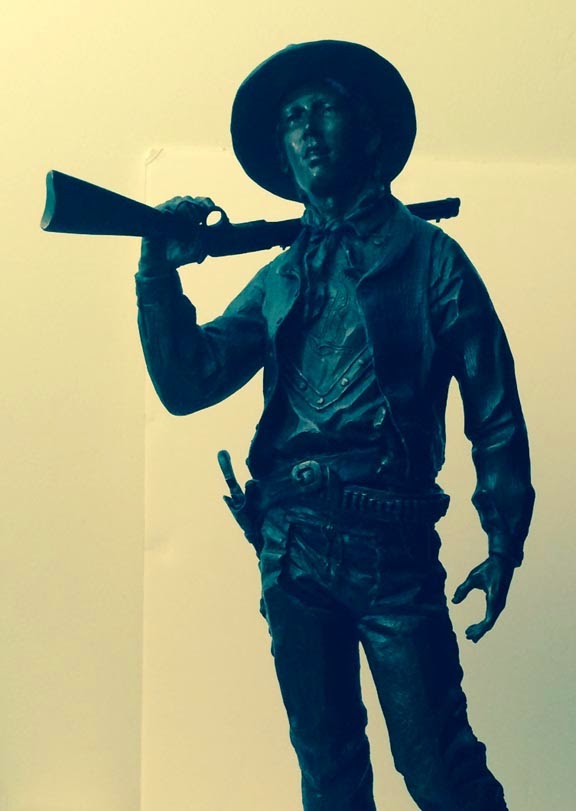
Two Billy Covers: 1A: Billy's Only Known Photo vs. 1B: Billy Stands Tall Sculpture Silhouette

   Ken Amorosano argues that the only known photo is marquee and sells the idea best. My position is that it's been used to death and we need something new and dynamic. I encouraged Dan to use the Bronzesmith Billy sculpture as a very dark silhouette to emphasize the mystery, but some argue this is too dark and we should print the sculpture so you can see his features (below, left):

 
Billy Cover versions: 2A Billy sculpture vs. 2B Billy photo stylized by Dan

   Carole Glenn feels the sculpture is too cold and Dan prefers this last one, on right, while I still bridle at using the same ol' same ol'.

   I woke up this morning and thought: if the theme of the issue is "What if everything we believe about Billy the Kid is wrong?" then shouldn't the cover show a beatific Billy, smiling smugly with a halo over his head?

 
Daily Whip Out: "Smug Mug Billy"

   Perhaps we are over thinking here, but choosing the right cover can mean the difference between winning and going broke. Anyway, no pressure, but we need some input from you. Thanks.

   Oh, and one more thing: we are discussing where Billy got his alias of Bonnie and it dawned on me that the name Bonnie has been around for a long time. Anybody know the history of this dittie?

"My Bonnie lies over the ocean, my Bonnie lies over the sea. . ."
—Beatle cover song

Tuesday, April 14, 2015

'7 Winchester Art Palette

April 14, 2015
   Still wrestling with the Billy cover. We may gravitate to the sculpture of Billy that Bronzesmith created last summer.

 
Billy '73 Winchester Art Palette

   Looks like we're going to hang this issue on a quote Fred Nolan said at the Gallegos House in Lincoln last October:

"What if everything we know about Billy the Kid is wrong?"
—Fred Nolan

The historic Gallegos House in Lincoln where all my Kid Krazy friends met me last October to solve the riddles of the Kid and the Lincoln County War.

And, of course, it was here at the Gallegos that I received the proposed Billy sculpture from my amigos in Prescott Valley, Arizona.


Why Do We Quote?
"Quoting is finding an echo, more beautifully or roundly expressed than we could ever manage ourselves, in the words of someone else."
—Ruth Finnegan