Monday, April 17, 2017

Check Out This Stagecoach: Matched White Horses or Mules?

April 17, 2017
   Got a debate going here at the True West World Headquarters. Found an old photo in our archives and the ID on the picture says it's a "White Horse Stage," but some of us think those are mules. What do you think?
Schribner White Horse Stage from Walcot, Wyoming to Saratoga, Wyoming, circa 1900

We asked our mule experts and here's what they had to say:

"Look like mules to me."
—Deb Kidwell "The Jackass Lady"


"My first thought is Pissed off Horses. Reason one, I have never seen a mule with a Roman nose and the lead one on the left has a very good example of a Roman nose. Thats the front bone shape sort of arches out. Not to say it has never happened to a Mule but just what I see. Because the ears are pinned back they appear to be larger, and the builds are more of a draft cross so the ears would be a bit larger than the average horse. They have draft cross mules as well. When the Donkey is mated with the Grey Percheron the Mules would be that colored. I have a book that has huge Grey Horses pulling a fire pumper and they look just like these in your photo. I put $98.00 on HORSES!  So keep me posted on who wins. Love the Photo."
—Sylvia Durando, Three Rivers, California

PS: "Seldom were Mules hitched to Coaches due to their unpredictable temperament!"

"A very nice set of mules."
—Richard Underwoord, Bishop Mule Days


"Yep, they're mules. Back in 1976 for a Bicentennial Event I spent a week on the Crook Military Road staring at my mule, Monte's ears. The son of a gun bucked me off up near Woods Canyon Lake.
My dad loved mules. We had a couple of them when I was a kid. I didn't like 'em much as they were much smarter than me."
—Marshall Trimble


"It may have been called the White Horse Stage but it's being pulled by mules. The longer ears for sure and the nose of a mule is often larger and less .. uh ...'delicate' than that of a horse. The nearside lead mule is a good example and if you study the others close they have the similar characteristic. Regardless, it is one impressive well matched six-up."
—Lee Anderson, equine historian and True West contributor  

"Cayuse hosses. Not a mule in the six up."
—Raymond Isenberg, a Mule Man, extraordinaire

Friday, April 14, 2017

Daily Life On A Doomed Wagon Train

April 14, 2017
   One of the coolest things about finding a diary or the interview of an old pioneer, is the details about how they actually traveled. Here is the description of a young, 16-year-old girl, Susan Thompson, who was actually on the Oatman wagon train:

A Perpetual Picnic
   "We were divided into companies and each band was governed by a captain. Royce Oatman was the man from whom we received directions and counsel." Each wagon had a supply of "jerked meat, dried apples and berries, flour, corn beef, meal, preserved fruits, bacon and beans that we had prepared during the spring months and which we planned were sufficient for eighteen months, lay with our bedding and clothes in a compartment beneath the wagon floor.

  "In a few weeks we had passed beyond the occasional towns and the scattered farms of Kansas and were out into that vast unknown region known as the West. We were a happy, carefree, lot of young people and the dangers and hard-ships found no resting place on our shoulders. It was a continuous picnic and excitement was plentiful.

   "Every two or three days a stop was made and while the women baked and washed, the men hunted for antelopes n' buffalos or smaller game, such as rabbits and pheasants. Often, when we were camping near a stream, we had quantities of fresh fish.

   "Never since those days have I seen churning done so easily. Each morning, after the milking, the milk was put in the churn which sat on the projecting cross beams which supported the canvas top of the wagon, and each evening, when we made our night's halt, we had fresh butter ready for supper.

   "In the evenings we gathered about the campfires and played games or told stories or danced. My grand-daughter in El Monte, has my old violin, which so many evenings gave out the strains of 'Money Musk' and 'Zipp Coon' as the young folks danced in the light of the campfire and the lard-burning lanterns. Often, during the daytime halts,we ran races or made swings. There was plenty of frolic and where there are young people gathered together, there is always plenty of love-making."


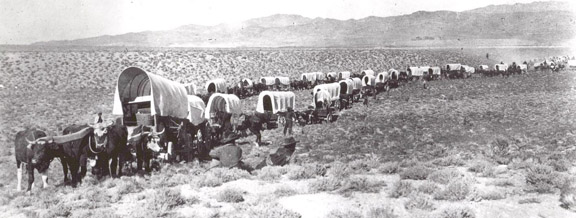
A typical wagon train on the move in 1855. Contrary to popular opinion, the trains
often attempted to traverse wide areas in parallel lines, as you can see here, with a second line forming along side the first. On the Santa Fe Trail, the big freight wagons would sometimes travel four abreast where the space permitted it. This strategy was utilized for  protection.


   When the wagon train would reach towns, sometimes, the resulting traffic jams would resemble big city congestion.


Oxen pulling wagons was the main mode of power.

   Eventually, the perpetual picnic gave way to more somber themes, as when a young girl died on the trail:

"We were on the prairies and there was no timber, so each family gave a board from their wagons for the casket. A kind of terror of the plains came over me as the dusk of the evening [came on]. . .we left the grave on a little hillside and heard the howling of the wolves drawing nearer and nearer."
—Susan Thompson, “Following the Pot of Gold at the Rainbow's End in the Days of 1850: The Life of Mrs. Susan Thompson Lewis Parrish of El Monte, California. By Virginia V. Root--Huntington Library, San Marino

   The Oatmans began their ill-fated journey on this wagon train that had some 93 members, riding, or walking beside 43 wagons (Susan Thompson, above, says 30), bound for The Land of Bashan  (today known as Yuma). Petty infighting, alternative visions and illness took its toll. So much so, that by the time they reached Socorro, New Mexico their ranks had been cut in half.


   And by the time they reached the Gila River west of the big bend, in Arizona, the wagons had been reduced to only one.

   To read that full story of the Oatman massacre go HERE.

Thursday, April 13, 2017

Layers of History On The Road Less Traveled

April 12, 2017
   When I go out to Old West sites, I'm always very aware of layers. Here's a good example: in Oatman, the town in western Mohave County, my family used to picnic there in the 1950s and my friends and I—mainly Rick Ridenour, Charlie Waters and Dan Harshberger—would play "guns" and we were thrilled to be walking along the streets of an actual 1880s Wild West town, when in fact, the town had gone belly up during World War II so many of the buildings we were awe-struck by dated from the 1930s and 40s, and not the 1880s. Add to that, the fact that Hollywood came to Oatman in the early 1960s and rebuilt part of the main street for a cinerama set piece that appears in "How The West Was Won" (1963).

   So, today, people walk the streets of Oatman thinking they are looking at the real Old West when they are actually looking at a movie set built on top of a Depression era mining town, built on top of an authentic 1914 mining camp.

   So, I am well aware of layers.

Layers On The Road Less Traveled
   Having posted a photograph of my recent trip out to the Oatman (the people, not the town) massacre site, my guide, Vince Murray and I speculated about the road up the bluff and, since it was quite developed (big boulders piled up on the sides, creating a very wide roadway) we wondered at length if it was a modern layer on top of the original road the Oatmans traversed on that fateful day in February of 1851.


Vince Murray standing in the roadway on the approach to Oatman Flat.

   Yesterday I got this email about the authenticity of the road we were standing on:

   "From the photo of the trail it is hard to tell from the perspective, but it appears to be James B. Leach's alternative trail about 100' to the south of what is probably Cooke's Wagon Road used by the emigrants and the Oatmans. The massacre took place at the old ruined Emigrant Trail trail going over the side of Sentinel Plain, which fell apart sometime before 1858. The newer trail up the side of the mesa (Sentinel Plain), 100' to the south, can be identified as Leach's improvements, because of its width. The windrows of rocks rolled back at the lip of the mesa on what is probably Cooke's Wagon Road measures 11'-12' apart. The windrows of rocks rolled back for Leach's 1858 road measure 18' apart. In Leach's 1858 report to the government he states that he improved the road by rolling the rocks back to 18' and on bends to 25' to accommodate 10 mule teams used by teamsters. Leach's road here was probably the trail Butterfield's Overland Mail Company used. Other sections of Leach's improved road can be seen on Sentinel Plain."
—Gerald T. Ahnert


An 1860s illustration of the gravesite and the approach to Oatman Flat.


   The problem I have with this layer of the wrinkle is, I took a photo of the bluff to the north of this road and I don't see any trail, or even a faint, alternative trail. Do you?


This photo is taken at the trail head, near the graves in the river bottom,
 and shows Oatman Bluff as it appears to the north of the above cut, or roadway.

Okay, here's an aerial view of what Gerard is talking about and although this is a little confusing to me, by my calculations, Vince, above, is standing on the Ruined Emigrant Trail.


Okay, after studying this aerial, here is how I think it relates to our visit and the top photo:

Daily Whip Out: "Emigrant Trail & Massacre Sign


"Damn, now I need to go out there a third time!"
—Old Kingman Codger

Wednesday, April 12, 2017

The Deadly Attack On The Oatmans

April 12, 2017
   It certainly wasn't like in the movies, where a horde of "Redskins" ride out of the timber, giving a high-pitched, quavering yell, as they circle an unsuspecting wagon train and rain arrows on the "white eyes."

   The deadly attack on the Oatmans on February 18, 1851 by a Yavapai hunting party (Olive put their number at 17) was almost the exact opposite of the Western movie staple most of us grew up on. And in some ways, it makes it even more chilling and unnerving.

   Royce (also styled as Roys) Oatman and his family (seven kids and a very pregnant wife) had just finished hauling their belongings up a rocky grade to a bluff on the south side of the Gila River.


My guide, Vince Murray, standing on the grade climbing up to the bluff where the attack happened. This is also the approach of the Yavapais as Lorenzo saw them
 "leisurely approaching us in the road."

   It was the end of a long day and their oxen were bone tired and so was the family. Oatman's wife, Mary Ann, 38, had enough strength to prepare a pot of bean soup and some bread for the family to eat before they continued on—they intended to travel all night to avoid the heat of the day. They were 120 miles from their destination.

   Lorenzo, 14, was loading the last of the baggage back in the wagon, when he turned and saw "several Indians slowly and leisurely approaching us in the road."

   Lorenzo said they conversed "with father in Spanish," and "made the most vehement profession of friendship." (perhaps, "Hola, amigos. Como estas?" Hi, friends, how are you?)

   Royce had a rifle but it was in the wagon. The Indians asked for tobacco and pipe, which Royce promptly produced. After the warriors finished smoking one of them mentioned seeing "two horses down in the brush." (this is intriguing because an American traveler, further down the trail towards the Colorado River, later reported having his two horses stolen the day before).

   According to the author Brian McGinty, "The Oatman Massacre," the winter of 1850-51 was the driest on record in the Southwest, so it's not hard to imagine the Yavapais being part of a hunting, or foraging party, seeking game or bounty to take back to their starving kin. This doesn't excuse what they did, but it gives some needed context to their actions.

   The Yavapais asked for pinole (corn meal) but Royce protested that he didn't have enough to give away, but they persisted and Royce reluctantly gave them some bread, which they ate, then asked for more. When Royce said no, he didn't have any more, one of the Indians brazenly walked over to the wagon and climbed in the back, rummaging around inside. When he came out, he demanded meat. When Royce again protested, the Indians became bolder and started taking objects from the wagon and stuffing items in their clothing. When the family again protested, the Yavapais withdrew a few paces and began talking in their native tongue.

   Essentially, they were divvying up who would kill who, and, who to spare.


A pile of rocks and a plaque mark the spot where the massacre happened.
It is known today as Oatman Flat.


   Royce tried to keep calm and started reloading the wagon with the family belongings the Indians had strewn about on the ground. At this point, one of the Yavapais let out a "deafening yell" as each warrior attacked a member of the family with a war club. Royce, his wife, his daughters Lucy and Charity Ann and his sons Roys, Jr. and Roland were brained senseless, falling to the ground. Lorenzo was also bashed on the head, and with blood streaming down his face, he half-ran, half-stumbled towards the edge of the bluff and fell over the side.

   Only two were spared, Olivia, 13, and Mary Ann, 8, who were forced to watch the warriors strip the dead bodies, looking for items of value. The raiders broke open boxes, tore open a feather bed, scattering its feathers to the wind. They took the wheels off the wagon, tore the canvas canopy off its frame. They unhooked the oxen, bundled up their plunder and rudely pushed the girls in front of them, as they headed back down the bluff into the gathering darkness.

"After we had descended the hill and crossed the river, and traveled about one half of a mile by a dim trail leading through a dark, rough, and narrow defile in the hills, we came to any open place where there had been an Indian camp before, and halted. The Indians took off their packs, struck a fire, and began in their own way to make preparations for a meal. They boiled some of the beans just from our wagon, mixed some flour with water, and baked it in the ashes. They offered us some food, but in the most insulting and taunting manner, continually making merry over every indication of grief in us, and with which our hearts were ready to break. We could not eat. After the meal, and about an hour's rest, they began to repack and make preparations to proceed."
—Olive Oatman, describing the first, grief stricken moments of her five year ordeal


Tuesday, April 11, 2017

What Exactly Did The Blue Tattoo Lines On Olive Oatman's Chin Signify?

April 11, 2017
   When Olive Oatman was returned from her five years of captivity among the Yavapai (one year) and Mojave (four years), she gravitated, along with her brother Lorenzo, to northern California where she came under the care and influence of a minister named Royal B. Stratton. The clergyman wrote up their experiences for a book, which became "Life Among The Indians."

   When published it sold out in a couple weeks. The second edition, this time published in San Francisco, sold out equally as fast. Going to New York, Stratton sold the book to a publisher there and the third edition, this time titled, "Captivity of The Oatman Girls" became a national best seller. A tour ensued where-in Olive became a celebrity.

   Stratton, of course, had cleaned up Olive's story. And then some. He took out all of the Oatman family's religious affiliation. The Oatmans were Brewsterites, an off-shoot of The Church of Jesus Christ of Latter-day Saints, at a time when Brigham Young was staging a mass migration to Utah. The Brewsterites were on their way to The Land of Bashan, which young Colin Brewster, age 21, prophesized was a veritable Eden, located at the confluence of the Gila and Colorado rivers (today known as Yuma).

   Stratton also removed any reference to any sexual shenanigans among the Native peoples. According to Olive (as coached by Stratton) she wrote, "to the honor of these savages let it be said, they never offered the least unchaste abuse to me." It must also be said, that at the time she was with the Mojaves, Olive was 15 and she spent four  years with them.


Daily Whip Out: "By The Light of The Mojave Moon"


   Scholars and historians have argued ever since about Olive's status among the Mojaves. Was she a slave, marked as personal property by the blue, vertical tattooed lines on her chin, so she could be retrieved if she tried to run away? Olive and Stratton made this case, while others say she was tattooed because she was a member of the tribe.

   Or, could there be another reason for the blue, vertical lines? A U.S. expedition, led by Lieutenant A. W. Whipple arrived in the Mojave Valley in February of 1854 to explore a possible railroad route through the area. Here is what Whipple wrote in his daily report:

"The young girls wear beads. When married, their chins are tattooed with vertical blue lines, and they wear a necklace with a single sea-shell in front, curiously wrought."
—Lieutenant A. W. Whipple 

Monday, April 10, 2017

"I Want My Records Back!!!

April 10, 2017
   When you tug on one string, you find that it is connected to all the other strings in the world. Case in point:


Daily Whip Out: "I want my beads back!!!
Weird Historical Connection: Turns out a Mojave chief's son, who lived where Needles, California now stands, demanded Olive Oatman return certain beads and trinkets when she returned to "polite society." It was on this date, April 10, 1992, that shock comic Sam Kinison was killed by a drunk driver outside Needles, on his way to a gig in Laughlin. Kinison was famous for a breakup bit where he screamed, "I want my records back!"

"I don't worry about terrorism. I was married for two years."
—Sam Kinison


Slim Pickens Critiques Hualapai Roundup

April 10, 2017
   We are doing a cover story on Slim Pickens and, in my editorial, I want to relate a story of how so many different people had a story about meeting him, including me. Slim actually critiqued one of my first oil paintings back in 1976.  Here's how that happened:


BBB in The Old Pueblo, circa 1976

   During the runnup to our nation’s Bicentennial I got it in my head I was going to be a Cowboy Artist. I had toyed with the idea before, but with all the hoopla of 1976, I made a commitment to do something Western worthy. Sticking close to my upbringing in Mohave County, I created an oil painting called “Hualapai Roundup.” It took me a couple weeks to execute and when I was finished I realized I needed some professional feedback so I called up an art gallery on Campbell Avenue in Tucson and asked if I could bring the painting in for an evaluation and critique. The owner said yes, to bring it by as he was closing and now would be a good time. So I loaded the big painting in my ‘74 Pinto and drove over there. The gallery was actually in an old house, and when I came in the front door, I saw this gangly cowboy sitting on a couch by the door and damned if it wasn’t Slim Pickens!

   I believe he was in town filming HAWMPS! at Old Tucson.  It was a film by Joe Camp, the man behind the BENJI movies, and Slim co-starred with James Hampton—Dobbs from F-TROOP—and Christopher Connelly and Denver Pyle.  It was a Western family comedy about trying to introduce camels into the U.S. Cavalry and one I recently rented to poach camel shots for my Beale paintings. 

   Slim couldn’t have been nicer and he ended up critiquing my painting, giving me pointers on bovine anatomy (“that cow at the center is a little short in the hind quarters”) and roundup job nuance (“Why are those four riders back there jawin'? Git to work!”). He made me laugh, he was very positive and he encouraged me to keep going. 


"Hualapai Roundup" oil, (1976) by Bob Boze Bell


   My mother had this painting for many years in her home in Cody, Wyoming. After her passing, in 2004, it returned to me and I finally donated it to The Kingman Regional Hospital—for saving my life—and to help raise money to buy defibrillators to save more lives. A silent auction was held at the Kingman Fairgrounds and the painting was bought by Tommy Grounds Upton, who is the daughter of one of the cowboys who worked the roundups portrayed in the painting. 

   This oil painting now hangs at Upton’s Hidden Pines Bed and Breakfast outside Kingman. The B&B is off I-40 at Exit 59, right on DW Ranch Road, at almost the exact spot of where the round up in the painting takes place.

"An artist cannot fail; it is a success to be one."
—Charles Horton Cooley


Sunday, April 09, 2017

The White Skin Behind Her Ear

April 9, 2017
   I spent most of the day yesterday out at the Oatman massacre site west of Gila Bend. As I stood on the bluff where most of the family members were murdered, I was overwhelmed with sadness for all of them.


 Daily Whip Out: "What Those Eyes Have Seen."

   When most of us think of the Olive Oatman story and her time among the In-dins, we picture her as a light-skinned, White girl, dressed as a Mojave with a bark-skin skirt on, but more-or-less standing out like a sore thumb in a line-up of Mojave women.

    In Royal B. Stratton's bestselling book, "The Captivity of The Oatman Girls" (1857), the sisters are illustrated as essentially White, topless, sunbathers mingling among the bronzed brutes.


Mary Ann and Olive lounging amongst the pine trees near Needles, California.


White girls (literally) among the In-dins.

   But what most of us fail to appreciate is the degree to which five years of emersion and assimilation would do to anyone's appearance. Here is the vivid description of Olive's reception at Fort Yuma after five years of captivity:

   "'Oh, I told you it was a parcel of Indian lies,' exclaimed the major as he saw the girl. 

   "'Look, here!' cried Carpenter, as he turned back her ear, disclosing the white skin behind it. "
—Susan Thompson Lewis, in her memoir, 1909  

   An officer at Fort Yuma thought she was a Mojave and only when her guide showed him the light skin behind her ear, did he realize she might be an anglo! That is certainly at odds with the portrayal in Stratton's book:


Olive probably looked more like the Native woman at far left.

"We are all prompted by the same motives, all deceived by the same fallacies, all animated by hope, obstructed by danger, entangled by desire, and seduced by pleasure."
—Samuel Johnson, 1750


Friday, April 07, 2017

Related to Outlaws: Black Jack Ketchum, Bigfoot Wallace and John Wesley Hardin

April 7, 2017
   Last weekend I spoke at the Duncan family reunion out at the Diamond Bar Ranch, a legendary place I had never visited in all my years in Mohave County.


Tap Duncan (third from right) counting cows at the Hackberry shipping corrals.

   Tap bought The Diamond Bar after leaving Idaho in 1894 and crossed with his wife and wagon and herd of horses at Bonelli Landing. By the way, Louis L'Amour claimed Tap taught him everything he knew about "cowboyin'."


Bonelli Landing on The Colorado where Tap and Black Jack Ketchum crossed.


   My grandfather, Bob Guess, worked as a cowboy for Tap Duncan on this ranch in 1912, so the place has some historical interest for me. 


Bob Guess

   Most of this is in my book "The 66 Kid" which also features a photo of my mother sitting on the hood of a car at the Diamond Bar Ranch in 1933. She never really liked me telling everyone that we were related to "Big Foot" Wallace, "Black Jack" Ketchum and John Wesley Hardin but she encouraged me in everything else. In honor of my grandfather, my mother and Tap Duncan I have decided to offer this very personal book at a special price. Here you go:


Special offer on "The 66 Kid," ad designed by Rebecca Edwards

"All good biographers struggle with a particular tension between the scholarly drive to assemble facts as dispassionately as possible and the novelistic urge to find shape and meaning within the apparently random circumstances of a life."
—Richard Holmes, "The Long Pursuit"


Thursday, April 06, 2017

The Trendsetters: Going Tatted & Topless Mojave Style

April 6, 2017
   Got some minor criticism yesterday, for showing Olive Oatman topless during her stay with the Mojaves. Someone commented it looked too modern, and another claimed I was trying to be "historically salacious." Well, perhaps, but please check out this early photograph taken on the banks of the Colorado River:


Topless Mojave women at Fort Mojave, 1860s

This informed and inspired my cover idea of showing a topless Olive with her tats flying and her Mojave world behind her.


Daily Whip Out: "River of No Return"

   And, if you think the top "topless" photo is an exception, here is a quartet of Mojave women in the studio:


Mojave Women In Formal Topless Wear

   So, not only were the Mojaves way ahead of all those topless beaches on the French Riviera, they were also way ahead of the current tat culture:


Tatted-Out Mojave Woman

   So, what can we conclude? Basically that the mighty Mojave Nation foreshadowed and predicted Millennial culture, over 160 years ago!

"Then I felt I like some watcher of the skies
When a new planet swims into his ken;
Or like stout Cortez when with wonder'ring eyes
He stared at the Pacific—and all his men
Look'd at each other with a wild surmise—
Silent, upon a peak in Darien."
—John Keats


Wednesday, April 05, 2017

Gone Native

April 5, 2017
   Working on a story for the September issue which I am planning on turning into my next book. The Mojaves called themselves the Ah Macav, meaning "along the river." It was along the Colorado River, close to where I grew up, that this extraordinary tribe of In-dins bought two white girls from the Yavapai and raised them as their own. The story of how those two girls got there and what happened to them during their stay—four years—is fascinating and mysterious, to say the least. The key part of the story, to me, is just how native did the older girl go?


Daily Whip Out: "Gone Native"

   Perhaps the closest contemporary example of this is probably the Patty Hearst story. Both girls went to the "other side," then reversed their allegiance back into "polite society." The telling comment from Susan Lewis (nee Thompson) is that Olive "somehow shook one's belief in civilization." I take that to mean, she had very strong emotions about remaining with the Mojaves, and preferred at least some of their culture to her Christian one. But, unlike Hearst, Olive wore the evidence of this conflicted allegiance on her face for the rest of her life.

   My goal is to somehow get into her heart and tell that story. Fortunately for me, Kathy is reading one version of her story ("The Blue Tattoo" by Margot Mifflin) and Kathy has profound insights that only a mother would have.

"Biography is a handshake across time, across cultures, across beliefs and across ways of life."
—Richard Holmes, "This Long Pursuit: Refelctions of A Romantic Biographer"

Tuesday, April 04, 2017

A Day In The Life of A Daily Whip Out

April 5, 2017
   I ran into a budding artist the other day and he said to me, "Admit it, you really don't do those Daily Whip Outs over lunch, do you?" I laughed and said, "As a matter of fact I do, but you need to see the whole process. It's much more involved than just whipping out paintings, from start to finish, at lunchtime."
   With that thought in mind, it's time for:

A Day In The Life of A Daily Whip Out


Daily Whip Out: "We Ride at Dawn"

   I live with my wife Kathy in an old adobe house, which we had built some thirty years ago. We need a new roof and the vigas and scuppers are mostly rotted and falling apart, but then so am I. Our adobe is modest and cozy (about 1,900 feet in the main house with about 900 feet in the studio).

   I usually wake up around 5 or 5:30. Sometimes I go back to sleep until six, but I usually get up by six and go out into the kitchen where I pour a cup of coffee and eat half a banana, while I sit at the kitchen table and write about my dreams (both literally and figuratively) and various ideas I got in the night. One of the benefits of old age is that I seem to work on problems while I sleep and I often get good ideas from this. Of course, sometime they turn out to be stoner-like-dreams where you write them down and look at them a day later and think, "What the hell was that?!" I try to be in my studio by seven.


My cluttered  but cozy studio


My art desk on a typical start of the day.


    Oh, and I also try and write down my goals for the day or write notes from whatever book I'm readying.


Sketchbook notes, April 3, 2017

Whether I'm in the studio, or still at the kitchen table, at seven I try and shift gears and start drawing, anything and everything, like this:


Daily Whip Out Sketches, August 6, 2009

Or, this:


Daily Whip Out Sketches: May 13, 2015


   After I get some quick sketches down, I go for a walk. It's about a half mile walk up the hill to Morning Star and then a half mile back. I heard a heart doctor from the Cleveland Clinic say you need to get your heart rate up to 220 beats a minute, minus your age, for at least one minute. The hill hike does that almost to the second. As I walk down the hill I take in all the scenery and enjoy all the extra oxygen that's been pumped into my brain. Here I have to practice reining in my ideas because I often get hijacked by them and come back wanting to do something else besides the stuff I wrote down for goals. That's why I often do patina paintings (a fancy way of saying starter paintings) before the walk so that I can force myself back to the original premise or goal (as Kathy will tell you, I am easily distracted).

A Typical Patina Painting

   The key to doing these patina paintings is they give me a starting place, or a leg up on finishing something, without having to start with a blank piece of paper or board. I have hundreds of these lying around my studio.


Daily Whip Out: "The Baja Hinny"

This painting, "The Baja Hinny" was started in the morning, but I didn't finish. I typically go into work at the True West World Headquarters around 9 or 9:30 and fight fires for about three hours then head home for lunch. It's about a ten minute drive. I get home, grab the unfinished painting, and place it in the kitchen where I can see it while I eat lunch. Sometimes I sit on the patio and eat an apple, or finish a half-coffee, half-milk concoction made with the leftover coffee from the morning. By about one, I go back to the studio and try and finish the painting before I go back to work around two. So, the idea that I went home for lunch and whipped out something like above is not quite accurate: you'll notice, I often say "went home for lunch and finished a painting. . ." Still, I consider it a daily whip out, but now you know the process, which is a little more complicated.

   Of course, some ideas take longer to develop, like this cover concept I came up with yesterday:


Daily Whip Out: "Mohave Moon"

   The sketch, above, was done in two sittings, one in the morning and one at lunch. I have a couple bigger versions of this already started (today at lunch) but they suck so bad I don't want to share them. Maybe tomorrow.

"An artist must be aware of one's own absurdity but not allow that knowledge to diminish the importance of one's witness."
—paraphrased from Adam Gopnik riffing on Montaigne in The New Yorker, Jan. 16, 2017


Bum's Rule

April 4, 2017
   Went home for lunch and finished a mule piece I was planning on using in the Mule Issue but ran out of time.


Daily Whip Out: "The Bad Ass"


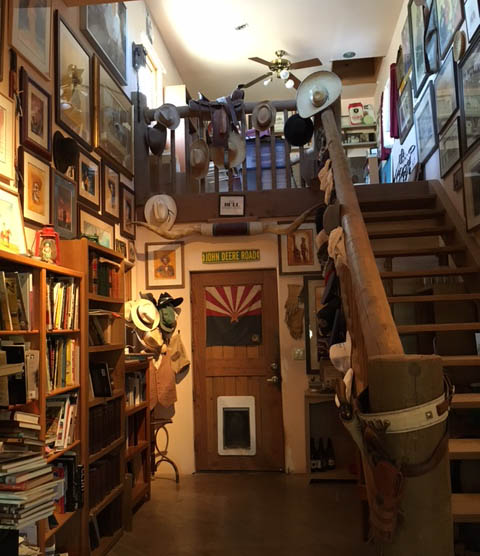
 I have learned so much about cowboy hat etiquette in the past several days, it's amazing. I had no idea of the quirky nuances in terms of hat manners of the American cowboy. For example, the Texas boys say if you go into a restaurant and sit at a table, the hat comes off, but if you sit at the counter, you leave it on. Sweet Jesus, I never knew that.

   There seems to be a lot of emphasis on being inside, or outside in terms of when to take off your hat. And speaking of Texas, the absolute last word on what qualifies as "inside" as it relates to taking off your cowboy hat, goes to Bum Phillips:

Fritz Hille Bum Phillips, coach of the Houston Oilers, would not wear his famous ten gallon in the Astrodome because it was indoors, according to his Mama. "If it can't rain on you, you are indoors." I have always followed that rule.

"It it can't rain on you, you are indoors."
—Bum Phillips, standing in the Astrodome with his hat off

Monday, April 03, 2017

Confessions of A Hathead: When Do You Doff It And When Do You Off It?

April 3, 2017
   All this discussion about the appropriate etiquette regarding when to doff and when to off a cowboy hat, certainly has brought up a couple sticky memories. 

   Back in the eighties I was at an editorial cartoonist convention in Washington DC and they had this annual talent show where the cartoonists put on little skits. One of the more prominent, syndicated cartoonists (actually a hero of mine) came up to me in the audience and asked me if he could borrow my cowboy hat for a skit. I said, "No, thank you." He was quite put off by this and gave me a "are-you-kidding-me?" look, before huffing away. I wanted to say, but didn't, "Hey, can I come over to your house and try on your underwear?" A cowboy hat is a very personal thing. He thought wearing the hat was just a gag or a goof, like putting on an eye patch at a Halloween party.

House Party: Doff It, Or Off It?

   A couple years ago I was at a road meeting in our neighborhood. It was pot luck and held at an attorney's million dollar home (with a lighted tennis court). The lawyer is also a weekend roper and, at the time, was the proud owner of a $92,000 custom, super-truck to sleep in at roping events and to pull his horses and gear.


I'm proud to say, my blind dog Apache always approved of me wearing my cowboy hats inside.


When Kathy and I showed up at the party, everyone was chatting and grabbing beers out of the ice chest on the back patio. I got one and gravitated into the kitchen where I got into a conversation with my neighbor Bruce about, what else, the Old West. Our host came by and, looking right at me, said in a snippy tone, "Take your hat off." I just laughed—I thought he was joking—and kept on talking. A couple of minutes later he came back by and said, loudly, "I'm serious. No self-respecting cowboy wears a hat in my house!"

   So I killed him.

   No, I took my hat off and placed it on the back of the grand piano in the living room. I really didn't think much more about this until today when I got into this exchange on Facebook:


In A Restaurant: Doff It Or Off it?

Tom Neiley 
I remember being in a restaurant here in Denver sitting at a table next to then U. S. Senator Ken Salazar. His lunch companion shows up and he stands up to shake her hand. But he doesn't doff his hat!!! That was the worst. Very bad form. I mean the guy grew up ranching in southern Colorado. So disappointing. I thought he was a cowboy!!😲
UnlikeReply12 hrs
Bob Boze Bell This is a tricky area and I can relate. I often show up at a restaurant or meeting hall for a speech or talk and I wear my hat inside, often eating with it on and then giving my presentation. They came to see the guy in the hat and it just seems, not wrong, but odd to take the hat off and place it in my lap then put it back on when I get up to speak. I've done it both ways, but it's a dilemma.
LikeReply2 mins
Bob Boze Bell And no doubt I have offended people by not doffing the hat, like you say, Tom. Interesting. I will certainly think about this the next time I give a speech!

"When in doubt, off it. When in Cowboyland, doff it."

—BBB