February 8, 2023
Here is a question me and my historian friends have wrestled with for a very long time: "Why did Custer really fail at the Little Bighorn fight?"
No Beard & No Buckskin
Of course, if you've read or listened to some contemporary musings about the fight you no doubt have heard that Custer was a psychopath, and an egomaniac, a certified nutjob—and worse–and he was lusting to be president of the United States. The attack in Montana was merely a stepping stone to the White House.
Conversely, in the 1960s, The Custer Battlefield, as it was known then, had West Point Ride Alongs and as one of the story goes, the West Pointers rode over the ground Custer rode over and the soldiers were told what decision the Boy General made at each juncture, and the West Pointers agreed with Custer at each turn. The point being the military tactical types agreed with Custer adding that he made solid decisions. So, who's right and why did everything go south?
It's complicated, and sometimes the answers are contradictory, but I'll try and explain how all the right moves led to the disastrous outcome. Here are the questions we need answers for:
Mysteries of The Little Bighorn
• What is the real reason Custer failed?
• Why were the In-dins better armed? Or, were they?
• Why were the In-dins so hard to spot in the battle?
• Did beavers do in Custer?
Were His Tactics Actually Solid? Paul Andrew Hutton Explains:
1. Splitting his command without knowing how big the village was, is a major, tactical error.
2. Custer had no plan, or, more accurately, he was making a plan on the fly and he was acting on impulse and his audacity and boldness had always carried the day.
3. Custer's subordinates let him down in every way. At the subsequent hearing about the debacle Reno and Benteen both testified they didn't hear any shooting downstream where Custer was being cut to pieces. Everyone else did.
The Question of Arms
At the time of the battle U.S. troops were armed with Springfield one-shot rifles that had a range of 600 yards.
The model Springfield 1865
was formidable because of its range
The concept at the time was to deploy infantry on horseback to the fight, then dismount, three troopers would stand and fight and the fourth would lead the horsess to the rear for safe keeping.
Meanwhile, the Indians were mostly armed with the Winchester '73 which was accurate to about 200 yards. But then as the In-dins began to kill more and more soldiers, they deployed the purloined weapons on the troops they were fighting, so that as the battle went on the Indians were armed with better and better weapons.
A Perfect Disguise
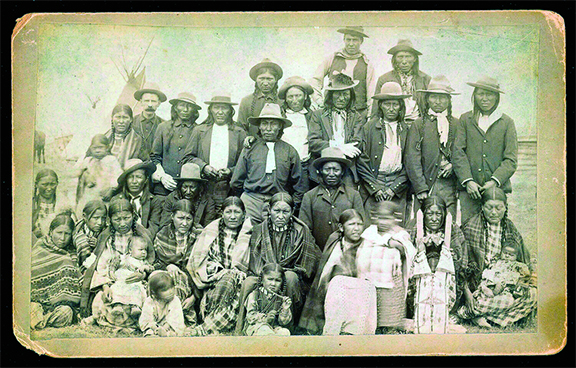
Custer had a previous fight with "hostiles" on the Yellowstone in 1873 and afterwards he complained bitterly to the War Department his men couldn't tell who the enemy was because most of the Indians were dressed in "complete suits of clothes issued at the agencies." So, unlike in the movies where all the In-dins are dressed in buckskins and war bonnets his troops had a hard time recognizing the enemy because they were dressed too similar to the troopers!
The White Man's Disguise
Cheyenne scouts and their wives, 1890
Custer Was Done In By Beavers?
One of the Indian participants, Mary Crawler, testified Custer's men couldn't cross where they wanted to because of a beaver dam. Three officers were shot at the attempted crossing, and Custer with his remaining men retreated to the ridge where he met his doom. So, it is possible Custer was done in by eager beavers. There's a movie title I'd like to see.
The 13th Horse Custer had a dozen horses shot out from under him in his earlier Civil War career. He always acted brashly and it always worked, until it didn't. As the Old Vaqueros are fond of saying, "Your greatest strength is your greatest weakness."
As Charles Windolph says in his memoirs ("I fought With Custer"), "we caught glimpses of white objects lying along the ridge that led northward. We pulled up our horses. This was the battlefield. Here Custer's luck had finally run out."
Two Degrees of Custer & Crazy Horse
And, speaking of Charles Windolph, he was the last surviving trooper from the Custer troopers and he lived until 1950. He was interviewed by Robert Utley in 1947 and I interviewed Mr. Utley in 2019 about his interview with Windolph. That, my friends, is a history that spans 143 years, or as I like to say, that is two degrees of Custer and Crazy Horse!
Me And Robert Utley, 2019
In Conclusion: Everything that could go wrong, did. Everything that worked before, did not. Between the tall grass and the In-dins dressed in white-man-clothing, the tide turned slowly, then quickly, and all the training and all the warfare theories went out the window. Add to that, the eager beavers, the superior firepower and the inevitable incompetence of Custer's subordinants and you have, to coin an old phrase, a perfect disaster.
A Cut Above The Rest
Isiah Dorman, an African-American scout with Custer, was shot and mortally wounded in the Reno fight, because, unlike the troopers, he stood and fought. Not long after, the In-din women come onto the field and start butchering all the downed troopers they could find.
Sitting Bull rode into this scene and recognized Dorman, who was married to a Sioux woman. The Sioux chief gave the dying Dorman water and said to the women, "Leave him alone, he's a relative." The women politely waited until Sitting Bull was gone and then lopped off Dorman's head and cut him into tiny pieces.
If this sounds familiar, it's because most of this is my outline-script for my latest YouTube video. Here's the link so you can follow along.
Custer's Little Bighorn Failures Revealed
The Final Contradiction
"If we hadn't been led by a coward we'd all be dead."
—Company commander Charles DeRudio, referring to Reno


 Rumblin' Tumbleweeds lookin' for a fight.