Showing posts sorted by relevance for query Dr. Bugs. Sort by date Show all posts

Saturday, May 06, 2017

Boze Boots & Dr. Bugs

April 6, 2017
   Found an old photo of myself taken in March of 1980 when I was hot on the trail of the Wyatt Earp-Curly Bill shootout site in the Whetstone mountains. First stop was Tucson where I picked up my custom-made Boze Boots by John Weinkauf, then on down to Rio Rico where Kathy and I stayed. She took this photo of me wearing my new boots.


BBB Wearing Custom Boze Boots by John Weinkauf

   Someone asked me if I still have them. Yes, I do:


Boze Boots front and center in my studio


Back to Dr. Bugs
  Came back around to the little known (in my history circle, at least) "Dr Bugs." I am quite intrigued by him and have some new things to say about him in my ongoing quest to find the truth behind the Olive Oatman story. As a matter of fact, he's just coming into view:


Daily Whip Out: "Fleshing Out Dr. Bugs, Phase I"

   If you want to read about his background and how he relates to the Olive Oatman story, you can read it right here: The Strange Case of Dr. Bugs.

   "The appearance of things change according to the emotions,
and thus we see magic and beauty in them, while the magic
and beauty are really in ourselves."
—Kahlil Gibran

Tuesday, April 18, 2017

A Strange Twist In The Oatman Saga: "Dr. Bugs"

April 18, 2017
   Tracking the Oatman massacre clues through the desert badlands of Gila Bend is slow going and grim work. Even today, the vast, dry river bottom is quite a daunting place to traverse in a Jeep, much less in a wagon, being pulled by exhausted oxen in the year 1851. The nearest settlement at that time was Tucson, more than a hundred miles southeast, with barely a couple hundred, very scared souls, cowering behind presidio walls. The Apaches had decimated the population and raided the place at will, until it was very close to being abandoned.

   Everything to the north of Tucson was strictly In-din country. Still, the Oatmans and two other families pushed on from the Old Pueblo to Maricopa Wells, a village of friendly Pimas and Maricopas (just south of present day Phoenix). Two of the last three wagons dropped off there but, based on a report from someone who had just been on the trail, the Oatmans pushed on.


Daily Whip Out: "Oatmans Traverse The Gila Bend"

The report came from a real life, crazy, whirling dervish character:


Daily Whip Out: "Dr. John Lawrence LeConte"

   As the Oatmans were deciding whether to venture on from Maricopa Wells, two riders came in from the west. One of them was a 25-year-old entomologist, looking for coleoptera. In other words, beetles. This son of a wealthy east-coast industrialist, he was a graduate of New York's College of Physicians and Surgeons. He related to Royce Oatman the fact that he—the doctor—and his hired guide, Sonorian Juan, had traversed the entire trail from Camp Yuma to the villages and they hadn't even seen any Indians, much less signs of Indians. This is where it gets tragic (Royce Oatman probably pushed on based on this report) and quite bizarre.

The Strange Case of Dr. Bugs
   Dr. LeConte (his father styled it as Le Conte, but the son preferred it mooshed together) had traveled by sea to San Francisco in 1849, where he explored the rich areas around San Francisco, collecting specimens of beetles everywhere (at some point he sent home to his father, 10,000 beetles preserved in alcohol). Then, from the Bay area, the good doctor traveled down to San Diego, by stagecoach, where he explored a dry lake bed east of San Diego, then, along with another physician, the two explored the Colorado River between the Yuma Crossing and the Gulf of California.


The serpentine Colorado River area below Camp Yuma Dr. LeConte explored.
It wasn't the safest place to be looking for bugs either.

And now, here he was, in February of 1851 with Juan The Sonorian, traversing the Gila River, looking for more bugs.

   You can't make this stuff up. 

   Studying his movements and his antics is mind boggling. I imagine he was exhausting simply to witness. He reminds me of a Roadrunner cartoon, shooting here and there, darting in and out, always on the lookout for his precious specimens, and, all of this, right in the middle of one of the most tragic episodes of the Westering experience.

   On the sixth day out from Maricopa Wells, the Oatmans were overtaken by Dr. LeConte and Juan the Sonorian, riding on horseback. In less than a week, the two had visited Tucson—close to a 100 mile run—collected specimens, returned to the Pima and Maricopa villages, then set out for the Colorado River where they ran right up on the rear tail gate of the Oatman wagon.

Beep! Beep!

   The Doctor and Juan discovered a depressing scene. The Oatmans were bogged down and their animals were almost collapsing and their food supplies were low. So, at Royce's suggestion, LeConte agreed to take a note to Major Heintzelman at Camp Yuma, beseeching the commander to come to the Oatman's assistance. Grabbing the note, LeConte and Juan blasted on down the trail.

   The day after they left the Oatmans, February 16, the two encountered four Indians on the trail armed with bows and arrows. Juan took them to be "Yumas" (Quechans) and, not friendly. Rebuffing their entreaties to parlay, the two tried to move on, but the Indians followed, then disappeared. The Doc and Juan made camp in a secluded canyon, and when they woke up their two horses were gone.


   LeConte sent Juan on to Camp Yuma on foot with the note from Royce Oatman while the doctor posted a card on a tree, warning the Oatmans of "the nearness of Apaches." A note they probably didn't live to see.

   When LeConte finally arrived at Yuma at the end of February (the Oatman massacre took place on Feb. 18) he demanded that Heintzelman send immediate help, but the commander pleaded he had no animals fit for the journey. When the commander finally relented and sent two soldiers out to reconnoiter, they came back with the news that the Oatmans had all been killed. Heintzelman then angrily turned on LeConte saying he should have stayed with the Oatmans. In his diary, the commander contemptuously called LeConte "Dr. Bugs."

"Some people like charity at other people's expense."
—Brevet Major Heintzelman, referring to Dr. Bugs

  LeConte never stopped moving. From Arizona he traveled to Europe, Egypt and Algiers and he was in Honduras for the building of the Honduras Interoceanic Railway. He moved to Philadelphia in 1852 and became known as the father of the American beetle study.

"And in the end, the love you take, is equal to the love you make."
—The Beatles


Friday, February 15, 2019

Sunrise on Juan The Sonorian

February 15, 2019
  Looks like another beautiful day. "Leave us all enjoy it," as a one-eyed, former governor of Arizona used to put it.


Good Morning, Cave Creek!


   Got up this morning and did a quick study of a key guy in the graphic novel I'm working on.


Daily Whip Out: "Juan The Sonorian"


Juan The Sonorian
   Juan is the Mexican guide who accompanied Dr. LeConte on his beetle search up the Gila in 1851. In my story, he is still alive, in 1900, and living near Yuma. Sharlot makes a point to track him down and find out what he knows about what actually happened to the Oatmans.


The Strange Case of Dr. Bugs
   Dr. LeConte (his father styled it as Le Conte, but the son preferred it mooshed together) had traveled by sea to San Francisco in 1849, where he explored the rich areas around San Francisco, collecting specimens of beetles everywhere (at some point he sent home to his father, 10,000 beetles preserved in alcohol). Then, from the Bay area, the good doctor traveled down to San Diego, by stagecoach, where he explored a dry lake bed east of San Diego, then, along with another physician, the two explored the Colorado River between the Yuma Crossing and the Gulf of California.


The serpentine Colorado River area below Camp Yuma Dr. LeConte explored.
It wasn't the safest place to be looking for bugs either.

And now, here he was, in February of 1851 with Juan The Sonorian, traversing the Gila River, looking for more bugs.

   You can't make this stuff up. 

   Studying his movements and his antics is mind boggling. I imagine he was exhausting simply to witness. He reminds me of a Roadrunner cartoon, shooting here and there, darting in and out, always on the lookout for his precious specimens, and, all of this, right in the middle of one of the most tragic episodes of the Westering experience.

   On the sixth day out from Maricopa Wells, the Oatmans were overtaken by Dr. LeConte and Juan the Sonorian, riding on horseback. In less than a week, the two had visited Tucson—close to a 100 mile run—collected specimens, returned to the Pima and Maricopa villages, then set out for the Colorado River where they ran right up on the rear tail gate of the Oatman wagon.

Beep! Beep!

   The Doctor and Juan discovered a depressing scene. The Oatmans were bogged down and their animals were almost collapsing and their food supplies were low. So, at Royce's suggestion, LeConte agreed to take a note to Major Heintzelman at Camp Yuma, beseeching the commander to come to the Oatman's assistance. Grabbing the note, LeConte and Juan blasted on down the trail.

   The day after they left the Oatmans, February 16, the two encountered four Indians on the trail armed with bows and arrows. Juan took them to be "Yumas" (Quechans) and, not friendly. Rebuffing their entreaties to parlay, the two tried to move on, but the Indians followed, then disappeared. The Doc and Juan made camp in a secluded canyon, and when they woke up their two horses were gone.


   LeConte sent Juan on to Camp Yuma on foot with the note from Royce Oatman while the doctor posted a card on a tree, warning the Oatmans of "the nearness of Apaches." A note they probably didn't live to see.

   When LeConte finally arrived at Yuma at the end of February (the Oatman massacre took place on Feb. 18) he demanded that Heintzelman send immediate help, but the commander pleaded he had no animals fit for the journey. When the commander finally relented and sent two soldiers out to reconnoiter—on two borrowed mules—they came back with the news that the Oatmans had all been killed. Heintzelman then angrily turned on LeConte saying he should have stayed with the Oatmans. In his diary, the commander contemptuously called LeConte "Dr. Bugs."

"Some people like charity at other people's expense."
—Brevet Major Heintzelman, referring to Dr. Bugs

  LeConte never stopped moving. From Arizona he traveled to Europe, Egypt and Algiers and he was in Honduras for the building of the Honduras Interoceanic Railway. He moved to Philadelphia in 1852 and became known as the father of the American beetle study.

"And in the end, the love you take, is equal to the love you make."
—The Beatles

Friday, July 07, 2017

The Cavalry to The Rescue

July 7, 2017
   We Boomers have been conditioned at an early age to believe that when we hear the bugle call, we know the cavalry is coming to save the day.


Here they come to save the day


Well armed, mounted and moving fast to, no doubt, rescue some besieged pioneers.

   When I was researching the Oatman Massacre, I ran across the account of "Dr. Bugs," who got into it with Major Heintzelman the commander at Fort Yuma. LeConte had run across the forlorn Oatmans and later, when LeConte arrived at Fort Yuma he urged the major to send out a unit, but the commander refused to commit any troops because the Oatman incident happened in Mexico, which was out of his jurisdiction. Well, technically true, they were slaughtered on the south side of the Gila River (this is before the addition of the Gadsen Purchase), but since the fort was specifically placed at the confluence of the Gila and Colorado Rivers to help guard and assist travelers on the Gila Trail, it seemed like a rather thin excuse.

  You can read about this in more detail right here: The Strange Case of Dr. Bugs

   When Dr. Bugs got angry and insisted the major send out a force, Heintzelman claimed he didn't have any mounts for the troopers to ride, and, finally, relenting to LeConte's badgering, the major borrowed two mules for two troopers to ride out and investigate. They, of course, found the slaughtered family and came back to report it. 

   I think it's safe to say, there was no bugle call.

"Illegal aliens have always been a problem in the United States. Ask any Indian."
—Robert Orben

Thursday, October 19, 2023

Olive Oatman for YouTube

 October 19, 2023

   Taped a new YouTube video today. I had to make a confession at the beginning.

   Some of the things I am about to tell you are going to be very hard to believe. I hope you can hang in there with me until we get to the end. I must say I had a hard time believing much of this research myself. That said, this is a tragic tale with some mighty big questions, which I state in the video and then we open with this image.

Olive and Lorenzo
shortly after her return to "society"


A Bold And Crazy Prophesy
   In 1848, a young, Latter-Day-Saints excommunicated prophet made a bold prediction that would change the life of a beautiful young girl named Olive Oatman.

   James Collins Brewster, 24, had visions of a promised land—The Land of Bashan—and his passionate message gathered adherents wherever he spoke: "Fear not, for I am with you. I will bring your people from the east and gather you into the west. The wilderness and the wasteland shall fall away and the desert will rejoice and blossom as the rose. It shall blossom abundantly and the glory of Bashan shall be given to it."
   And where was this so-called Land of Bashan located? At the confluence of the Gila and Colorado Rivers, today known as Yuma, Arizona. Never mind that the area rarely gets more than 3.5 inches of rain a year, is mostly sand dunes and harsh desert with daytime temperatures reaching triple digits every day for months on end. Oh, and never mind that James Collins Brewster had never been to Yuma Crossing and spoke of the banks of the river being lined with pine trees.


The Oatmans Take Off
   On August 10, 1850, 93 Brewsterites, including the Roys Oatman family of 9, took off from Independence Missouri in 43 wagons headed for the Land of Bishan.

Enter Dr. Bugs
  As the Oatmans were deciding whether to venture on from Maricopa Wells, two riders came in from the west. One of them was a 25-year-old entomologist, looking for beetles. This son of a wealthy east-coast industrialist, he was a graduate of New York's College of Physicians and Surgeons. He related to Royce Oatman the fact that he—the doctor—and his hired guide, Sonorian Juan, had traversed the entire trail from Camp Yuma to the villages and they hadn't even seen any Indians, much less signs of Indians. This is where it gets tragic because Joyce Oatman probably pushed on based on this report.

The Strange Case of Dr. Bugs
   Dr. LeConte (his father styled it as Le Conte, but the son preferred it mooshed together) had traveled by sea to San Francisco in 1849, where he explored the rich areas around San Francisco, collecting specimens of beetles everywhere (at some point he sent home to his father, 10,000 beetles preserved in alcohol). Then, from the Bay area, the good doctor traveled down to San Diego, by stagecoach, where he explored a dry lake bed east of San Diego, then, along with another physician, the two explored the Colorado River between the Yuma Crossing and the Gulf of California.

And The Zinger is?

   I believe Olive had two children because the respected historian Sharlot Hall told a researcher, privately, in 1904, that Olive did in fact have two children with a Mojave husband and one of them sometimes visits Fort Yuma. And, I do believe Susan Thompson, even though she got the time spent with Olive after her release wrong. Her quote is devastating. She said Olive was a "grieving, unsatisfied woman, who somehow shook one's belief in civilization." I don't think that is a sentiment or a statement you can make up. It strikes me as painfully honest and true.


Daily Whip Out: "Olive Sheds A Tear"

   So, of course she didn't want to be rescued. She was leaving behind her family. And, in the end, she lost two mothers. A double tragedy.

   Oh, and what about the prophet Brewster's crazy claim about the Land of Bashan?

Ironies of Ironies
    Thanks to Teddy Roosevelt and the newly minted Bureau of Reclamation in 1902, The Yuma Project diverted Colorado River water to irrigate more than 58,000 acres along the river, all the way to the Mexican border. 


Daily Whip Out: "Bashan Reclaimed"

   The water turned the harsh desert into a lush tableland supporting 275 farms and 90,000 residents. Farming year round, today these farms produce $196 million in crops every year. The Yuma Chamber of Commerce claims that 90% of all wintertime leafy vegetables in the United States come from this area—an area once prophesized as the Land of Bashan.

Let's end this with a quote from Brewster:

"The wilderness and the wasteland shall fall away and the desert will rejoice and blossom as the rose."

Amen.

Sunday, May 07, 2017

If You Seek A Good Story, Stop Seeking!

 May 7, 2017
   Spent the weekend working on The Great Western and Olive Oatman stories. They are related and will be part of a big packaged, cover story feature in the September issue of True West.

Seeking A Good Story
   The story is there, I know it's good, but how do I tell it in a compelling way? Here are a couple theories I poached from Adam Gopnik:

• Having two emotions at once is better than having one emotion repeatedly.

• We all have "mixed emotions," anchored in our soul's harbor. "They bang hulls inside our skull."

• In good stories there is a placement of opposites in close relation. "There is also the balancing of opposites, the rhythm of assertion and counter-assertion, the sudden questioning turns, life living is role playing. . ."
—Adam Gopnik

• What is needed is a conscience speaking through contradiction. Sounds easy, but we must have a knowledge of our own absurdity but it should not diminish the importance of our witness.


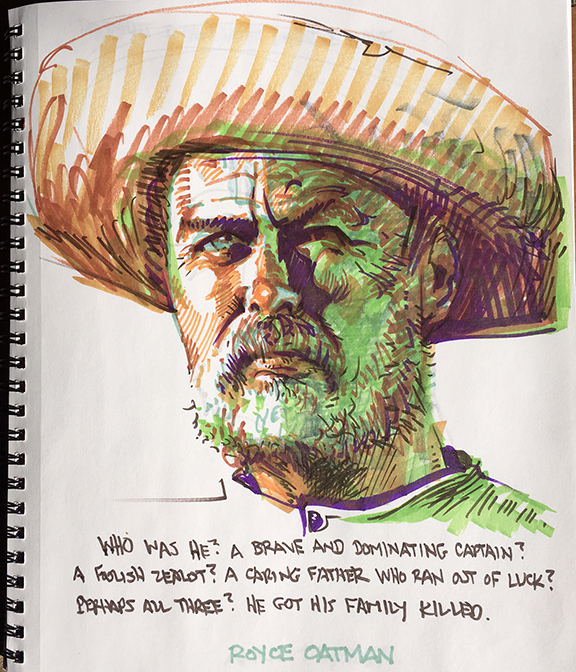
Daily Whip Out: "Dr. Bugs"

   So, I seek to tell the complicated story of Olive Oatman in all her contradictions. But I get bogged down in too many aspects of the story, too many ideas and images (see Dr. Bugs, above). It doesn't help that I'm doing the drawing and writing. The biggest criticism of our Mickey Free project was perhaps best critiqued by Vince Murray who said that it "had too many moving parts." It was confusing and convoluted. Not sure how to strip it all down, but I do know one thing:


Daily Whip Out: "Dammit, I just want to tell a good story!"

   I wonder if ol' Hermann has the answer?

"When someone seeks," said Siddhartha, "then it easily
happens that his eyes see only the thing that he seeks, and
he is able to find nothing, to take in nothing because he
always thinks only about the thing he is seeking, because he
has one goal, because he is obsessed with his goal. Seeking
means: having a goal. But finding means: being free, being
open, having no goal."

—Hermann Hesse

Sunday, April 23, 2017

Royce's Rough Road of Bad Decisions: Weary & Wary vs. Armed & Dangerous

April 23, 2017
   The question has been asked, why weren't the Oatmans more wary on that February day in 1851? And why didn't they put up more resistance to the Yavapai attackers they met on the rocky trail near Talking Rocks?


Daily Whip Out: "Royce's Rough Road of Bad Decisions"


  Yes, the Oatmans were wary, but they were also tired and discouraged. They had tried to cross the Gila River the night before, but their oxen were so weak they couldn't make it across, so the family camped on a spit of sand in the middle of the river and the water kept rising and putting out their meager fire. I don't think they got much sleep.  Royce Oatman allegedly cried for an hour in the wagon, probably admitting to his wife what a mistake he had made by pushing on alone from Maricopa Wells where they left behind the last two families who had been traveling with them.

   In the morning the Oatmans pulled themselves together and successfully made it across the river, but then they had to make it up the steep roadway to the bluff, where the rough wagon road, leaves the river bottom, and the jaded oxen couldn't make the grade, so most of the family (the mother, Mary Ann was eight months pregnant) had to unload the entire wagon and help push the wagon to the top, then walk back down the grade and bring up all the baggage and equipment, by hand. The oldest boy, Lorenzo, 14, was just putting the last of the luggage back in the wagon when the Indians walked up from behind them. 


The actual ridge, the Oatmans were trying to climb up on, February 18, 1851.


   So, yes, the Oatmans were wary but they were also weary and exhausted. When they saw the Indians approaching, Royce told the family not to panic. He had dealt with Indians before and everything would be alright. He would be nice to them and reason with them and they would go on their way.

   Of course, the raiding party must have spotted the extreme vulnerability of the party immediately (Royce's rifle was in the wagon and he probably didn't retrieve it for fear it would provoke them). As the Yavapais played their hand out, demanding more food, rudely mocking Royce's protestations, they kept pushing the situation farther and farther until, upon getting little or no resistance, they finally made their decision to strike.


J. Ross Browne's drawing of the Oatman graves in 1864, also depicting the road, in middle background, the doomed family had just climbed. The attack occurred on top of the bluff.


Weary & Wary vs. Armed & Dangerous

   Two days prior to this, these same Indians tried to overpower the aforementioned Dr. LeConte ("Dr. Bugs") and Juan The Sonorian near the same spot and here is how Olive (actually Stratton, her ghost writer, for "Captivity of the Oatman Girls")) narrates what happened in that situation:

   "Dr. Lecount (sic). . .camped about thirty miles ahead of us, turned his horses into a small valley hemmed in by high mountains, and with his guide slept until about daybreak. Just as the day was breaking and preparations were being made to gather up for a ride to the fort (Yuma) that day, twelve Indians suddenly emerged from behind a bluff hill near by and entered his camp."

   Notice, like with the Oatmans, the raiders simply walked into their camp, unlike in the movies where arrows fly and the raiders invariably launch a ferocious and stealthy surprise attack.

   "Dr. Lecount, taken by surprise by the presence of these unexpected visitants, seized his arms, and with his guide kept a close eye upon their movements, which he soon discovered wore a suspicious appearance. One of the Indians would draw the doctor into a conversation, which they held in the Mexican tongue; during which others of the band would with an air of carelessness edge about, encircling the doctor and his guide, until in a few moments, despite their friendly professions, their treacherous intentions were plainly read."

   The Yavapais were bold enough to face off with the two well-armed travelers, whereas with the Oatmans, nobody in the family—Royce, or his son Lorenzo significantly—were even holding firearms during the parlay.

   "At the suggestion of his bold, intrepid, and experienced guide, they both sprang to one side, the guide presenting to the Indians his knife, and the doctor his pistol. The Indians then put on the attitude of fight, but feared to strike."

   So the raiders crouched like they intended to fight, but then at the last moment backed off. Were they testing the two, or, did they have another objective? Juan (in the Oatman narrative he is called "Manuel") became "enraged at their insolence, and would again and again spring, tiger-like toward them crying at the top of his voice, 'terrily, terrily!'"

   This has to be a bad Spanish translation: "terrily"? Could Stratton have meant "Ondelay"? Be on your way! Or, "Get out of here!" Or, perhaps "Terminar," or "Terminala," which according to my Estudiante de Espanole-inclined wife, Kathy, means, "Terminate immediately!"

   At any rate, the "Indians soon made off," but, as it turns out, the 12 Indians who had engaged with them, feigning a fight, etc., were doing so partly as a distraction so that their comrades could steal the two traveler's "mules and horse."

   In the Oatman encounter, two days later, one of the Indians mentions two horses down in the brush, which seems to be a reference to this encounter and the stealing of Dr LeConte's mounts.

   It's more than a little shocking the subtle but significant differences between the two encounters, and how being wary—or kind!—isn't enough. The 17 Yavapais had no problem overwhelming all 9 of the unarmed Oatmans, whereas they were repulsed, or, at least, deferred from their ultimate goal of killing the intruders and taking all their stuff by a guy holding a knife and another guy—a bug collector!—holding a pistol. Sometimes might is, in fact, right.

"You can't challenge tradition unless you understand it."
—Old Vaquero Saying 


Thursday, May 08, 2008

May 8, 2008
Spent another morning down at the Heart Institute. This time I went alone (so Kathy can catch up on work). Dr. informed me the CT scan shows reduced blood flow. Need to have an angiogram so they can see if the stents are still working. Worrisome because the first two stents they installed in Kingman did not do the job and a couple days later they needed to go back in and put in two more. This latest setback points toward the possibility of open heart surgery, but I'll take the odds.

The doctor also read my Kingman emergency room files and pronounced me, "Tough and lucky."

Drove back out, listening to Barbara Walters being interviewed on the Diane Rheem Show. She said a very inspiring thing: "I didn't have the skills, I didn't have the confidence, but I had to do it." She was referring to some aspect of her TV career, but I applied it to my Top Secret Project efforts. Arrived at the office at 11. Fought a couple editorial fires, signed a stack of books for mail orders and came home.

Had leftover roast beef for lunch. Man, that sucker turned out great. Kept my portion small and chased it down with watermelon.

Speaking of food, here's a comment I got about not going to the Matador on Tuesday:

"If you passed on the best huevos rancheros in the world, you can do anything."
—Charlie Waters

And Speaking of Uncle Bugs
Here's a photo of Charlie Waters in Prescott with his namesake, Thomas Charles Bell (about 1983-84). Left to right: T. Charles, Jolyn (behind), Charlie, Deena and Linda Waters:


We had just got done eating at the Dinner Bell Cafe. Charlie was still the editor and publisher of the Prescott Courier.

"A film is just like a muffin. You make it. You put it on the table. One person might say, 'Oh, I don't like it.' One might say it's the best muffin ever made. One might say it's an awful muffin. It's hard for me to say. It's for me to make the muffin."
- Denzel Washington

Thursday, September 12, 2019

Geronimo From All Angles

September 12, 2019
   Going to beat the band today on the book. Making headway.

   Cleaning yesterday, look what I found:


Living Room Flashback

  A promo shot for a certain realtor. The dog's name was Dusty, the jackalope is gone (bugs got inside), I see two Ed Mells and an Edward Curtis, and those are John Weinkauf custom-made boots on the realtor and if you look close you'll see a pink bottle up on the left-hand corner of the fireplace which is from Wyatt Earp's campsite, but don't tell anyone.

   As I keep doing research on the Apaches, one guy sure stands tall and that's this individual:


Alchesay, White Mountain Apache

   He has a high school named for him and rightly so. Look for a big cover story on him by Dr. John Langellier, in an upcoming issue of True West. Alchesay has so much credibility as opposed to say, I don't know. . .this guy?


Daily Flashback Whip Out:
"Geronimo at Embudos"

   However, when it comes to popular culture, no one can top the G-Man in terms of world wide recognition.


Geronimo Italian Comic

Okay, if you think I am being too hard on the G-Man, here's a more sympathetic take on him.


Daily Whip Out: "Geronimo From The Side"


"The Apache Indian language is the hardest to learn but young Wratten exceptionally learned and understood the language in such a short time and as far as we know there isn’t another white man who can speak the Apache language as freely as George M. Wratten.”
—Jason Betzinez

Monday, July 28, 2008

July 28, 2008
It was 29 years ago today that I drove out to Pioneer, Arizona to get hitched in the Broken Dream Saloon (or, was that the name? can't remember now). Carole Compton Glenn was the maid of honor and Daniel Harshberger was the best man. Hans Olson played "Arizona" and the rock n' roll judge, Harold Lee, married us. I told Kathy this morning I'm more proud of this achievement than anything I've ever accomplished.

Feedback on the Exits Exit continues to pour in. Just got off the phone with Charlie Aldrich, 87, of Vegas, former stuntman at Corriganville and the road manager for Clint Walker (Cheyenne on TV). Charlie read the piece and had to call. He's a longtime True West subscriber and friend of Joe Small, our founder. Great guy. Really made my day talking to him. Here are a few comments off the Review Journal website:

Catherine Lamb wrote on July 28, 2008 04:56 AM: "Sitting in Sweden and reading the article, but this makes me feel as if I were there. Thanks, a great piece."

Trudy (Peart) Burrus wrote on July 27, 2008 08:47 PM: "Charlie, I'm glad you wrote this. It's a fitting tribute to all. We are so lucky -- in so many ways."

John Pemberton wrote on July 27, 2008 07:01 PM: "Bugs, You capture the best in all your friends! God Bless you, your family and our amigo Booze!!!"

Terry Lavely wrote on July 27, 2008 09:24 AM: "It is really nice to read something in the newspaper that makes you feel good, as opposed to most of the doom and gloom we see daily. Very well written piece, thank you."

End of comments. Went to a new cardiologist last Thursday. Dr. Klag looked at my chart and shook his head. "Do you know how lucky you are?" he asked me. Yes, I know. "If it comes from a cow, I want you to stay away from it," was his terse advice. No milk, no cheese, no beef tacos, hamburgers or steaks. Yes, sir.

"Earl Nightingale said many years ago that one hour per day of study in your chosen field was all it takes. One hour per day of study will put you at the top of your field within three years. Within five years you'll be a national authority. In seven years, you can be one of the best people in the world at what you do."
—Brian Tracy

Ah So!
China's Internet population has surpassed the United States to become the world's biggest, with 253 million people online.

"I thought I could change the world. It took me a hundred years to figure out I can't change the world. I can only change Bessie. And honey, that ain't easy either."
—Bessie Delany, African-American Author and Civil Rights Pioneer

Thursday, July 24, 2003

July 24, 2003
Still muggy and overcast. Hit 110 yesterday. Quite oppressive, but as we like to say, “It keeps out the riff-raff.”

Drove down to Greenway and I-17 at 5:30 to meet Theresa (from Tri Star Boze Publishing) and picked up two of my Wyatt Earp hardbound books. Stopped at Rolberto’s on the way home and got carne asado burros to go ($6.25 cash).

Talked to Thomas in New York last night. He’s struggling under the expense of living there. It’s good for him to have that reality check.

The Vera issue is nearing completion. Tweaked “Classic Gunfights” yesterday. Several bugs in the new layout. Typography is still a concern to me. It’s not very “Western” but at some point I have to trust Dan’s vision.

In yesterday’s journal entry, in the photo at the Bell gravesite memorial: that’s Sheriff Tom Sullivan on the left and Dr. Jannay Valdez, of Desoto, Texas on the right. That’s also Steve Sederwall (mayor of Capitan and one of the major players in the Billy dig) in the background, between them.

Somehow ripped off a toenail in my sleep last night. I was having violent, logistic-heavy dreams: I’m trying to move from Kingman and I have stuff scattered between Tucson and Phoenix and I need a ride cause the brakes are out on my vehicle and my stuff is everywhere and I’m a long way from where I need to be and I’m afraid someone is going to steal my stuff (not hard to figure out the “symbols” in this recurring nightmare, eh?).

"I went to a bookstore and asked the sales clerk where to find the self-help section. She said if she told me, it would defeat the purpose."
—Steven Wright