Monday, October 05, 2015

What Did The Killer of Van Gogh Look Like?

October 5, 2015
   So, what did the 16-year-old punk and Buffalo Bill wannabe, Rene Secretan, actually look like? The Louvre in Paris found a sketch, done by van Gogh, which is a crude, quick sketch of a young kid (possibly too young) with a big hat on. The authors of "Van Gogh The Life," ran it with this caption, "head of a Boy with Broad-Brimmed Hat (probably Rene Secretan)."


 I have my doubts, but I have utilized that sketch to build on a possible likeness:

Rare BBB faux-tintype of Rene Secretan

Thanks to research by Gay Mathis, here is the provenance on the pistol that surfaced: In the 1950s, a rusty revolver was discovered buried in a field just behind the Château d’Auvers, where Van Gogh is said to have shot himself. An examination suggested that it had been in the soil for 60 to 80 years. The gun was discovered close to the Chemin des Berthelées, the spot painted by Dr Gachet’s son in 1904, in a picture he entitled Auvers, the area where Vincent committed suicide. The revolver was found just beyond the low farmhouses in the centre of the painting.


That would be this scene with the Expert from Auvers pointing at the murder site.


   This actually makes some sense. That Rene buried the pistol, or hid it near the shooting site as the boys fled the scene.

   Good to be back in my studio working. One of the depressing observations from the trip is the fact that you really don't see anyone reading newspapers like you used to in the old days, say 2005, or so. This realization led to this:

Daily Whip Out: "Folding Newspapers"

"Nothing ever goes away until it has taught us what we need to know."
—Pema Chodron


Sunday, October 04, 2015

The Demise of The Redheaded Madman

October 3, 2015
    Got home last night after traveling more than 12,000 miles on my quest to find the truth about the demise of the The Redheaded Madman. Got up this morning with my head chocked full of van Gogh and headed out for a walk and this is the sight that greeted me.


Ratcliff Ridge this morning at about 6 a.m.

   And this:


Old Stage Road at sunrise as the storm moves in (started raining around nine).


   I saw plenty of sky on our travels, but none compared to this. 

  Now, back to the mystery of van Gogh's death. Many versions refer to the artist shooting himself "in the chest," but Dr. Gachet's report said the bullet entered his abdomen just "below the ribs." That is not a chest wound and actually supports the theory that Vincent was shot in an accidental way by someone else. Who shoots themselves in the side? Add to that the police report that the shot was fired "too far out" for Vincent to have pulled the trigger and you have a strong case—at least anecdotally—for the Buffalo Bill wannabe shooting Vincent by accident. That said, we should look at a motive for suicide and it's not hard to find one.

The Case for Suicide
   As interesting and intriguing as the suspicious events surrounding the van Gogh shooting are, there is ample evidence of a suicide motive. Vincent returned to the north of France from his incarceration in the mental institution outside San Remy, a mere three months earlier. He viewed it as a return to the north, towards his home in Holland, and he began a series of paintings he called "remembrances of the north" where he revisited scenes from his early days and transposed them to the lovely farmland around Auvers.
   As usual, he had an agenda: to woo his brother into leaving Paris and moving to Auvers Sur Oise where they could create the family he has been lacking since before his move to Arles. He has been exiled even from his fellow exiles (Gauguin, et al) and he is, once again, alone in a strange town,  But this time it's different. Theo is having financial troubles, wants to quit his job where he feels unappreciated, and their baby (named for Vincent) is sick and the mother, Jo, is stressed when van Gogh comes by train to visit, he sees all this and realizes the worst: he is a burden to his brother. He feels trapped. What can he do to help? 

   Well, exactly a year before, in July of 1889, a painting by his hero Millet had just sold for a record amount—a half million francs—because Millet had died. It's the old saw but a fact of life in the art world: dead artists sell better than live ones.

   He went back to Auvers and borrowed a gun from the inn keeper, hiked up the hill west of town, along the perimeter fence of the Auvers Chateau, shot himself, but botched it and walked back to his room at the inn and died two days later.

   It doesn't quite fit—the shot in the side, the angle, etc.—but it does make sense, emotionally. He does have the motive.

   For years, the pistol was never found (nor any of Vincent's art supplies which he carried with him) but about five years ago, the pistol surfaced. I don't know the details yet, but will report it when I find out.


Thanks to Gay Mathis for locating images online of the alleged pistol used in the shooting of van Gogh. Dealing with Old West weapons I am very suspect of this "find," and need to find out more about the provenance of it.


Did he? Or, didn't he?

   I was searching for a photo of Rene Secretan and, instead, found this take on why the murder of van Gogh is not sexy:

"Myth is all. Suicide makes a better sales point than death-by-yokel."

And this:

"We need closure. We need the myth of the crazy, tormented, self-destructive artist to convince us that painters, poets, and musicians are all nuts, so their larger-than-life lives can continue to offer escapism from the bourgeois armchair of our own lack of freedom. And also, paradoxically,  make us feel relieved we are not artists. In our dreams, van Gogh must commit suicide, otherwise the story doesn’t have legs."
—John Perreault, author of both quotes

As usual, this is about half-right. As Kathy put it, "John Lennon was murdered and it doesn't diminish his artistry." Touche m' lady.


"Now I think I know, what you tried to say to me and how you suffered for your sanity and how you tried to set it free.  They weren't listening, they're not listening still....perhaps they never will."
—Don McClean, "Vincent" on the American Pie album

Friday, October 02, 2015

21 Days That Shook My World

October 2, 2015
   Back from the van Gogh tour. After our Holland and Belgium hunt, we met the Ds (Dan and Darlene Harshberger) in Paris and they accompanied Kathy and i to the south of France. We ended up back in Paris where we hooked up with Mike and Phyllis Hawkins on her birthday and it was Phyllis who took this pic of us on the last night. We were on the hunt for 21 days (that shook my world). Feature to follow.


Fish La Boissonnerie at 69 Rue de Seine on the Left Bank 
where we met Mike and the birthday girl, Phyllis Hawkins,  for dinner on our last night in Paris.

   After dinner, we walked through the narrow streets and talked about riding the metro, the danger of trains after the thwarted terrorist attack several weeks ago, and the upcoming elections back home ("We'll take in refugees after the election, of course.")


Kingman compadres (and their better halves) toast one
to Charles Richard Waters in the City of Lights.

Most Poignant Moment In Amsterdam
   On our fist day in Amsterdam we were walking through the crush of tourists and locals in a popular square when we encountered two city workers in uniform straight ahead. One was gesticulating rather wildly about the work they were supposed to be doing, pointing where they should go and what they should do As he was doing this, his co-worker was taking a big toke off a joint (I kid you not). As he inhaled sharply, he shot his boss a narrow look that told me his priorities: "Yes, HYPOTHETICALLY we could be working on something."

"Work is only work if you'd rather be someplace else."
—Old Stoner Saying

Thursday, October 01, 2015

The Death of An Honest Man: Vincent van Gunfighter?

October 1, 2015
   As Wyatt Earp strode the boardwalks on Allen Street and dealt faro in the Oriental Saloon, 5,000 miles to the east, a young Dutchman, age 26, made a belated decision to become an artist. The year was 1881, and while Earp had a showdown coming in the fall, and Billy the Kid had mere weeks to live, Vincent van Gogh, who himself had a mere nine years left to live, launched himself on a fiery and ultimately fatal and tragic march into the history books and immortality. That Vincent would eclipse both Earp, the Kid, and even Jesse James, in international fame is a strange note, to me, but the fact that the Wild West connected them all is the most crazy story of all.

   Buffalo Bill and his Wild West Show came to Paris in 1889 to perform at the International Exposition, or Exposition Universelle as it was billed in France. This was also the festival that premiered the Eiffel Tower to the world. All of Cody's shows were sold out and everyone in Europe was suddenly crazy about the Wild West. The up and coming artist Paul Gauguin scored tickets and immediately went out and bought a Buffalo Bill hat, which appears to be a Boss of The Plains style chapeau, at least in the self-portrait of Gauguin that hangs in the Musee d"Orsay.


Paul Gauguin apes Buffalo Bill in his self-portrait

   So how does Buffalo Bill figure into the death of van Gogh? Read on.


The murder site as it appears today from the Expert's notebook. Her finger points to the plaque on the wall, near the gate, at right.

   After some searching and accosting neighbors in the subdivision at upper left in the photo, we found the site.


My van Gogh posse at the death site, including, 
from left Richard, Bud, Kathy, Dan and Darlene.


Now, a few details about the gun that killed van Gogh.


The van Gogh murder pistol

   This strange looking pistol is of the type that killed van Gogh (the Expert had a photo of the actual gun, same model, which was rusted and falling apart, but I didn't get a photo of it). In the traditional telling of the story, van Gogh borrowed the pistol from the hotel owner, Gustave Ravouix, and subsequently shot himself with it, but, according to the 2012 biography "Van Gogh The Life" by Steven Naifeh and Gregory White Smith, there is credible evidence that the pistol belonged to Rene Secretan, a 16-year-old punk, rich kid who was also enamored of Buffalo Bill and went further than Gauguin, by dressing in fringed buckskins and a big hat with the brim pushed up in front. In the van Gogh biography by Naifeh and Smith, it is Secretan and possibly some of his gang who accost van Gogh on the west end of town, near the chateau of Auvers, a large estate owned by M. Gosselin, who actually lived in Paris.

   According to a renown researcher, John Rewald, who interviewed locals in the 1930s, the actual shooting was precipitated  by "young boys who shot Vincent accidentally" and that they "were reluctant to speak up for fear of being accused of murder and that Van Gogh decided to protect them and to be a martyr." This is borne out by the gendarme's (the police) question of anyone else's involvement, to which Vincent replied, "Do not accuse anyone; it is I who wanted to kill myself."

   After being knocked unconscious by the shot, Vincent allegedly awoke at sunset and walked back to the Ravoux Inn and went up to his room. When Theo arrived the next day from Paris, he found Vincent sitting up in bed smoking his pipe. Incredibly, he lived for two days before expiring.

   Here is what our esteemed gun editor, Phil Spangenberger has to say about the above pistol:

The gun in the photo is a pinfire revolver, of the Lefaucheux system. It took the metallic cartridge (below it) that had a little pin where the hammer struck to detonate the round. These were also called "Teat Fire." If it is small and not the size of a Colt Peacemaker, but more like an 1849 Pocket Colt or similar size, it looks like it might be the Belgian-made "Guardian" or "Guardian-American Model of 1878" with a folding trigger. That's about all I can tell  you at this point.
Did it shoot off Van Gogh's ear? ha ha.
—Phil Spangenberger


The Ravoux Inn in 1890 with the owner Gustave Ravoux sitting at far left. The girl in the doorway is his 13-year-old daughter Adelene, who is the source of the accepted version of Vincent's death. As she got older she retold the story, adding new and longer quotes. Not unusual for oldtimers: "every time they retell the story, they get closer to the center of the stage."

   Here is the hotel as it appears today.


The Ravoix Inn as it appears today.

"It has always seemed to me that suicide was the deed of a dishonest man."
—Vincent's favorite quote from Millet


Wednesday, September 30, 2015

A Murder of Crows

September 29, 2015
   We are approaching the end of the tour. While there are plenty more paintings and locations to discuss, here is where the story of his life ends


"Wheat Fields With Crows," by Vincent van Gogh

   In popular legend this is Vincent's last painting. It speaks of madness with three roads intersecting in the foreground and, at first glance, none of them appears to lead anywhere. As the guide pointed at the middle road in the painting—which more or less matched the roads we were standing on—she noted ominously that the middle road ended abruptly and led nowhere, Dan The Man Harshberger, who was standing to my right, said, "No, the road clearly dips to the right and leads out of the scene." Leave it to a graphic designer from Kingman to add some levity that I have a hunch even Vincent would have appreciated.


Kirk Douglas, as Vincent, paints his supposed last painting, "Wheat Fields With Crows."


   In the movie "Lust For Life," Vincent (Kirk Douglas) is painting this scene when the end comes and a murder of crows (how appropriate in this situation) fly at him from all directions and in desperation he retrieves a pistol from a tree bough and we hear a loud report that signals his suicide. This is the "official" version of Vincent's sad end and has held sway for over 110 years. It also makes good, local business sense because the tour guides (sometimes three groups at once are working the narrow roads of the town up on to the high ground of the wheat fields. As we stood at the intersection of death and murderous crows, another group ahead of us was heading towards the cemetery, not 50 yards to the east, while another group was about to come out the main gates. 


A Viking tour group heads towards the cemetery where Vincent and his brother 
Theo are buried. They have just left the alleged site of "Wheat Fields With Crows."

   Our guide told us the big crowds started showing up in 1995 and that this year they are expecting 500,000 visitors to the gravesite. For comparison, I believe the O.K. Corral gets 200,000 visitors a year and Lincoln, New Mexico, Billy the Kid's hometown, gets 60,000.

   Vincent has become big business, something that would no doubt embarrass him to no end.

   When the tour ended, I asked the tour guide, a local woman, several questions about the new theory of Vincent's murder.


The Expert points to a photograph of van Gogh heirs placing special wreaths on Vincent's and Theo's grave, which are just to the left, along the wall of the cemetery in Auvers Sur Oise (which I have heard pronounced Ah-vers-say-was and Ah-vers-sur-was).

   She was quite forthcoming and flipped her photo chart to a page and said, "Here is a copy of the painting Dr. Cachet did of the actual murder site.


The Expert points to the real murder site of Vincent van Gogh.

   Oh, and, "Wheat Fields With Crows" was not his last painting.

"I do not say that my work is good, but it's the best bad that I can do."
—Vincent van Gogh

The Langlois Bridge vs. The Actual Langlois Bridge

September 29, 2015
   My goal on this trip is to stand where he stood, see what he saw and feel what he felt (short of feeling the syphilitic symptoms).

   One of my favorite van Gogh paintings is of the Langlois Bridge on the outskirts of Arles, France. It portrays a very complicated draw bridge apparatus, stripped down to basics and placed in a beautiful complimentary color-schemed design. For several days, in 1888, Vincent hiked out to the site of the draw bridge, which is about a mile from The Yellow House where he was staying. He did numerous drawings of it and several paintings. This is the classic version and my favorite:


The Langlois Bridge, by Vincent van Gogh


   One of the first things I did when we landed at Arles was to go to the Tourist Office and ask where the site of the Langlois Bridge is. In English, heavily laced with a strong French accent, the woman told me where to go, showing me on the map, but, she added as an aside, the "actual site" is over here. This sounded like, "Le auct-chew-wol mizzen-seen es oh-vehr heer," Whoa! You mean the bridge I'm going to hike out to is not the ACTUAL Langlois Bridge that van Gogh painted? No, apparently it's not. It was either rebuilt on the other site farther south of town, or recreated from scratch at the new spot.


Dan and Darlene Harshberger and a stray dog we named "Vincent" at the "new" site of the Langlois Bridge.


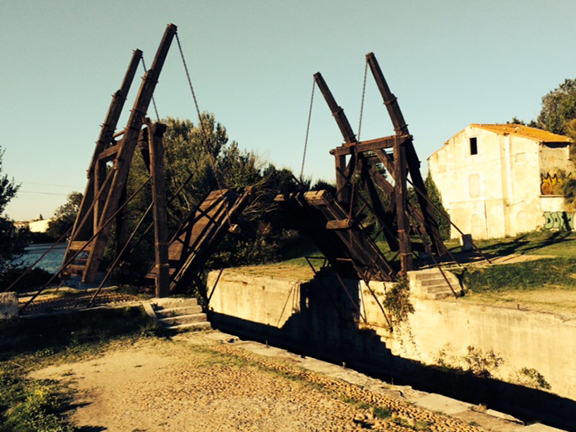
The alleged Langlois Bridge with the draw bridge up 
(it appears rather permanently up).

   The wooden struts seem heavier than the painted version and not quite as delicate, although that could be an artistic license deal. Fred Nolan sent me a photo he took in the 1960s of the Langlois Bridge and it is much closer to the painting.


Fred Nolan snapshot of the Langlois Bridge in 1960s


Either way, the one we saw is not the actual Langlois Bridge and for a Western history nut, it's tantamount to saying, "You can drive to Sierra Vista and see the O.K. Corral."

 "You must set it down all down at once. Paint in one rush, as much as possible in one rush."
—Vincent van Gogh

Tuesday, September 29, 2015

Unique and Odd Choices by Vincent van Gogh

September 29, 2015
   One of the profound realizations I have had on the van Gogh tour is seeing the scenes he painted in person. When you are standing on the site you can see all the things he DIDN'T choose to paint. Here is a good example in Arles, in the south of France. Vincent painted several scenes along the Rhone River as it passes through Arles, including "Starry Night On The Rhone," his first pass at one of his most famous paintings (he painted four versions, the last being "Starry Night" which he painted while in the asylum in San Remy).

   As a fellow artist I am always on the lookout for scenes that could make compelling paintings and in Arles, where the Romans built a coliseum and various structures and walls, it all seems so suited to the artist temperament, and although he did a couple paintings that flirted with the edges of that world, he chose some pretty ordinary things, like this bridge access not far from our apartment.


Van Gogh's Bridge In Arles

   This is a very strong painting with a wonderful design and strong values. Here's how the site looks today:


At each site, the town has put up a plaque on the spot that Vincent saw when he did the painting. The guy, at left, is looking at the plaque.

   Yes, it appears the bridge is caged in the 1888 view and is much sexier than the steel, plain car bridge it is today. Here's another view with a closer look at the plaque:


The actual scene of the Arles Bridge today. Note the small tree in the painting
has taken over the entire scene.

      Not far to the right is this scene, which Vincent chose NOT to paint:


Ancient walls in Arles van Gogh chose to ignore

   Today there are genre painters who paint nothing but these quaint, but dynamic scenes of these old facades and walls, but for the most part Vincent gave these scenes a wide berth. He definitely had a unique eye and perhaps some of it is rooted in his Dutch upbringing. Something else I learned is that van Gogh did not think much of "Yankees." There was a painter from the U.S. who was painting nearby and Vincent noted of him that, "He is a Yankee and probably paints much better than most Yankees do, but a Yankee all the same." Van Gogh thought Dodge McKnight was "a boor" and "a slacker" (his word). Funny, huh?

"There is an art of the future and it is going to be so lovely and so young. . .I feel it so strongly."
—Vincent van Gogh to his brother Theo

"


Pedal Pushers For Men, Part Deux

September 29, 2015
   I have already reported on the new trend in Europe towards the skinny-skinny-squared jeans for men with the high-water-cuffs that are dangerously close to being, what we used to call, Pedal Pushers or Capri Pants. I didn't have the nerve to ask the tattooed dude in the Brasseria Quasimodos near the Notre Dame to turn around and pose for me, because, well, asking a guy to turn around and let me take a photo of his pants because I like them, is not something a Kingman guy like me is brave enough to do.

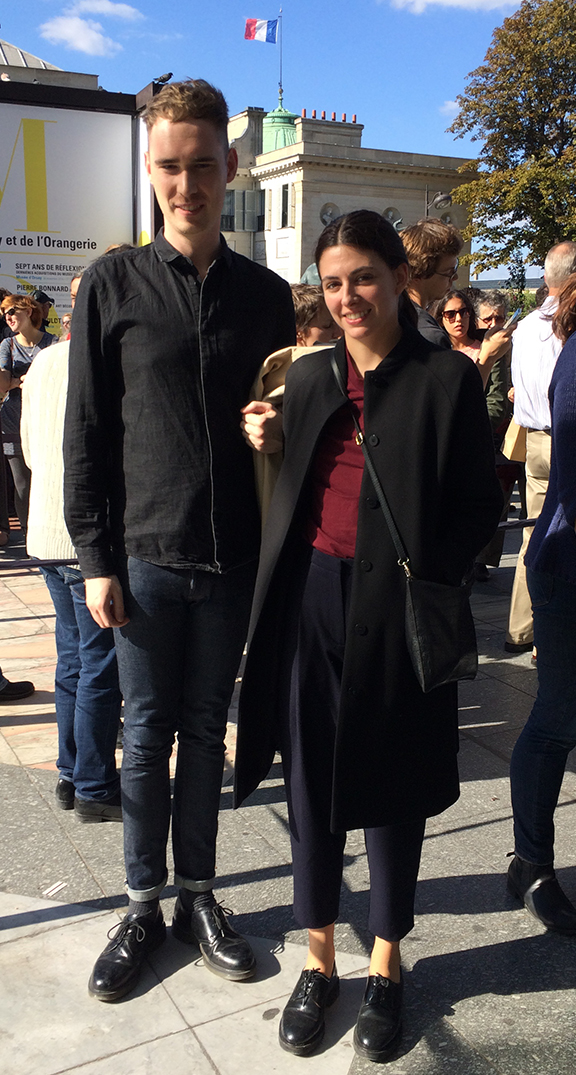
   The Kingman guy's wife, however, has no fear. On Sunday we went to the Musee D'Orsay Museum to see the van Goghs and while we were standing in line I spotted several pairs of Pedal Pushers on guys and my wife—Kathy Radina—said, "Give me your iPhone and step aside." Kathy proceeded to say something I could never say, "Excuse me, but I love your outfit. Can I take a photo of you to send to my son?" All the guys were flattered and complied with pleasure. Here are the results for your viewing pleasure:


Imagine showing up for the sock hop in this get up. Meri Bocu Bozina!


These two are French Canadian and spoke perfect English. 
I do spot a bit of Li'L Abdner going on here.


High Water Peggers and one incredulous Kid from Kingman behind him.


Oh Capri Me Baby!

"Never fear, these guys put their pants on one leg at a time, just like your mama."
—Old Harry Nipple Saying


Monday, September 28, 2015

Lust For Life, Anyone?

September 28, 2015
   We took a commuter train from Paris to Auvers Sur Oise this morning and went out to the death site, in the wheat fields where Vincent, according to legend, took his own life by shooting himself in the upper abdomen. There are several problems with this scenario: eye witnesses put him west of town, in the opposite directions from the so-called wheat fields, which are right next to the cemetery where he is buried (how convenient for tour guides!) and the traditional death site is northeast of town, or more accurately, north of the train station on the east end of town. The biggest problem with the suicide theory is that the police investigation concluded the gun was fired some distance from the body, or "too far out" for Vincent to have pulled the trigger himself.

   The likely murder suspect in this mystery is one Rene Secretan, who loved to dress up as Buffalo Bill ever since he saw the Wild West showman in Paris the year before (1889) at the international exposition where the Eiffel Tower premiered. When the movie, "Lust For Life" came out in 1956,


Kirk Douglas made a very convincing Vincent in "Lust For Life."


Mr. Secretan, who was by that time 82-years-old was quite upset. The Academy Award winning movie, starring Kirk Douglas as Vincent, really ticked off the old Frenchman. He gave several interviews on what a fruitcake van Gogh was and how he liked to abuse the mad Dutchman.

   I went to both murder sites, saw a photograph of the weapon, which has now been "found." And interviewed a local expert on the case and I have a good idea of what really happened.

   Afterwards, me an my posse went into the only restaurant open on a Monday in the small suburb of Paris and found a big wall mural at the end of the bar. It made me smile.


Lust For Life, Anyone? A mural showing three scenes
from the 1956 movie starring Kirk Douglas.

"Advise persons never to engage in killing the legend."
—Billy the Kid meets John Ford quote


Sunday, September 27, 2015

The Plot Thickens

September 28, 2015
   I've traveled from Amsterdam to Brussels, and from Paris to Arles in the south of France, looking for clues in the mysterious death of Vincent van Gogh. Today I travel by train to the scene of the crime, Auvers Sur Oise. There are intriguing aspects of the case which I will spell out in great detail so you can make your own decision.


BBB at San Remy in the south of France.

"As regards making oneself scarce or disappearing—now or ever—neither you nor I should ever do that, no more than commit suicide."
—Vincent in a letter to his brother Theo

Friday, September 25, 2015

The Mad Redhead In The Yellow House

September 25, 2015
   Vincent got off the train at Arles in February of 1888. He had left Paris, where he was living with his brother Theo in Montmartre and was seeking a new place to paint. Van Gogh, like so many artists of that era was in love with Japanese prints and he wanted to find a landscape that matched the snow-capped scenes in the oriental woodcuts that were all the go in Paris. A freak snowstorm blanketed the area when he arrived and he impulsively decided this was going to be his Japan. After a stay in the Hotel Carrel he found a dilapidated house just south of the train station and set about refurbishing it. He had the outside repainted yellow.


Vincent van Gogh's painting of his beloved "Yellow House" in Arles.


   Vincent envisioned Arles as an art mecca for the Impressionists and tried to talk several artists into joining him. Guaguin was not his first choice, but he was the only one who came. Before Guaguin arrived, Vincent began to paint with a newfound intensity and in the next several months would produce many of the iconic paintings he is famous for, including "Sunflowers," "Starry Night Over The Rhone," "The Bedroom," "Langlois Bridge," "The Night Cafe" and ""The Cafe Terrace On The Place Du Forum."

   Of course, Gauguin came, they fought over everything, Gauguin left and Vincent had a meltdown (and cut off his ear), ending up in the local hospital. After a time, he got out, but had a relapse and 30 neighbors signed a petition to have him arrested for groping the local women and following people into their houses. The locals called him "flou roux"—The Mad Redhead. Kids threw rocks at him. The house was closed and all his stuff impounded. Van Gogh was moved to an insane asylum in nearby Saint Remy. It's amazing that any of his paintings survived, considering the animosity towards the Mad Redhead, but Theo had everything shipped to Paris and he saved it all.


The Yellow House in the early 1900s.

   Vincent never came back to Arles and in a year he was dead, perhaps shot down by a Buffalo Bill wannabe. The Yellow House continued to deteriorate until World War II when. . .


The Yellow House after being hit by Allied bombing in 1944.

   A bombing raid demolished the Yellow House. Today the site is a mecca for painters and fans of The Mad Redhead, Vincent van Gogh.


The site of the Yellow House today. Note elevated train trestle at right.

   We had lunch in the brasserie of the building that stood behind the Yellow House. It was eerie to look out on scenes he would paint many times. We had traveled a long ways, but it was a thrill to be on the spot of van Gogh's beloved Yellow House.

"There are three types of people who major in art: those so full of passion they find inspiration in a falling leaf; those who yearn to feel anything at the sight of a falling leaf; and those who cannot do math."

—Jessica C. Bakule


Thursday, September 24, 2015

My Inky Heroes

September 24, 2015
   Some connections span the globe and defy language and culture. If you try and represent life through pen work there is a bond that connects a whole bunch of us. And if you believe nothing is sacred when it comes to humor, then we are connected by an even stronger bond.


My heroes on the wall at the visitor's center at Arles, France

These are the cartoonists from Charlie Hebdo who were assassinated for their cartoons. These guys are from my tribe and I grieve their loss. Hard to believe someone would kill them for that, but this is the world we live in. I still think no one has improved on Robert Crumb's line:

"It's just lines on paper folks."
—R. Crumb

Headphones in the 1840s

September 24, 2015
   Here's an example of early day headphones. Looks like the late 1780s. Saw this excellent painting in Le Musee Reattu in Arles, France. 


Early day head phones, or spit curls and draw strings?

   Actually not headphones, but I did do a double take, how 'bout you?

"The future ain't what it used to be."
—The Late Great Yogi Berra

HEY TEXAS!

September 24, 2015
   I've had at least 50 shoutouts from the Dutch, Belgians and now the French and every single one of them says, "TEXAS!" or "HEY TEXAS!" or "TEXAS?" Talk about owning a brand. When I tell them no, I am from Arizona they seem so disappointed (mainly that they guessed wrong). Funny how Texas owns the cowboy hat in the view of the world. Makes sense, but still kind of weird to a Westerner.


BBB in front of the Cafe Nuit (The Night Cafe), scene of a famous van Gogh Painting.

   We took off from Paris yesterday morning at Gard de Lyon (Lyon Station) on a bullet train heading south down the center of France. It is the same route Vincent van Gogh took in February of 1888 as he made his way from Paris to Arles in the south of France. It took Vincent a day-and-a-half by train, and it took us three hours to cover the same distance. The high-speed train is electric, very smooth and silent. The only interruption is when we met other trains, also going between 150 and 200 mph and then there is a swoosh and a vortex interruption-like vibration, like an incoming rocket going by your ear, Startling the first time you experience it, but by the third hour, it's kind of soothing in a we're-going-awful-damn-fast way.

   We're spending three full days here and we've rented a little house with three floors and a very narrow, steep staircase leading to the top "penthouse" which is actually a miniature crow's nest with a low ceiling where the Ds have parked themselves. My big goal for today is to see the actual Langlois Bridge, which is about a half-mile walk from here. Pics to follow.

"When,  for instance, you are painting a landscape, don't leave out the rain just because you've started with the
sunshine."
—Henri Matisse


Tuesday, September 22, 2015

Hey, Buffalo Grill, what did you grill, Buffalo Grill?

September 23 2015
   My research here in France is revealing tantalizing clues regarding the murder of Vincent van Gogh. Buffalo Bill created a huge cultural impact in the City of Lights when he landed here with his show in 1889. Kids started wearing fringe jackets and big hats. His influence can still be seen in Paris.


The Buffalo Grill, across the street from the Moulin Rouge in Montmartre.

"Hey, Bungalo Bill, what did you kill Bungalo Bill?"
—John Lennon's reaction to seeing a gun show in the U.S.

Pedal Pusher Pants for Men!?

September 22, 2015
   My son asked me about the new fashions in Paris. Well, the latest in fashion that I've noticed, now that I've been on the continent for the past week, is men wearing pedal pusher pants! 


Men's pants-legs getting skinnier and skinnier on the Champs Elysees in Paris, France.


We used to call them Capri pants, which were exclusively the domain of females. Saw my first pair in the Cartoon Museum in Brussels. An Asian dude with really tight pants, about two inches above the ankle, very feminine looking (to me). Now that I'm aware of the trend, it appears gay men are inclined to do it the most. Tried to get a photo of a hetero guy wearing ripped jeans with rolled up cuffs, at least four inches above the ankle, but he got away from me and I just got him from the back.


Capri pants on a male dude at Quasimodo's near the Notre Dame in Paris.

"Clothes make the man, but sometimes the clothes make the man unmanly."
—Old Homophobe Saying

Sunday, September 20, 2015

Paris Girls Gone Wild!

September 19, 2015
   When the clouds cooperate you need to take a photo.


Patriots

   This is a statue in Brussels to the patriots who defended the city. Notice the swooning women at the base. When the statue honoring Harry Nipple is built in Kingman I am going to propose that these women be incorporated into the design, only with big, beehive hairdos.

   Kathy and I were given a tour inside the historic L' Hotel De Ville in Paris this morning. Fantastic paintings inside. From the top floor I could look out the window and see our apartment across the Seine. It's to the right of the statue. The tower looming over the back is the Notre Dame.


"The Seine, the Seine, when will I again, meet her there, greet her there on the banks of the Seine."

   The steeple and towers in the back are the Notre Dame. Inside the Hotel De Ville (it's actually city hall) they had some pretty amazing paintings.


Paris Girls Gone Wild in the Hotel De Ville #1

Paris Girls Gone Wild in the Hotel De Ville #2

Paris Girls Gone Wild in the Hotel De Ville #3

   These well-painted ladies are just three examples of about 15 nudes in one room. And, did I mention this is the Paris city hall? Can you imagine an American city with these paintings in their city hall? Perhaps Duluth, I don't know (never been there).

"Virtue is the lack of adequate temptation."
—Old French Saying