Thursday, August 03, 2017

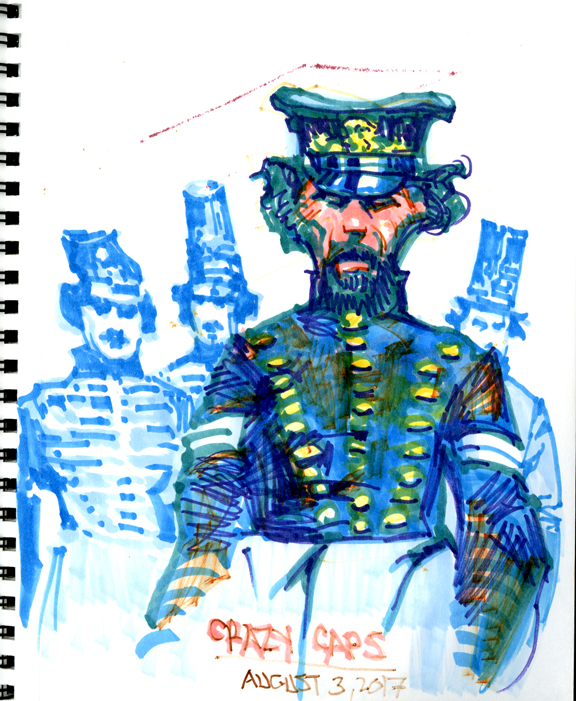
Crazy Caps From The 1850s

August 3, 2017
   When I was going through security last Monday at the Frankfurt, Germany, airport, Herr TSA-dude demanded that I put "ze cap" in the bucket to go through the X-Ray machine. Never mind that I hate that because they always place my hat wrong side down and my $750 hat invariably gets dinged as it goes through those car wash, rubber-fringe deals. Anyway, you want to see crazy caps? I'll show you some crazy caps.


Crazy caps from the 1850s

   Some of these caps are hard to believe, but there you have it. Photographic proof that there are more styles of headgear to be utilized in Westerns than have ever been donned in a movie—ever. Imagine if I submitted sketches inspired by this photo to the wardrobe designer on an upcoming Western. Do you think they would be approved?


 Daily Whip Out: "Crazy Caps From the 1850s"

   If I ever get the opportunity, you will see these caps in a Western I would probably call, "Ze Krazy Kaps der Frugen-Bozer." Or, something close to that. Danka.

"Germans are unable to speak the German language."
—Hans Georg Stengel

Another Ridiculous Sunrise Over The Seven Sisters

August 3, 2017
  Still off schedule, bent bad by jet lag. Woke up at midnite, just like the previous two nights. Rolled around and tried to read an article on fellow cartoonist and musician, Gary Panter, but finally decided to get up and do something with my life. In the old days, that would have been enough to put me right to sleep, but not now.

   I want to see the new film "Dunkirk" by the director, Christopher Nolan. In an interview for the film Mr. Nolan had this advice: "Stay open." This resonated with me. One of the handicaps of being task driven is focusing too hard on a preconceived idea. You need to stay open for the Happy Accident, or something else that you did not plan on, but is actually better than what you started out with.

   Did a quick sketch, inspired by a postcard I picked up in Wiesbaden, Germany, of a series of topo maps which apparently someone published as a postcard (I can't read the text). Having been a draftsman in my younger days, these topography renderings resonated with me. I'll post a couple of these sketches later.

   Got out on the road at about 5:45 and was met with this spectacular sunrise shaping up over Ratcliff Ridge.


Ratcliff Ridge Aglow: 08-03-17


   Turned around to see the clouds in the West and took a couple photos that way:


Another Ridiculous Sunrise Over The Seven Sisters


   Kept walking and emailed them to myself and when I turned around it was all gone. The moral: pay attention and stop emailing stuff when you could be looking! The other takeaway is, I would never have seen this brief array display if I hadn't been under the influence of jet lag.

"For everything you lose, you will gain something. For everything you gain, you will lose something."
—Old Vaquero Saying

Wednesday, August 02, 2017

Cool Wolves Like Marty Robbins and The Late Great Sam Shepard

August 2, 2017
   I'm still suffering jet lag. I don't want to complain (Oh, he went to Europe, and he has sleep issues, oh the poor baby!) but I woke up at midnite for two nights in a row now. Got up the first night and worked until about noon and then really hit the wall. Last night I tried to go back to sleep, but gave up at about three and went out into the kitchen and turned on the coffee. Kathy is still in Germany until mid-September so I'm bachin'-it.

  The good news is it is very peaceful and enjoyable out in those early morning hours. Got some sprinkles on my walk.


Storm over the Crow's Nest


Went out to the studio and grabbed a DWO called "Coyote Eyes" and re-purposed it as a possible illustration for an Olive Oatman feature for November, added the Oatmans at the bottom.


Daily Re-Whip Out: "Wolves Wait Their Turn As They Follow The Oatman Wagon"

Too Cool for School
   We are featuring several very cool guys in the October issue and two of them had connections to the magazine. Marshall Trimble, actually knew Marty Robbins and tracks the Glendale, Arizona native through his long career (Rosa's Cantina in the song "El Paso" was actually a Glendale restaurant Marty frequented).


Marty Robbins: "A Big Iron On His Hip"


   The other guy who we need to give a shout out to, is the late, great Sam Shepard, who wrote a searing stage play, called, fittingly, True West. Sam is such a class guy he requested permission to use the name from the then owners of True West magazine.


Daily Whip Out: "Sam Shepard Was True West Cool"

Another group of cool guys get the some needed respect in the October issue as we celebrate these hombres in our art coverage:


Daily Whip Out: "The Vaquero"


"Not to brag, but I can unhook a bra using just a bent paper clip, some WD-40, and my reading glasses."
—Russ Shaw, Jr.

Tuesday, August 01, 2017

Adapt Or Die? Plus, Sam Shepard's Tortured Soul

August 2, 2017
   My daughter is in the financial sector and we talk quite a bit about adapting to shifting trends,  in our respective fields. I mentioned to her in an email that I wasn't really impressed with German beer and here is her reply:

"Ah, yes, the German beer thing! I heard a great piece on NPR about that. Apparently all German beer is the same (or the most well respected ones are the same) because they have been using the same ancient and purist brewing methods for a century. They have not changed the recipe in that amount of time so they are true "purists" meaning no weird shit in their beer (berries, etc) like we have over here in the US. The only difference between the different brands is marketing! What?! That's wild. Well, with the whole micro brew movement happening in the US the demand/taste for the purist German beer is declining so there is a huge debate happening in Germany - do they stick with their purist ways (which is really boring) or do they break a century old way of doing things to follow the fads?? Doesn't this sound like the very same conflicts we have discussed In both of our industries? Stay the course OR adapt or die. Interesting!! Fascinating."
—Deena C. Bortscheller

Speaking of beer, we lost a cool cat this week who looked good sitting at a bar drinking one:


Daily Whip Out: "Adios Mr. Vaguely Tortured"

   And, by the way, Sam had to get clearance from True West magazine to use the title for his riveting play. This was before we bought the magazine. The guy was definitely a thinker. Here are three great quotes from the writer, actor and director:

"The funny thing about having all this so-called success is that behind it is a certain horrible emptiness."
—Sam Shepard
"Love is the only disease that makes you feel better."
—Sam Shepard
"I hate endings. Just detest them. Beginnings are definitely
the most exciting, middles are perplexing and endings are a
disaster. The temptation towards resolution, towards wrapping
up the package, seems to me a terrible trap. Why not be more
honest with the moment? The most authentic endings are the
ones which are already revolving towards another beginning.
That’s genius."

—Sam Shepard

Random Murakami: Shotgun Shells And Buckwheat Husks

July 30, 2017
   My son Thomas gifted me a book of short stories by Haruki Murakami and I am struck by his oddly effective descriptions and metaphors, so I decided to try and illustrate a couple of them to see where it led me.


Daily Whip Out: "Random Murakami #1"


Daily Whip Out: "Random Murakami #2"


"I'm still not sure I made the right choice when I told my wife about the bakery attack."
—Haruki Murakami, in his collection of short stories, "Desire"


Back In The U.S.S. of A

August 1, 2017
   Yesterday I flew half-way round the world to my home in the great Sonoran Desert. Spent fourteen hours in the air and about five hours fighting to get in the air. I was traveling with the sun, so I left Frankfurt, Germany at 9:30 in the morning, got to Charlotte, North Carolina at 12:35 and then on to Phoenix, landing at 3:30.  Took another hour to get home, Drove through a monsoon rain and it was wonderful.

   I have numerous thoughts and impressions about Europe and Germany but before I get into all that, here is a postcard I found in Wiesbaden, Germany. I asked the clerk to translate the words and she said it had something to do with Trump not having a whistle to blow through? I didn't quite get the gist of it. Any German speakers who can help us here?


German postcard of a random In-din (It's definitely not Sitting Bill)

Frightening how easy it is to mistake a child in a ghost costume for a small klansman.
—Russ Shaw, Jr.

Sunday, July 30, 2017

More Views On Why European Western Comix Don't Fly In The U.S.

July 30, 2017
   I have spent the last couple weeks in France and Germany seeking out some great comix on the American West and, believe me, they have some wonderful work over here and, more importantly, they have an appreciation for our American West that is exhilarating, to say the least.


German word balloons from the graphic novel "Mac Coy"


   I have asked my American history friends to weigh in on this dilemma—why don't European Graphic Novels on The American West sell in the U.S.— and I have posted comments from The Top Secret Writer, among others. Here are two more angles, the first from a film historian on all things Spaghetti Western.

Chris Casey's Take:
   "I've been reading European comics and graphic novels (with the help of dictionaries I must quickly add!) such as BLUEBERRY, DURANGO, TEX WILLER, etc., for quite a long time (at least since the late 1980's) and I have asked myself the questions you are asking yourself, now, many, many times. Sure, there's the language barrier---but, that could be eliminated fairly fast if an American publisher would pick up some of these titles for release Stateside.


Lt. Blueberry by the master cartoonist Jean "Moebius" Giraud


   "Frankly, I think a large element as to why is plain and simple prejudice.   I've lost track of how many people in the Western history and movie buff realm that cannot stand the Spaghetti Westerns (or any of the other European Western films like the German WINNETOU series that predated the Spaghettis)---even though they really haven't seen very many.

   "Their thinking runs along these lines, a lot of the time: 'They were made by foreigners!  How can they be good?'  'They aren't authentic!'  'They are inaccurate!' Immediate blind resistance!

   "And when they decry the authenticity and accuracy of these movies and comics I always have to chuckle and shake my head, because a huge chunk of these folks are rabid fans of John Wayne, Roy Rogers, Gene Autry, The Lone Ranger, and so forth.   And, in my opinion, there aren't any better examples of non-accuracy than those (from a historical standpoint). But it can't be just prejudice that is stopping these publications from succeeding here. Wish I knew what it is, because I would fix it!"
—Chris Casey

Fellow Artist Thom Ross Weighs In:
   "As the United States we share a united mythology; What is fascinating is that in other countries all around the globe each one produces a similar cast of characters.

   ?The social bandit: Billy the Kid (USA)  Robin Hood (England)  Ned Kelly (Australia) Villa (Mexico)

   "The defeated military hero:  Custer (USA)  Leonidas (Greece)  Roland (France) and the powerful National figure:  cowboy (USA)  Knights in armor (pick your country) samurai (Japan)  cossacks (Russia).

   "But like Australia, out country is so 'new' that we don't have that same sense of antiquity that almost every other country does so we've had to make due with what we produced in our short history; and the clashing of cultures etc in the Wild West was perfect for the formula......but it happened only yesterday so the wounds may still be scabbing over.  (Look at some of Europe's truly great heroes: Saul, Spartacus, Jesus, Leonidas....there are four cultural heroes who go back over 2,000 years!)

   "And the grim realities of war is still very fresh in Europe.  Outside of 9/11 the last time our land was invaded was when Villa crossed the border into New Mexico in 1916!  That those European countries had such spans of peace.

   "So the need for a hero of some sort is still a necessity for people today who may feel that they are losing their country/culture.  Here in America one could almost feel that we are not just losing our country and culture but we are giving it away if not THROWING it away.

   "So the comic book, and the comic book heroes, have faded away in America.  Yet now when we make movies (the 'new' comic book!) we make movies about Batman, Spiderman, and Wonder Woman.  These tales do have some sense of morality I suppose.....but a cowboy is at least based in fact whereas a multi-millionaire who dresses up at night like a winged rodent and does these impossible "anti-gravity" acrobatics while battling crime does not carry the same weight because we all KNOW it is totally invented.

   "And the capitalistic morality of the Cartwrights (Bonanza) and the Barkleys (The Big Valley) has been rejected here at home.  

   "Yet somehow the American West lives on as a kind of wonderworld for many people in Europe who no longer have the room or the LANDSCAPE where these morality plays can be acted out.

   "New Mexico is the size of Germany......but in population it is 2 million vs 80 million.  We still HAVE the mythic landscape which we take for granted while those who live in Europe can only dream of.

   "So a comic book, with it's reliance on artwork, can still show VISUALLY this wide-open landscape where the cowboys and indians, good guys & bad guys, can act out their legends. 

   I have a German friend, Klaus Messerer, whose father was a HUGE western freak.  I told Klaus that the next time his father came here to visit from Germany we should take him to Lincoln and show him the places that figured so largely in the story of Billy the Kid.  Klaus said we can't do that........his father was convinced that the whole 'Wild West' thing was a TOTAL fabrication, and that there never was a real Billy the Kid.  The myth was so powerful that it actually erased the reality in his mind! To me, Klaus sums it all up:


   "Germans don't want to talk about their ugly history of WWII.  They would rather read stories about the American West.  About the American dream.  Americans want to forget their ugly history of the Indian wars.  Americans have forgotten the American dream, they take it for granted."
—Klaus Messerer


German Woman Herding Cats & Rooftop Readers

July 30, 2017
   What's so amazing about Europe and Germany in particular, is you are walking down the street and you happen to look up, on the top of a random building, and there is an amazing sculpture of a German woman herding cats. 


   Wow! Crazy! Love it.

   Here's another rooftop sculpture:


"The Rooftop Reader"


"People who compare other people to Nazis are as bad as Hitler."
—Wonderful Russ

Friday, July 28, 2017

Time to Catch Up On My European Daily Whip Outs

July 28, 2017
   I've been drawing up a storm since I landed at Charles De Gaul two weeks ago. Here are a few of my efforts.


Daily Whip Out: "Zaboly Hombre"


Daily Whip Out: "Go Go Betty"


Daily Whip Out: "German Rocker In Repose"


Daily Whip Out: "Down The Colorado"


Daily Whip Out: "Wiesbaden Market at Webergasse"


Daily Whip Out: "Sitting In Das ! Burger Sequential Study"


Daily Whip Out: "Sequential Study, Part II"


Daily Whip Out: "The Radical"

"If you can say it in words there would be no reason to paint it."
—Edward Hopper


Thursday, July 27, 2017

Bathing And Bending It With Ray Charles And Goethe

July 27, 2017
   Here is an early photograph of a very historic hotel in Wiesbaden, Germany:


The Schwarzer Bock Hotel in the 1880s

   Yesterday I went down into the basement to the Schwarzer Bock spa and bathes where Goethe once bathed in 1818. I kid you not. Here's what the G-Man had to say about the experience: "The primary duty of every bather is not to sit and think, but rather to bend to a higher purpose his wit, and make a merry life of it." 

   Thanks to that little bit of advice I got a little bent.


Daily Whip Out: "Goethe's Great Advice: 'Bend It Baby!'"

   Later, in 1865, Dostoevsky worked on his novel, "The Gambler" while staying in the hotel. Still later, in the 1940s, some terrorist group bombed the roof of some nearby baths. When the lovely guide took us on a tour of the historic premises, she showed us several photographs of the bombed out roof which happened during the 1940s and she discreetly did not put blame on anyone. As for the bombing and the bombers, I wanted to say, "What kind of A-holes would do that?!" But I knew the humorous irony would be lost in the translation so I kept my mouth shut, for once.

   So, little by little, as you can clearly see, I am maturing.

   On the way out of the baths there is a display case showing several of the modern day celebrities who have stayed at the Schwarzer Bock, including Ray Charles, who wrote the following in the guest book: 

"Thank you for a very good stay—see you soon."
—Best Wishes, Ray Charles.

Wednesday, July 26, 2017

Negotiating German Water Closets

July 27, 2017
   It is well known that Germans like their beer. Had to laugh when I saw this in a Wiesbaden cafe.


Oldtime Beer Buds: "I'm not sure why, but this beer lights up my nether region."

Full disclosure: I'm not sure why that little flash is there in his crotch, but I didn't plan it.

Negotiating German Water Closets 

   The Germans like to put their bathrooms in dark basements with cryptic symbols over the doors: H and D. I took a guess that D stood for dame and went into the room with the H. I was greatly relieved to see this graphic, which I assume is a royal gentleman who monitors my aim? Either way, I was relieved.


You Vill Choose And You Vill Not Miss.


"My aim is true."
—Elvis Costello

PAW! Hiii! & YAP! And Other Dang Peculiarities of Those Crazy German Westerns

July 26, 2017
  Delving even deeper into the incredible fascination of the Europeans with the American West. A Croatian comics expert, Marko Fancovic, is explaining to me the history of these comics, so that I may see the Black Forest for the trees.  Turns out there is an Italian wing of the genre and a Franco-Belgium wing. And then, of course, the Germans. 

   Here's a good example of a German graphic novel utilizing their phonetic terms for sound effects in a Western.


Bang For The Buck   Of course we Americans use "Blam!" but the Germans are quite fond of "PAW!" for Bang, but where does "Hiii" come from? Is it the high pitched cry from a guy who has been shot? Like in Hi-eeeh!? Or, is it, perhaps, the horse snorting? Inquiring minds want to know.

   And here's another example of the YAP! And PAW! phenom:


Lot's of PAW! Heavy on the YAP!


   It's funny, I didn't come here looking for Western comics, I just stumbled onto it because of my son seeking out comix stores in Paris and in Germany. It's so crazy, to have traveled so far, to the Old World to find something so new about my home country—The New World. I feel like I have looked into the future to see the history of the past. Very exciting and, yes, weird as hell.


Window Rock or Rainbow Bridge, both in northern Arizona,
seem to be the inspiration for this stunning scene from the graphic novel "Mac Coy".

   I asked Marko about why Lucky Luke and Lt. Blueberry never quite caught on in America. Both are huge successes in Europe but have never gained traction in the U.S. Here is what Marko told me:

The thing is, European relation to comics is quite different from the American one - there are two "schools" or approaches, you might say, the Franco-Belge one and the Italian one, and neither adapts well to the US 'comic book' format - it's just something the American audience isn't used to, a different way of thinking. Lucky Luke has a specific sense of humor that draws very much upon the European relation to western lore, which might be slightly off-kilter to US audiences. Blueberry, however - the best comic ever, any country, any genre, any medium - was I think wrongly marketed overseas. Many Americans are crazy about Blueberry; I've had numerous Facebook inquiries where Blueberry can be found in English, or laments that it was not properly published in the US and is out of print. There are also some other great European westerns - my favorite after Blueberry might be "Comanche" by Hermann and Greg.
—Marko Fancovic

The End of The Beginning
   And, so how do the German's like to end their graphic novels? Like this:


A Shorthand version of The End, as Das Ende is German for The End.

The End.


Tuesday, July 25, 2017

Why Aren't Comics About The American West Popular In America? Part II

July 25, 2017
   I sent out a call to my history gang back in the States to help me understand why European comics and graphic novels are still celebrating and buying graphic novels about the American West and in the U.S. it's a dead letter deal.

   But before we get to that, I have been attempting to read my German comics and they do this crazy mash-up with their native tongue and American Western slang from movies, to wit:


A typical German-Western graphic novel word balloon mashup:
"Hauptsache, du lasst meine kinder in Rume, Bastard!"


The Top Secret Writer's Take On Why Europe
Still Gets The Wild West
   "Those folks take the long view on history (since they really have a history as opposed to our 200 years) and with the exception of WWII are pretty much over it all. They have had so many colorful heroes and villains that they don't sit in lofty moral judgements over their ancestors (no banning of images of Cavaliers or Roundheads in England). Hell, when Napoleon is your national hero how can you get upset over Custer and the American Indian Wars. Plus, thanks to Buffalo Bill, they remain captivated by the American West.
—Paul Andrew Hutton


A striking German graphic novel cover by Xavier Dorison and Fabien Nury.


American Comic Book Writer And Editor, 
Jeff Mariotte Weighs In
   "The heyday of Western comics in the US ran from the 40s into the early 60s. By the late 60s, the revisionist history vogue was going strong. I'm not putting down that revisionism--in many cases, it was just telling the story more accurately--but it served to de-mythologize the Old West for a lot of people. Anti-heroes were big, too, so the heroic western characters we grew up with were relegated to the backseat. Think about the western movies of those days--for every Butch & Sundance or Jeremiah Johnson, there was a Little Big Man, Missouri Breaks, and the Altman's Buffalo Bill & The Indians movie discussed in the current True West.


   "That didn't happen so much in Europe. Their cultures are old enough that they've probably already dealt with their revisionists. When I was a kid in France in the early 1960s, everyone I met assumed my family were cowboys. To correct that impression, I told them I was from Chicago, which changed their assumption to gangsters. We attended an event around '63 or '64 called--if memory serves--"Trois Jours a l'Americain," which purported to be a recreation of American life, but it was almost all cowboys and Indians.


An In-din Miss Kitty from the German series, Der Stern Der Wuste.

   "When I lived in Germany in the early 70s, there were still plenty of Western comics (and other genres--it wasn't just Westerns that disappeared here, but also romance and horror and medieval, etc.; the lack of Westerns was notable because they had been such a big part of the market for so long, but superheroes were already taking over). In any given week, you could find Western movies playing in German theaters. Not very good ones, but the mythology still lived over there.

   "It wasn't just comics, either. Think how prevalent TV Westerns were into the mid-60s. By the early 70s, how many were left? But we're talking comics, here, so I digress.

   "Comics boomed in the late '80s-early '90s, but that boom was almost entirely superhero-driven. By the time I created Desperadoes at Image Comics in '97, there were no major-publisher Westerns on the market (and if there were any in the small presses, they were well hidden).

   "Now fast-forward 20 years. The people making comics are mostly in their 20s and 30s. When they grew up, comics were all superheros, all the time. Sadly, most of the creators in the comics biz don't have much frame of reference outside of comics, and when they do it's usually movies and TV. Nobody who came of age after the mid-'60s had the experience of seeing Westerns as a big part of the comics market. And to exacerbate that, the sale of comics shifted from newsstands to specialty stores during that same era--the early 70s and beyond. 

   "Since Desperadoes, there have almost always been one or two Westerns on the market here, and there continue to be now. But those are outliers, with marginal sales at best. Nobody's getting rich writing Western comics in the US. Desperadoes always did pretty well overseas. It had multiple translations, and I got fan mail from France, Spain, Germany, Italy, Wales, etc. Here in the US, though, it was always touch-and-go.

   "So my operating theory is basically this: In the US, we de-mythologized the Old West, which made it harder to sell heroic stories in that setting. And we know what today's West is like. In Europe, the mythical West remains a more universal image of what the American West was and is than it does here, whereas comics about contemporary American superheroes dealing with contemporary American situations are of less immediate interest than they are here.
—Jeff Mariotte

   "Because too much focus placed on too few historical events. We need new definitions and new stories."

—Vince Murray

Monday, July 24, 2017

The Enduring Popularity of European Westerns

July 24, 2017
   My son Thomas finds all the best comic book stores in every town we visit. In Paris he found, what we came to call Comic Book Row, which is an intersection and side street off Saint Germaine, on the Left Bank, full of specialty comic book stores (one shop specializes strictly in Tin Tin art prints). I was immediately stunned (and that is the right word) at the wide variety of Western comics and Western themed graphic novels shown prominently in almost all the stores. And we're not talking about just the old school titles like Lucky Luke and Lt. Blueberry, but new titles with big, over-sized, hard covers and excellent artwork on the inside. I bought as many as I could fit into my carry on suitcase, quickly went over that limit and decided to buy another bag to transport these home. They are that cool.


A partial sampling of the Western graphic novels I bought in Paris, Mainz and Frankfurt.

   As I have studied them for the past several days, my amazement has given way to bewilderment. Why aren't these titles available in the U.S.? Or, better still, why isn't there a market for Westerns in the country that created the genre in the first place?

   I asked the Frankfurt Comicladen X-Tra-Boox shop owner Ludwig Strzyz this question, and here is what he told me: "In the U.S. it's 90% super hero comics, and then in the back of the store, near the toilet, or in the toilet, is all the rest. In Europe we have big and healthy categories for Adventure and Western."


Frankfurt Comic Shop Owner—and fellow drummer—Wolfgang Strzyz

   Full disclosure: Wolfgang put on a tape of the Kink's "You Really Got Me," and I knew I had to buy something from this guy. We compared notes as drummers and rock music (at the check out counter he has a 24-hour cam site pointed at the crosswalk at Abby Road in England and we spent several minutes laughing in amazement at all the kids posing on the legendary site of the Beatles walking across the painted stripes).


T. Bell scores another coup down a side street in Mainz, Germany

"It's just lines on paper, folks."
—R. Crumb, who lives in France


Saturday, July 22, 2017

Paying Homage to The Godfather of My Business

July 22, 2017
   Two days ago we visited the site of the invention of the machine that makes my business possible.


Daily Whip Out: "The Godfather of Texas Boogie, Billy Gibbons of ZZ Top? 
No, Wait, This Is Supposed to Be Johannes Gutenberg,
The Founder of The Printing Press"

   Yes, Johannes actually looks a little like the leader of that little ol' band from the Texas Blues Country and maybe they both have more than the beard and crazy headgear in common. Just maybe they harken back to the roots of Western civilization and, at the same time, they lean towards a more Boogie-fied consciousness?

   On a related note, my son Thomas bought a punk rock CD by a German group called Tooten-hoozen (that is my phonetic spelling). Great sounding name, wish I could say the same for the tunes. We almost went to a Punk Rodeo but it was too far to go in a day.

   But I digress.

   Many experts currently predict the demise of our business, but I have to tell you, being in Paris on the Avenue of Comix (there is an intersection of several streets south of the Notre Dame on Saint Germaine where a gaggle of comic book stores thrive), and seeing young people standing in line to buy comics—many of them Westerns!—is a joy to behold. Down the street at Shakespeare And Company, they actually have a doorman-bouncer at the door with a line of people waiting to get inside, a BOOKSTORE! This makes me so happy, I am almost weeping as I type this.


BBB paying homage to The Man Who Made Magazines Possible: 
the bust of Johannes Gutenberg outside the Gutenberg Museum in Mainz, Germany


"Everybody's crazy 'bout a sharp dressed man."
—Billy Gibbons, ZZ Top