Saturday, February 12, 2022

When Band Mates & History Mates Come Thru!

 February 12, 2022

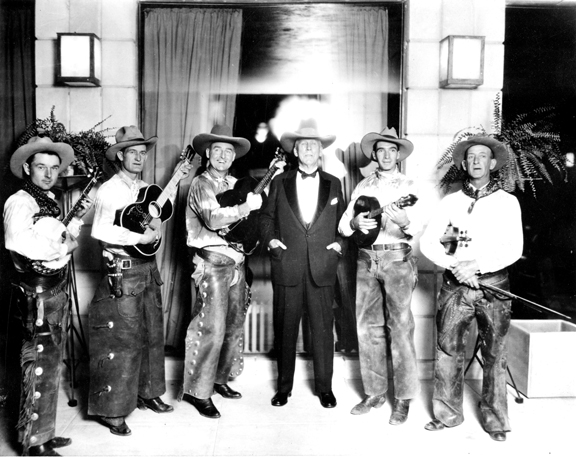
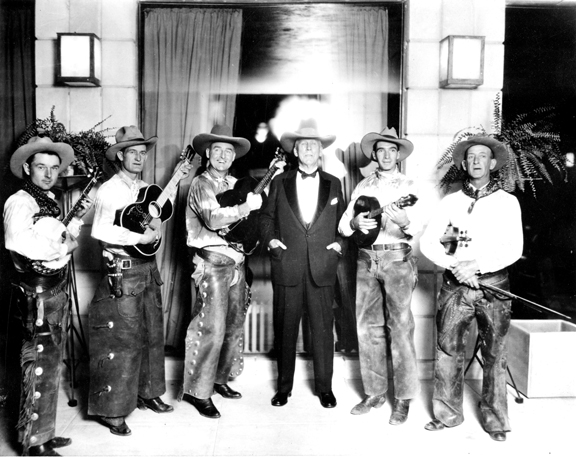
   Well, how about this. I posted this photo yesterday with the question who, when and where, and in a matter of minutes, a band mate and a history mate had the answers.


"The picture is of Romaine Lowdermilk and the Arizona Wranglers. Photo taken at Biltmore Hotel during winter of 1929-30. Left to right: Charles Hunter, J.E. Patterson, Lowdermilk, Edward V. Price (in tux), Laverne Costello, Charles English. The group sans Lowdermilk moved to L. A. and were very successful. Lowdermilk owned and operator of (possibly) the first dude ranch in Wickenburg the Kay El Bar. He wrote short stories and some excellent cowboy songs. Romaine Lowdermilk came to AZ in territorial days and cowboyed up on the Arizona Strip. Later he was the first statewide radio singing Cowboy."

—Greg Scott


"The photo of the cowboy band in your latest post is the Arizona Wranglers, perhaps best known for their recording of "The Strawberry Roan."
—Mark Lee Gardner


   This is such a joy to me. To know the right guys to get the answers like this. People compain bitterly about social media and Facebook, but this is one of the benefits. The almost instant response and answers to today's pressing questions.


   Speaking of which, I always seek out stories about others in media to see if I can glean advice, or, better yet, avoid pitfalls in the often snakepit profession I am in. It was in this vein that I read the obit for Grace Mirabella, the former publisher of Vogue and Mirabella. The New York Times obit of Grace—she died last week at age 92—was full of glowing accolades about how impactful her editing leadership was and how she changed the fashion industry. Then in the last part of the obit we get this: "Ms. Mirabella left the magazine in 1996 to lecture and write. Mirabella, which never turned a profit, folded in 2000." A former editor said she thought Mirabella "might have been missing a certain editorial levity and might have lacked some of the fun of glossy magazines." Then, the kicker: "It didn't feel like it had that joy."

   And, so, the joy I feel from Mark Lee Gardner and Greg Scott identifying that great photo, above, is the glue—and the fairy dust—that keeps True West alive and kicking.

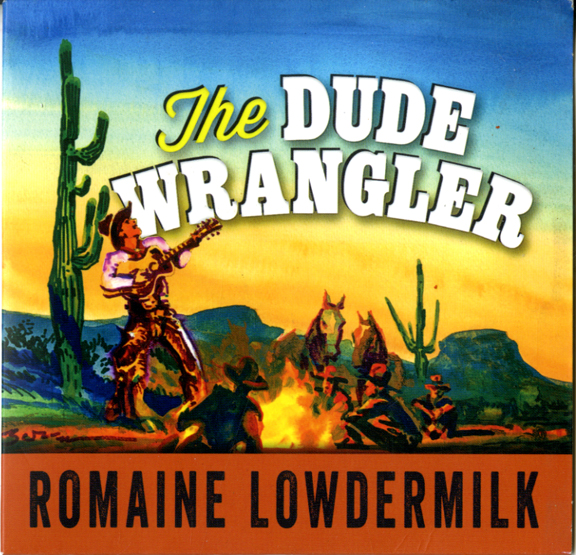
   One last piece of joyful irony. The legendary Valley Musicologist, Johnny D (John Dixon), had me illustrate a CD he produced of Romaine Loudermilk's best tunes and I believe I used the above photograph to paint him. 

BBB Has A Scattershot Memory 


"Work is only work, if you'd rather be someplace else."

—BBB


Friday, February 11, 2022

Band Mates And Check Mates

 February 11, 2022

   In my younger days, I was a drummer in several bands, mostly Rock, but also some Country and Western as it was styled in the Stone Age (as in the actual rock formation, not the rolling version). I always feel a special bond when I find out someone was a musician in a former life. I get even more of a fond-bond tug when I find out someone was a drummer, which, as you might know, is not considered a "musician" by most guitar players.

A Cowboy Orchestra
(which is practically a non sequitur)

This classic "Cowboy Orchestra" photograph, above, which I have been carrying around since the early 1970s. Looks like the 1920s or 30s and I think it was taken at a resort in Phoenix, perhaps the Westward Ho, or The Biltmore. I seem to remember that is where I found the photograph. Anybody know who these cats are?

I just recently found out that a certain Arkansas boy played in various bands back in the day. His name is William Robert Thorton. Like me, he was a drummer. When he gave up that dream and turned to acting, a friend of his suggested he modify his first two names to be a little more unique, and so he did, tweaking his name to "Billy Bob" Thorton.

And now, you know, the REST of the story.


"Most orchestras are basically 1800s cover bands."

—Old Rock Musican Check Mate Saying

Thursday, February 10, 2022

I Swear. You Swear. We All Swear. But This Is Where Cowboys Don't Swear

 February 10, 2022

   I think it's safe to say most of us are more profane than our parents, or, certainly earlier generations. I know I swear quite freely in conversation with friends, and at work—especially at work—and for some reason, when I am talking outloud to myself. When I am on my daily walks, I talk a blue streak, usually about some dumb thing I did, or said. Some times my dog Uno looks up at me, like, "Are you alright?"     

   Some might see this all as liberating and make the argument that today we are freer to express ourselves without judgement or the silly rules of polite society. I half-buy that, except for when I was with my kids, 6 and 9, on a Salt River Tubing bus and some teenagers in the front of the bus were loudly cussing up a storm with the centerpiece being the F-bomb in all its ridiculous permeations. The bus driver finally told them to "pipe down," but, of course, that made them even louder and more profane. At that point I didn't see it as liberating, just coarse and inapropriate.


   Which brings us back to the swearing in "1883." I have posted several takes on this cussing phenom down through history and in Westerns of late, and the response has been astounding, with over 180,000 views and over 700 comments. Let's see if I can distill down what I heard you say and what I believe to be true: The usage of the F-bomb in a Western is off putting because it sounds too modern and coarse for a cowboy to be using. Some linguists have postulated that the over-usage of the F-bomb as a verb, adjective and everything in between is a by-product of WWII when "The Greatest Generation" needed extra octane when it came to describing and surviving savage war conditions. If true, and I tend to buy it, then the usage of the word in a Western is not authentic to Old West times.

    Here's a good rule of thumb: if you hear a cowboy use the word Ma'am in a sentence, he will not say swear words of any kind in front of women and children. He just won't. It is not condoned in his culture, past and present. And, it is not coddled and it will not be tolerated even by the roughest of the breed. Especially by the roughest. Yes, he will swear on the range with other men, perhaps even using the F-bomb, but if a woman shows up, he will clip his lip, pronto. This is true today, and, by all accounts, it was even more true back in 1883.


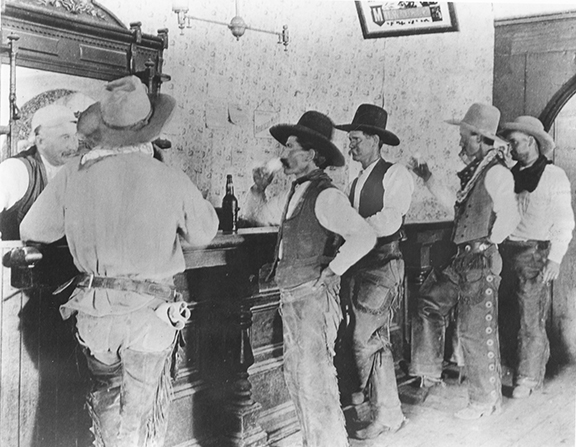
Tascosa Cowboys Belly Up to The Bar

   Cowboys lined up at the bar in Tascosa, Texas. You can be sure the language was salty, but you will notice there are no women present. This was the rule back in those days. Saloons were almost without exception, male exclusive. Some progressive bars, like in Tombstone, had club rooms for women with a separate entrance. But if a woman did come in the saloon, a cowboy would often yell out, "Church!" which was a signal to clean up the language. Also, note, they are wearing their hats indoors, proving the old adage, the past is a foreign country. They do things differently there.


Watch Your Language Here

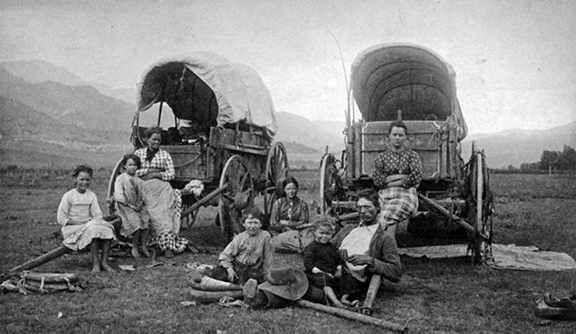
   A good photograph of a wagon train family, resting after a hard day on the trail. A cowboy would never swear in front of these people. It was not condoned and if some crude person did, other cowboys would shut him up. That was the rule. Period. To the show's credit, Taylor Sheridan had a scene where the camp cook got too salty and used the F-bomb and he was redressed by an irate mother (Faith Hill). Now THAT was damn sure accurate!


"If you must curse, please use your own name."

—God

Wednesday, February 09, 2022

Into The Storm 1883 Style

 February 9, 2022

   Okay, enough ragging on the history behind the new hit show "1883." Let's take a look at something epic and worth talking about.

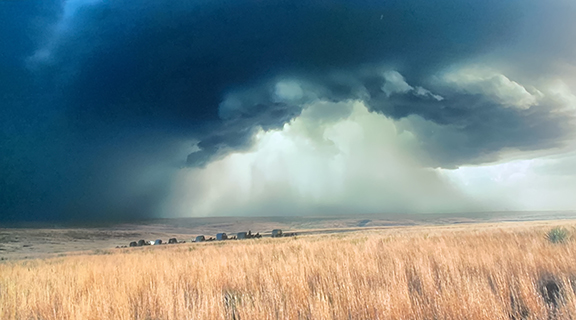
Into The Storm
from the seventh installment of "1883"
  

 A spectacular mash up of what appears to be actual footage of a super cell storm that turns into a tornado. I assume this is a matt mashup with CGI, but dang, it is excellent. Anybody know how they did this?

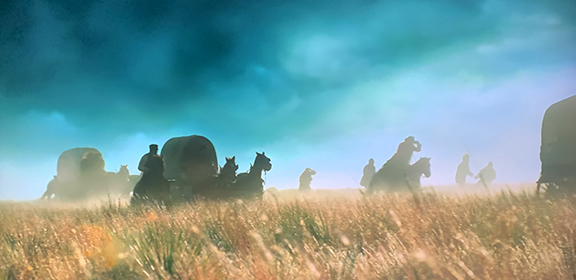
Wagons Overtaken by Storm


   After the storm we get a shoot out with cattle thieves and then this.


Charlie Goodnight with the 1883 Crew


   And yes, that is who you think it is. Let's take a closer look.


The Founder of The Feast

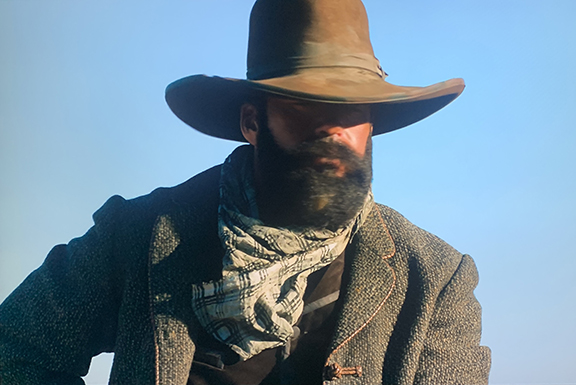
   Yes, that's Taylor Sheridan as Charlie Goodnight coming in to help clean up the dead Commancheros. And wearing a pretty cool hat, to boot, I might add.


"She made out with a Comanche during a tornado?"

—Alan Rockman

Tuesday, February 08, 2022

1883 Hats Way Off

 February 8, 2022

   As I mentioned yesterday, we love "1883" in our house. Kathy, especially, is in love with Elsa and the emotional resonance of the story. I can't remember the last Western we watched and enjoyed so much together. All that said, I raved about Elsa's wonderful hat, but there are some clunkers in the show. Case in point:

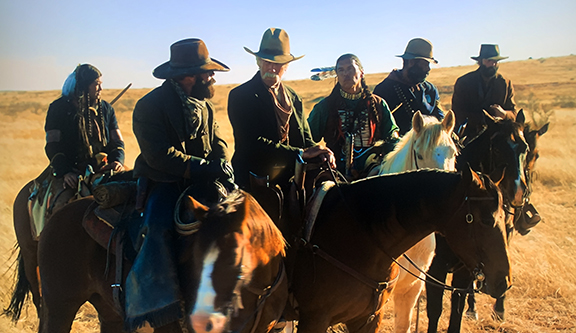
Episode 6: Commancheros Scope Out Prey

   This scene of Commancheros preying on the wagon train is pretty weak. Half those hats look like they grabbed some bull riders from a PRCA event in Lubbock and put them in the shot. Way too modern for a period piece, especially the hat on the far right. Plus, to my eye, they all appear to be anglos and the beauty of the historic, actual Commancheros, is that they were mixed-race gangs. As Josiah Gregg put it, "These parties of Comancheros are usually composed of the indigent and rude classes of the frontier villages, who collect together several times a year, and launch upon the plains with a few trinkets and trumperies of all kinds, and perhaps a bag of bread or pinole." Most were from New Mexico, and they were a motley crew, consisting of Hispanics and ne'er-do-wells of mixed ethnicity which included Navajos, Comanche, Apache and Kiowa, along with a few renegade anglos. 

   Now THAT could have been such a cool scene. And here's how they should have looked.

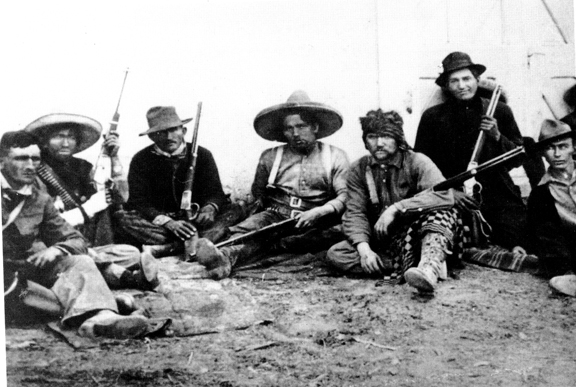
Mercenaries In Mexico during the Revolution.


   This is how you spread out the headgear and mix up the gear, making it more hodgpodge, random, not uniform. And this is how I would have staged the fight.

A Ridgeline Defense during the Mexican Revolution

    Look at that kid, second from left, hanging tough with his father and uncles! Yes, I know, I am asuming the lad is with kin, but dang, that is a mere boy on the front lines. May be posed, but those three on the left seem mighty serious to me. Anyway, this is how I would have staged the Commanchero scene in 1883. More Mexican and less Texas Ranch Rodeo.

"The Oscar is in the details."
—Old Hollywood Saying

Monday, February 07, 2022

A Big, Fat, Thank You to 1883

 February 7, 2022

   Kathy and I watched the seventh episode of "1883" last night and I was tickled to see a scene where the F-bomb was put into cultural context. It was almost as if Taylor Sheridan had read the 700+ comments on this blog post about the authenticity of swearing in the hit TV show. One of the main points made by many of you is that cowboys didn't use the F-bomb in front of kids or women. The scene, last night, between the new camp cook and Sam Elliott's character dove right into that and, to my ear, was a refreshing take on it and right on the money.

"Watch your language."

   Thank you.


Boy Howdy

   In the next issue of True West magazine we are doing a deep dive into virtually all the historic aspects behind the hit show. The trails they reference, the stopping points (Doan's Store) and the adversaries they encounter.

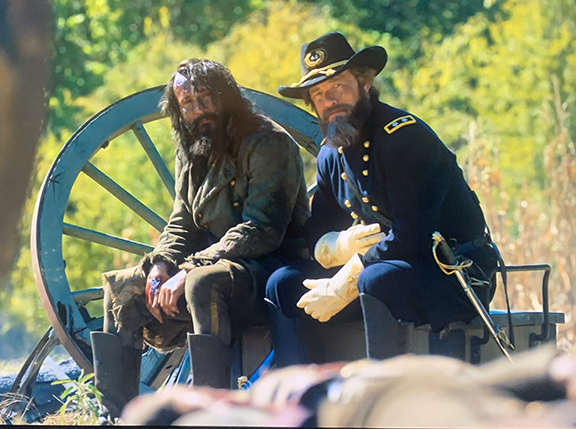
   Here's a sneak peek at one of the aspects we thoroughly enjoy and appreciate. Remember the flashback (episode two) to the Battle of Antietem and a Confederate officer staggers to his feet and wanders among the dead bodies (many posed faithfully from Mathew Brady photographs). Then we see Union General Meade (Tom Hanks) sit down next to the Confederate officer (Tim McGraw) and they commiserate.

Opposites attract

   Of course, this actually happened in the Civil War and there is a famous photo of Union officer George Custer sitting with a captured Confederate officer who was his classmate at West Point. We'll run both photos for your edification.


Thank you.


Hats Off to 1883

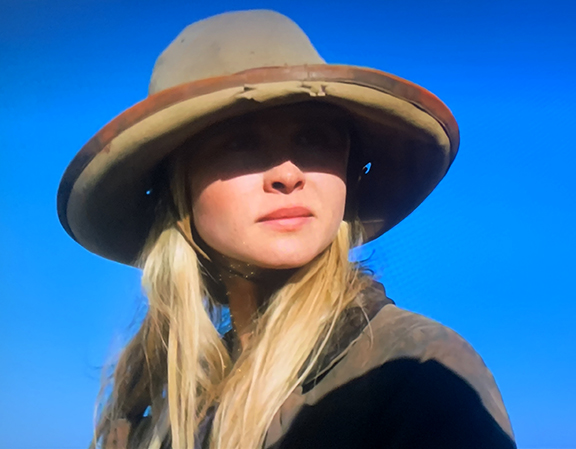
   But, I have to say, my biggest joy in the whole damn shebang, is the cowboy hat Elsa ends up wearing to wonderful effect.

Elsa Stylin' it

   And, unlike many movie cowboy hats, hers gets some serious wear and tear as the episodes mount up. I also loved her confession when she said she realized she is a "cowboy." Not a cowgirl. A cowboy, without apologies or gender specific politics.


Thank you.


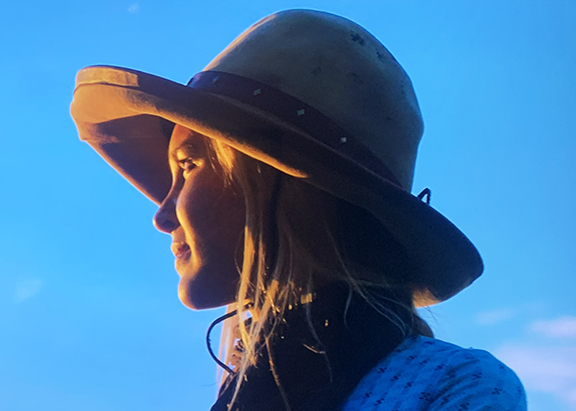
   I dig Elsa's hat so much, let's see another shot of her in that big, windswept chapeau.

Elsa Rocks The Cowboy World


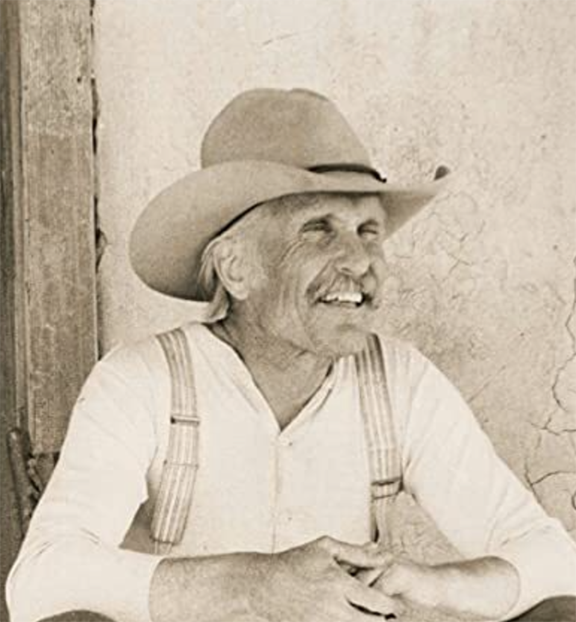
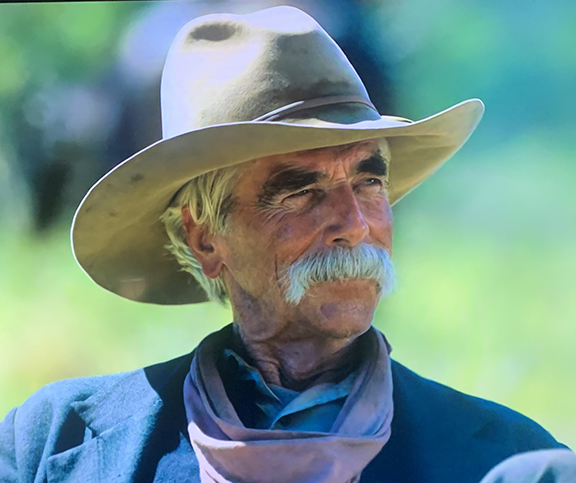
A Big Lid homage to the same hat


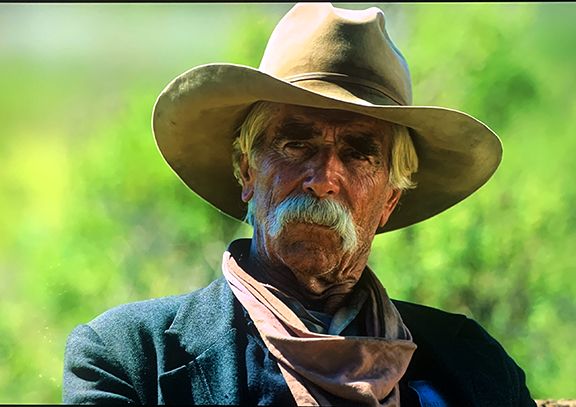
Robert Duvall, on top, in "Lonesome Dove" and Sam Elliott in "1883." Both are sporting the same crease and brim style, which, when I was growing up, was called the "Tom Mix Dip," but today it has become known as the "Gus" in honor of Duvall's character Gus McCrae. The hat style is actually from the 1920s but it's so ingrained in the popular culture now that it is deemed authentic.

In The Land of The Nitpickers 

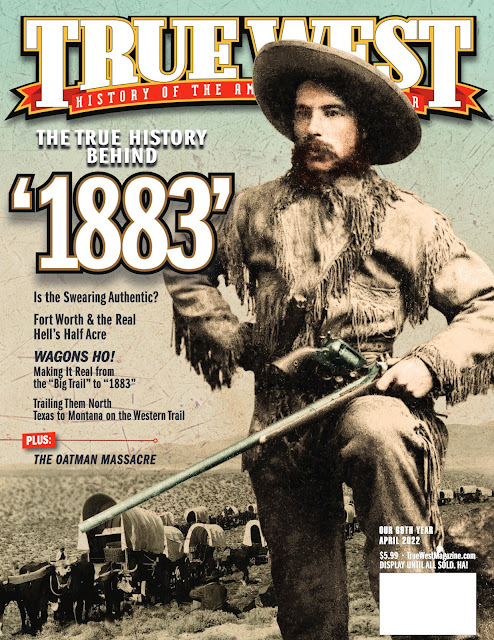
  Like I said, we love "1883." It is a breath of fresh air. But, that's not to say we don't find fault with the history. Our intrepid editor, who shall remain nameless (you could look him up in the masthead) maintains that the show should be called "1843" because that seems to be the conditions Taylor Sheridan wants to portray in his prequel to "Yellowstone." But that doesn't fit the Dutton family tree. And, by that, ahem, Stuart Rosebrook means the perils of the immigrant trail were pretty much played out by 1883 and the In-dins all on their respective reservations (we will have an authentic 1883 map to illustrate). Abilene had ceased being a cattletown several years prior to the events portrayed, and, well, we could go on and on, because we are, in fact, Nitpickers with a capital N. In this issue we lovingly give you a detailed insight into the state of the West in 1883 and follow up on some of the characters portrayed, or, who they seem to have been modeled on. It's going to be a fun one. Here's the cover.


More Dopplegangers Inside


"Founding Fathers strapped down in graves to prevent further spinning."
—Top Secret Writer Who Shall Remain Nameless

Saturday, February 05, 2022

My Fellow Redundant Americans

 February 5, 2022

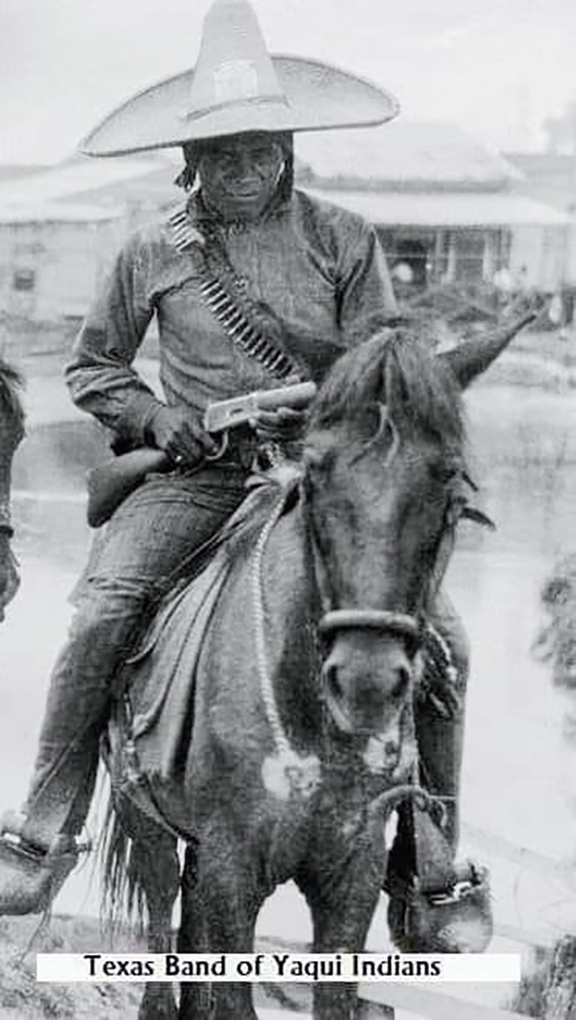
      Here's a good question. How come none of the bad guys, or good guys, in a Western, ever look like this? And why don't we see horses like this?

Yaqui In The Saddle Again

   It's dang authentic and yet, it's always ignored, or rarely used. Not sure why when it's so obvious and cool. Actually, I do know why. When movie companies get horses or costuming they go to one person. In the case of the horses it's invariably some ranch guy who has a bunch of modern quarter horses and so everybody ends up riding the same kind of modern looking horse. The only time in memory when this was not the case was in "Lonesome Dove" when Tommy Lee Jones brought one of his favorite polo ponies and rode "The Hell Bitch" to great effect. Jones' polo pony was small and feisty (like the Yaqui hoss above), the opposite of what Robert Duvall and the rest of the actors rode. The disparity gave the show it's wonderful diversity, at least as it relates to horses.


Blast From The Past!

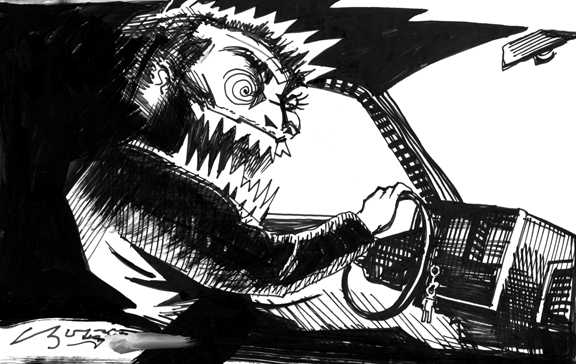
Arizona Driving Courtesy Tip #57: when the temperature hits triple digits, people driving with their windows down get the right-of-way. For whatever reason they do not have air conditioning. For your own safety, DO NOT CUT THEM OFF in traffic.

Daily Flashback Whip Out:
"Windows Down, Stay Clear"


My Fellow Redundant Americans
   There are several place names in Arizona that are doubly ridiculous. I speak of Picacho Peak and Table Mesa. In Spanish picacho means peak and mesa means table. So, I think we get the message. Once is apparently, not enough.

Tucson Peak, 1930s
(renamed by my crazy American compadres
as Picacho Peak, or literally, Peak Peak)


   Still tweaking my take on the accuracy of the swearing in "1883." I may add this little bon mot.

"When the French swear, do they say, 'Pardon my English'?" 

(P.S. bon mot is French and means literally "good word.")

Friday, February 04, 2022

The Two Keys to Good Storytelling

 February 4, 2022

   Turns out, there are two basic keys to great storytelling.

1.) Withhold key information until the end.


Name that ridge.

   Here is a good example:


Seer Samuel
   I don't know if you believe in ESP, but let's say you do. Let's say you believe that thought waves travel through air like radio waves. . .or that dreams can predict the future.
   Every modern-day psychic and seer seems to remember the first awareness of that gift.
   Edgar Cayce was a child when he began to absorb knowledge from books. . .without opening them.
   Peter Jurkos' only talent was painting houses. . .until he fell off a ladder. After days of unconsciousness, he awakened to his remarkable abilities. Today his psychic services are rendered to police departments throughout the nation. . .to aid them in the apprehension of criminals.
   But this is the story of Samuel. . .a prophet's name if ever there was one. He was born under a comet. . .died under one, too. Some mystics might say that's important.
   And, if yu're amazed by his first brush with ESP, just wait ill you hear the rest of the story.
   See, Samual was not born in Tibet, but in Florida.
   His young life, though exciting to him, was not extraordinary. . .until one night. The night he had a dream.
   Samual's brother Henry had shipped out on the Pennsylvania. One day, the ship's captain swore at brother Henry and struck him. As is the inclination of older brothers, Samuel went on board after hearing of the incident and decked Henry's assailant.
   Yes, Samual was quite protective, quite fond of his brother Henry. So much so that his hatred for the Pennsylvania's captain survived that impulsive retaliation.
   Perhaps his mind was there. . .that night at his sister's house. . .the night he had a dream.
   No sooner had Samel fallen into slumber than a picture welled up before his closed eyes. . .a dreadful picture.
   It was a corpse in a coffin. . .a metallic coffin, supported by two chairs.
   Half wanting to know, half not wanting to know, Samuel, in his dream, slowly approached the coffin.
   At his bedside one might have heard Samuel cry out as he turned away, still dreaming from the sight.
   For the corpse. . .in that coffin of steel. . .was Henry, his brother. And, on Henry's heart. . .a red rose.
   Samuel awakened with a start, sat upright in bed. Tears kissed the darkness as he fumbled for the light, got up, and went to awaken his sister.
   He told her everything. About the coffin of metal. About the two chairs. About the red rose. And about. . .Henry.
   It was a bad dream, his sister assured him. And they would both forget about it. . .until one sultry mid-June morning. . .
   The Pennsylvania was docked, was loading wood. . .when four of her eight boilers exploded.
   The Pennsylvania.
   Henry's ship.
   Her front end was blown away, and in a disaster comparable to a jet-plane crash today, a hundred and fifty lives were lost.
   Brother Henry was among the less fortunate who lingered and, scalded beyond recovery, suffered terribly for six days.
   Each of those days and nights, Samuel sat beside him. When it was over, for the first time in almost a week, he slept.
   The next day, Samuel went to the room where the bodies of the dead awaited burial. Each in a coffin of unpainted wood.
   Except one.
   Those who held the deathwatch with Samuel had so admired the gentle, gallant young Henry, who had suffered so. . .that they had collected sixty dollars and bought for him a metallic casket. it sat supported by two chairs.
   As Samuel stood beside his brother, seeing that awful dream materialize in every detail but one. . .an elderly lady entered the room and placed on the breast of the dead brother. . .one red rose.
   Now, whether Samuel was really a seer, I'll leave that up to you.
   But if dreams of the future continued to come true, that side of his life has been obscurred by a perhaps greater gift.
   For seer Samuel, born under a comet, was born in Florida. . .Florida, Missouri.
   The steamship Pennsylvania. . .was a riverboat.
   And the lad who had the bad dream come true, Samuel Clemens you know. . .as Mark Twain.

   Huh? Now THAT's how you withhold information and make it compelling. Notice how he gives several false clues: he makes the point that Samuel was not born in Tibet but Florida. At the end of the strory he owns it and says it was Florida, Missouri. A clever little subterfuge to hide the fact that if he said Samuel was born in Florida, Missouri, up front, fans of Mark Twain, like myself would have figured it out, but by creating a "red herring" he throws us off the trail and by extension, hanging on his every word. I don't know how someone gets this smart. I can only marvel at the genius of it.

2.) The second tenet of good storytelling is to know when to pause for effect, and few have ever been as brilliant about withholding information and pausing for effect than the one—the only—Paul Harvey.
   And now. . .you know the rest of the story.

   You're welcome.

"History doesn't repeat itself, but it does rhyme."
—Mark Twain
Thursday, February 03, 2022

I Need More Stinking Badges!

 February 3, 2022

   We have to relax a little bit and get some perspective. This means you AND me. None of us are getting out of here alive.

   For example, I still need me some more badges. Literally.

Daily Scratchboard Whip Out: 'Badges?!"

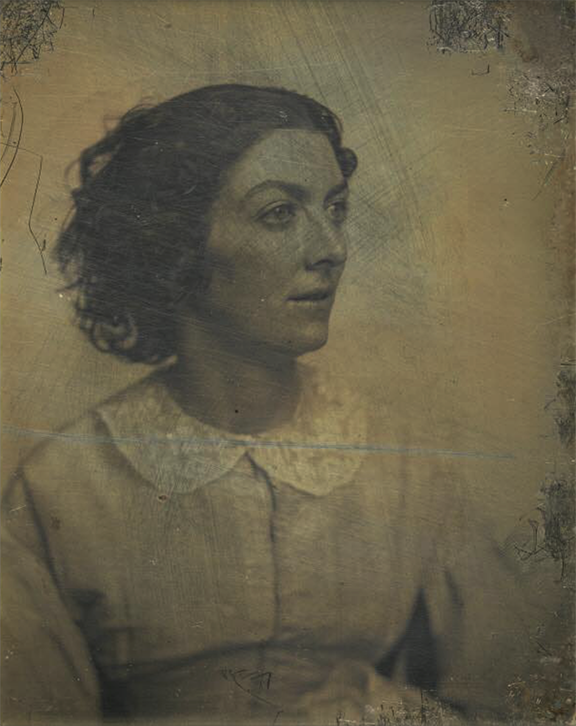
   Working with Jana Bommersbach on our women's book. This young lady will be featured.   

Lola Montez

   Isn't that a great photo. She seems so contemorary. She won't be the only one.


“A lot of you white people probably thought Indians never had a sense of humor. We never thought you were too funny either.”

—Charlie Hill

Tuesday, February 01, 2022

Badges?

 February 1, 2022

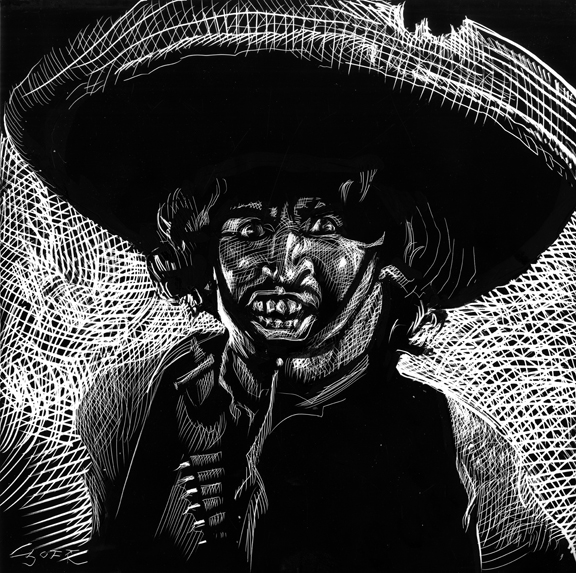
   Thanks to my son, I have returned to "The Underdogs" by Mariano Azuela, which is a brutal, eloquent, disenchanted, first-hand-take on the Mexican Revolution. Azuela was a country doctor who became a medical officer and served under Carranza and Pancho Villa, and he began his novel while still in the service (1915). So the scenes and exchanges he writes about have an intimate, he-was-there authenticity. Here is just a taste. Officers and soldiers—one of them named Towhead Margarito— are in a cantina when the confessions begin:

   "I killed a woman in Torreon 'cause she didn't want to sell me a plate of enchiladas. There was a big ol' argument about 'em. I didn't get to eat what I wanted, but at least I calmed down.
   "'I killed a shopkeeper in Parral 'cause he slipped two bills from Huerta in with the change,' said another man with a small star, his blackened, calloused fingers glittering with jewels.

   "I killed a guy in Chihuahua 'cause I always ran into 'im at the same table at the same time whenever I'd go in to eat lunch. . .He really annoyed me! What do ya want?"

   "H'm! I killed. . ."

   "The theme is inexhaustible."

—Mariano Azuela, "The Underdogs" which in Spanish, Los de Abajo  means "those from below" and that gives it a double meaning.

Daily Whip Out: "Towhead Margarito"


  And, speaking of great stories about Mexico:


   One of the most well-known lines from a classic Western film is widely misquoted. In popular culture the famous line becomes, "Badges? We don't need no stinking badges!"


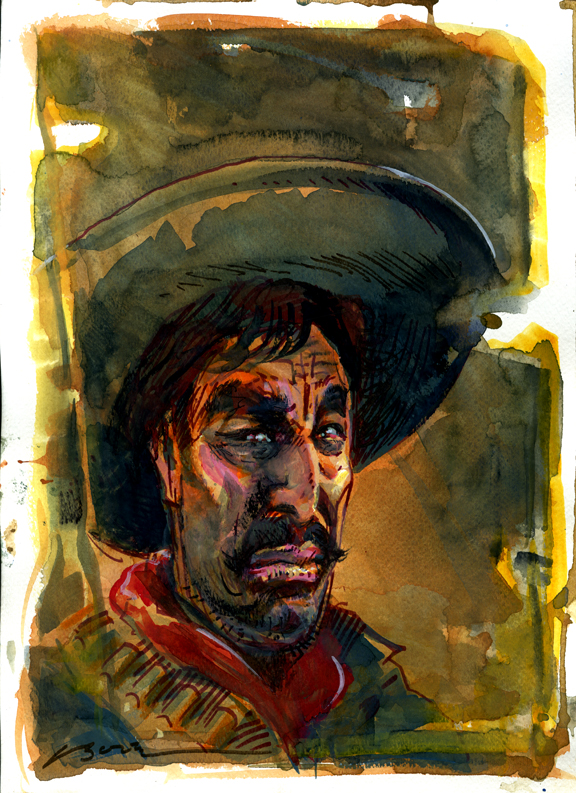
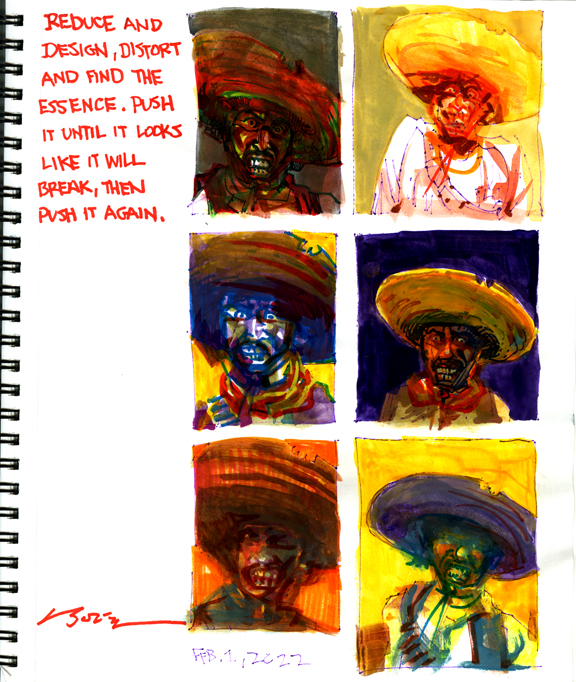
Daily Whip Outs: "Badges! (Pushed)"

   Actually, in the 1948 classic "The Treasure of the Sierria Madre", the Mexican bandit leader (Alfonso Bedoya) tries to convince Fred C. Dobbs (Humphrey Bogart) that he and his men are Federales. Dobbs asks, "If you're the police, where are your badges?" And the bandit replies, "Badges? We ain't got no badges. We don't need no badges! I don't have to show you any stinkin' badges!"

Daily Whip Out: "Badges?"


  In the 1927 novel of the same name (on which the movie is based), the bandit says, "Badges, to god-damned hell with badges. In fact, we don't need badges. I don't have to show you any stinking badges, you god-damned cabron and chinga tu madre!

Daily Whip Out: "Tres Dusteros"
(reworked)

"Buenos dias, Cabron."
—Old Vaquero Saying

Monday, January 31, 2022

Why The F-Bomb In Westerns Sounds So Odd

January 31, 2022

   We're working on a big feature on "1883" for the April issue of True West magazine. Recent posts about the authenticity of swearing in the hit show really went viral (180,000 views, 650 comments!) and it got me to mulling about doing a sidebar like this to help explain how we got here.


A Short History of Swearing On Film
   Quite a few people today still believe swearing in movies started with "Frankly, my dear, I don't give a damn," from "Gone With The Wind" in 1939, but that is a popular misconception. Yes, it was scandalous and a big deal, but, as it turns out, actors had been swearing in films since the beginning of the artform. For example, there is compelling evidence that deaf people complained about swearing in silent movies way back in the teens. Actors were swearing for emphasis and relying on the fact that no one could actually hear them (but deaf people could read their lips!). 
Read My Lips You Son of A Bitch!

   When sound came along a decade, or so, later, swear words came along with "damn" being uttered on film in 1929, "son of a bitch" in 1933 and the "F-bomb" in 1933. Subsequent watchdog groups squelched these early swearers until the above mentioned "Gone With The Wind," scandal and that held sway until the volatile sixties when the F-bomb reappeared in M*A*S*H (1970) and then—perhaps—peaking in "The Wolf of Wall Street" (2013), with 506, or 569, F-bombs depending on who is counting. So, the incidents of swearing on film are not new. Of course, prolific swearing in a Western is pegged to "Deadwood" (2004) where David Milch used swearing to connote lawlessness in an outlaw town. By the time we get to "Yellowstone" and "1883" the F-bomb has lost some of its power due to overuse. However, to longtime lovers of Westerns, it still sounds slightly jarring, like hearing your grandmother go toe to toe with a drug dealer. It could happen, it just doesn't quite ring true to our ears. But that probably says more about our history with popular culture rather than with the true history of cursing on film.

"The world may be a stage but the play is badly cast."
—Old Vaquero Saying

Sunday, January 30, 2022

Are Frank McCarthy's Paintings Detail Porn?

 January 30, 2022

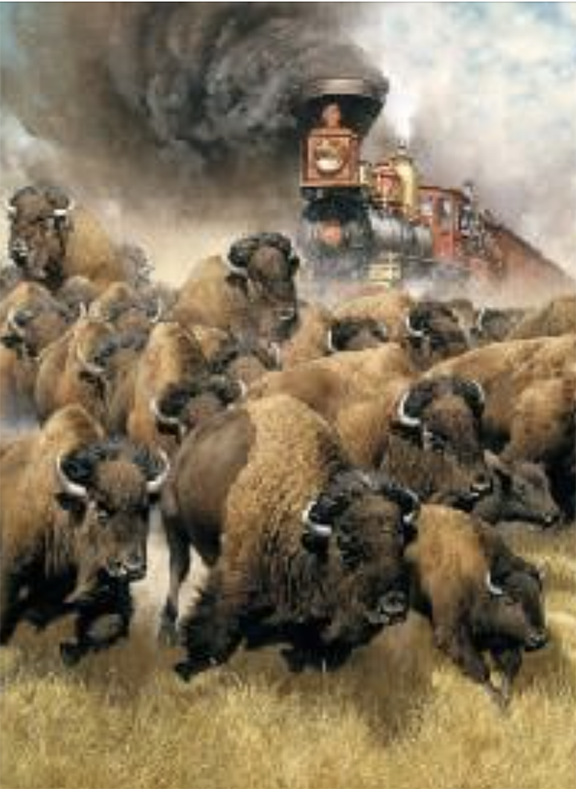
   It all started with two semi-unrelated events. I was looking for possible future True West covers and came across this painting:

Frank McCarthy's "Coming of The Iron Horse"

(cropped to show the proportions

of a possible TW cover)


   Someone commented that it was a masterpiece and then someone else commented that McCarthy was merely an illustrator and not a fine art painter and then my brother in Art—Kid Ross—weighed in with this:

   "When I was a junior in college I bought a book of Frank McCarthy's paintings.  One of my art teachers scoffed at it.  I didn't know why; now I do.

   "You can see this in much of the contemporary western art scene: these guys get together and dress up to look like a mountain man or an Indian etc.  They take photos of each other and then merely reproduce the photograph....and you can both see and FEEL just how "dead" these paintings are.  (Especially when they give them names!)

   "Look at Remington's paintings and how his brush work merely "suggest" things.....compared to Remington's brush work, Frank McCarthy's is detail pornography in that it shows you everything leaving nothing left to the viewer's imagination.

   "I still have that book of McCarthy's paintings and I keep it as a reminder that it is in the obscure that we find the meaning; the obvious is merely the obvious.

   "As your doctor I suggest that you go back and ingest more acid and listen to Jimi Hendrix at a very high volume.

   "McCarthy was an illustrator, Remington was an artist, I am a drunk. So when these artists paint photo-realism I have no problem with that.....unless it is being judged as great art BECAUSE of it's realism."

   "Respectfully yours!"

—The Kid Ross (as Huey Lewis always called me)


Meeting of the Obnoxious Hat Nitpickers,
December 19, 2015. 

Left to right: Rusty York, Thom "Kid" Ross and Paul Andrew Hutton (showing off his Apache Wars book which was hot off the press and not even out yet)

"All paths lead to Pete Maxwell's darkened bedroom at midnight and when you get there, the Kid is gone, and the house is gone; only the river remains."
—Kid Ross

Saturday, January 29, 2022

Out On The Mickey Free Front

 January 29, 2022

   Got together with one of my cartoonist compadres, Jerry Scott, yesterday. The former Lake Havasu High School grad writes both the nationally syndicated strips, "Baby Blues" and "Zits," and draws, along with two other artists, the cartoons as well.  Jerry and his wife Kim (who also went to Lake Havasu High School), were in town and came out to Cave Creek to see their old home. We solved some life and drank some fine tequila (1800 Reposada) to make our conclusions more eloquent. 

   Meanhile on the Mickey Free front:

Daily Whip Out:

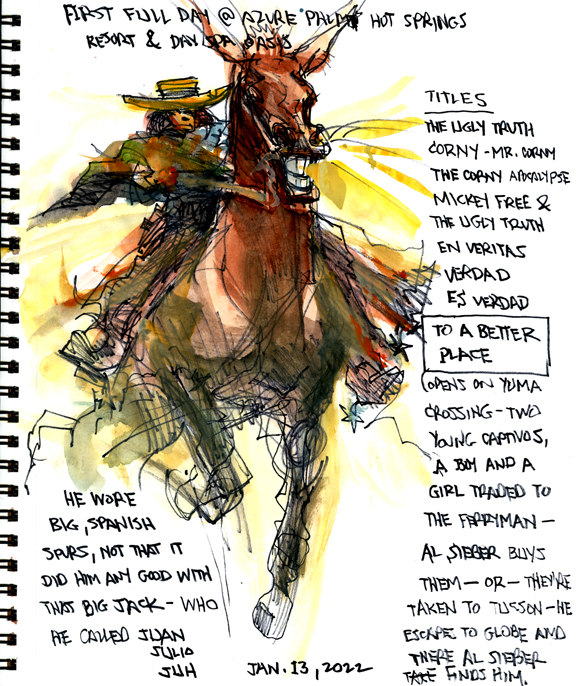
"Somewhere In Sonora A Smirking Captivo On A Grinning Jack Rides Out of A Very Tall Dust Devil"


   Yes, sometimes short and punchy titles give way to long, tedious and descriptive ones, but, eventually we get back to the concise-clipped bits.


Daily Whip Out: "Mick In Flames"


   And, then there is the oddly, but historically correct named.


Daily Whip Out:

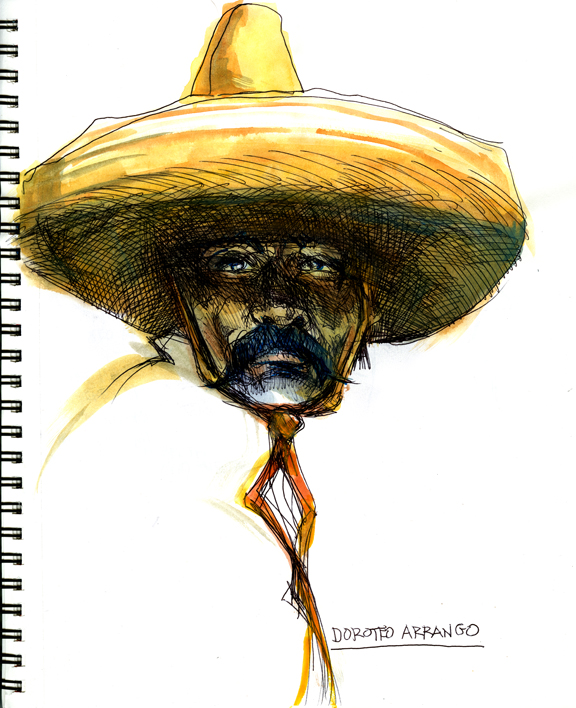
"The Penetrating Stare of Doroteo Arrango"


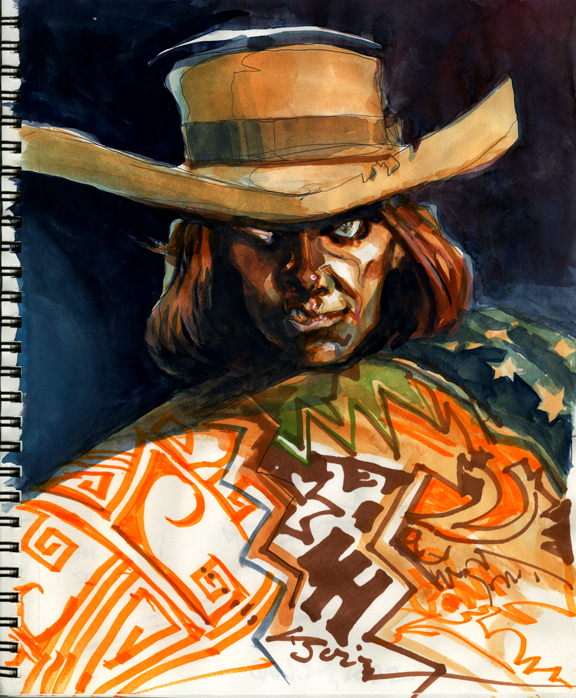
   Meanwhile, our main boy was a little bit of everything and his pancho reflected his mongrel pedigree.


Daily Whip Out:

"Mickey Free's Mishmash Pancho"

   And, he rode that big, bad jack, who was himself a mongrel of sorts and the funny thing is, nobody wanted anything to do with either one of them. They were both cross-eyed mutts who nobody wanted to claim.

Daily Whip Out: "Big Mutts In Cowtown"


"One has fear in front of a goat, in back of a mule, and on every side of a fool!"
—E W Howe

Friday, January 28, 2022

Led Zep Anyone?

 January 28, 2022

Led Zeppelin anyone?

"Wayyyyyyyyy down inside. . .
woman (woman, woman, woman. . .")

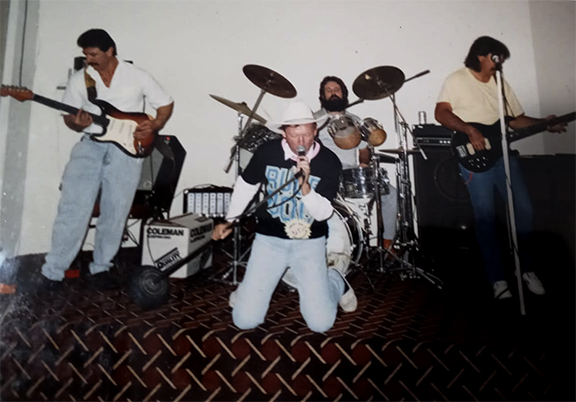
Some distant gig, probably in Kingman. The song is "Whole Lotta Love" which I enjoyed doing by applying my best Gabby Hayes meets Robert Plant voice to full effect. I have a hunch if I'm ever up for the host of "Jeopardy," this photo will be used to disqualify me.


"In the days of my youth I was told what it's like to be a man. . ."

—Led Zep, "Good Times-Bad Times"

Thursday, January 27, 2022

Crazy Arms And Dirty Mouths

 January 27, 2022

  Saguaros that grow in the Cave Creek riverbottom often have twisted arms because they bend in a tortured manner from frost and freezing conditions (there is more moisture in the air held in by the canyon walls). When we first moved out here, in 1987, I went out one day and sat underneath this giant near our house, in the creek bottom, and drew it from the ground, underneath, looking up at the sky.

Daily Pen & Ink Whip Out: "Crazy Arms"


Unfortunately, this massive contortion-gymnastic flowering-sky dweller did not survive and fell some time before the millenium.


The Current Dirty Mouth Problem

  With the rise of the new Taylor Sheridan hit show "1883" once again the question is raised: did the citizens of the Old West really swear like they do on the show? If you are skeptical about all this potty mouth stuff, here is someone who agrees with you.

Youthful Depravity

"The fact must come home to every observer that Deadwood's rising generation is very depraved. Go where we will our ears are greeted with profanity and obscenity from almost baby lips, while our visionn is assailed by sights of the most lamentable character. These urchins are not all of that peculiar class known as 'hoodlums' for whom ignorance is some excuse, as many of them receive the kindest and best instruction at home, but from too lenient parents who allow their children to wander through the city, visiting haunts of iniquity where are exerted those pernicious influences which sooner or later deaen the most acute sensibility, destroy all sense of righ and morality and inspire to an emulation of the worst characters of the town."

—The Black Hills Daily Pioneer

January 26, 1881

So, exactly ten months before the gunfight at the O.K. Corral, people were already complaining about all the swearing in Deadwood, South Dakota, of all places. More than a century later, the home to the HBO hit show of the same name, where swearing was unleashed at an even greater volume than in "1883" or "Yellowstone," put together.

Two things are clear. When people say the swearing in a Western is not authentic, they are actually reflecting to the mid-Twentieth Century morays in poplular culture. The court records from the nineteenth century are replete with plenty of swearing, and it's brutal and all inclusive. And, two, the style of swearing evolves with certain words gaining in prominence (the F-bomb allegedly became ominpresent during WWII). So, a case could be made for the citizens who lived through the actual year of 1883 might not have uttered the F-bomb with such frequency, but—and this is critical—most men in polite society did not swear in front of women or children. Out on the frontier, women like Sarah Bowman aka "The Great Western," swore like sailors with the men. So, the most inauthentic part of "1883" is when Sam Elliott uses the F-bomb in front of the women. That is just, well, flippin' awful.

Daily Whip Out: "Mickey On The Jump"

"I think that if a man has the urge to be an artist, it is because he needs to find himself."

—Georges Simenon