Saturday, September 19, 2015

Pronouncing van gogh

September 19, 2015
   Well, the Brits say van Goff and the Dutch say, something like van Ghk-ough-chk. Has three syllables with a gutter stick at the beginning and end. Don't think I'll live long enough to pronounce it the way they do. And by the way, they pronounce it different in the south of Holland, wouldn't you know?

   Here we are living it up on Gay Street in Brussells:


Gay Sreet with a giant gay cartoon on the wall of a building in Brussells.

 I always try to be alert to how Americans are perceived in the old world. Here is an example of a huge, multinational American corporation buying a giant sign and squatting it on top of an old classic style building in Brussells. It you look up ugly American I think you will find this image there to illustrate it.


The Coke Building in Brussells

   There was a terrorist incident on the trains yesterday. We were en-route from Einhoven to Brussells. A SWAT team took down a kid in a bathroom on the train in Rotterdam, which delayed all the trains in the area. We were affected.

We have been somewhat nervous about riding the trains from Einhoven to Brussells on Friday and on to Paris today. We did encounter delays and a few anxious moments when everyone around us on the train looked suspicious but after a bomb scare in Antwerp, we arrived safely in Paris today. Everyone could not have been nicer, especially this sweetie from Dordrecht:


A Dordrecht Commuter Who Made Us Laugh And Calmed Us Down.


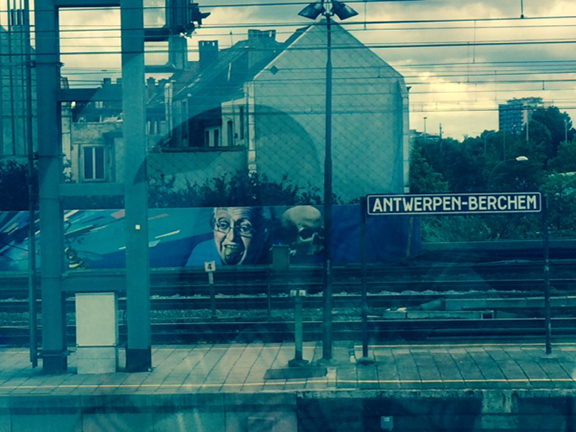
Antwerp After The Incident

Our tour guide in Brussells said there were 100,000 refugees in Belgium alone. However many there are, they are in the northern part of the city. We decided not to go gawk, so no, we haven't seen any walking the streets. They are in tents. They can sleep in a big building at night, but must leave at 8 a.m., so it's easier to just stay in the tents, moving all the children and such. She said she wants the U.S. to help more. An American traveling with us said he was sorry, but "we need to kill them over here, so they don't come to our soil." And then we split a beer. 

"I am quite sure I have no race prejudices, and I think I
have no color prejudices, nor caste prejudices, nor creed
prejudices. Indeed, I know it. I can stand any society.
All I care to know is that a man is a human being -- that
is enough for me; he can't be any worse."
—Samuel Langhorne Clemens

Thursday, September 17, 2015

Small Town Boy Makes Good

September 17, 2015
   Imagine, if you can, a small town kid from Kingman, Arizona who overcomes the stigma of being an outsider from a hick town, who overcomes the prejudice of being perceived as a clown and a joke, and through several flukes of major proportions, is able to travel to Nuenen, in the deep south of the Netherlands, to the hometown of another small town boy who he greatly admires. Part of the quest is to see how one small town boy is perceived by his hometown.


Small Town Boy Billboard #1


Small Town Billboard #2


Small Town Boy Billboard #3

   Imagine this small town boy, disliked by so many, returning home 130 years later to see what the locals have made of him.


Small Town Boy Cafeteria

   He failed at almost everything he tried. He was ridiculed for starting painting too late in the game and  he sold only one painting for 400 francs during his brief lifetime. Today his visage is on every conceivable surface in his hometown.


Small Town Boy Outside A Restaurant in the square at Nuenan.


Even the local real estate signs utilize the home town favorite


Hometown Boy Can Sell Anything

   One of the houses he lived in has a plaque beside the front door.


Even the local museum uses a pun based on his name (Vincent Center, Vincent-er—Get it?).


Small Town Boy in the park. How many statues are there in the U.S.
 of a guy walking along with a drawing pad in his hand?

   All of this is extra ironic, since he felt like a stranger in his own hometown. "I do not like to be in company," is how he put it.

"Of one thing I am sure, you are no artist."
—H.G. Tersteeg (an art expert), to Vincent van Gogh in what turned out to be one of the dumbest statements in the history of the world


Tuesday, September 15, 2015

The Laugher, the Canals And The Girl With the Hashtag Tattoo

September 14, 2015
   Looking for the girl with the Hashtag tattoo, who has the answers to all my questions about the man with only one ear. She appeared to me in a dream.


The Map Savvy bartender at De Saloon in Amersterdam

I despise locals who don't know where they are on a map, or even know the streets or roads about them. Not so with this savvy lassy in Amsterdam. Not only did she pinpoint where we were in the very complicated canal infested girded environs of Amsterdam but she also pointed me in the direction of Ann Frank's house.

   Portraying someone laughing, or even smiling, is very rare in early paintings. Here is a noteworthy exception, painted by Hendrick Ter Bragghen in 1628. Part of a dyptic, "Demacritus And Heraclitus", this laugher seems to be saying, "whether you laugh or cry, the world remains incurably foolish." Or, so says, the Rijksmuseum caption next to the painting. A modern interpretation might be, "He who smelt it, dealt it."


The Laugher

The canals go on forever in Amsterdam.


The Land of Many Canals

"She had made a promise to herself that she intended on keeping. She was never going to go out with another writer: no matter how charming, sensitive, inventive, or fun theycould be. They weren't worth it in the long run. They wereemotionally too expensive, and the upkeep was complicated.They were like having a vacuum cleaner around the house thatbroke all the time and only Einstein could fix it. She wanted her next lover to be a broom."
—Richard Brautigan

Sunday, September 13, 2015

Cowboy Hat Ground Zero In The Deutchland

September 13, 2015
   We just ran a feature in True West magazine about "Big Brims" in the historical and reel West, but I have to say none of the hats we featured hold a candle to the hats I saw today in terms of big brims. And in the Netherlands!

   Cowboy hat ground zero, indeed. Look no further than the Dutch, who were sporting bigger hat brims than the Spanish conquistadors or the vaqueros (or Tim McCoy for that matter) and in the 1620s! Check out these 18-20 inch+ shade tree chapeaus spotted at the Rijksmuseum in Amsterdam today:


"I'm your hat Huckleberry."


   An intimate couple (she is actually smiling which is so rare in old paintings!) pose for a painting from one of the Dutch Masters in the 1620s. Check out this shade-tree chapeau and the dude looks a bit like Val Kilmer to boot. These guys wore some big hats, long before the advent of the American cowboy. And if you think this is just a painter's exaggeration, here is the real deal:


Count Ernest Casimer's big-brimmed death hat

   Count Casimer commanded the Dutch Army at the siege of Roermond. As he was inspecting the trenches a Spanish bullet got him in the head, killing him. This was in 1632. His family kept the hat and it is today on display in the Rijksmuseum in Amersterdam. I'm not a hat-size expert, but that has to be a 18-20 inch brim, no?

   The Dutch Masters were painting some very impressive paintings concurrent with Valasquez in Spain, who I thought, before today, was the big dog in European art. Of course, the Dutch Master of Masters is Rembrandt and we saw "The Night Watch" (which also sports some major brims) and this big masterpiece, below. And in every single one, the dudes are sporting hat brims that would dwarf anything Hoot Gibson or Tim McCoy ever placed upon their heads. Sobering to say the least. Nothing is really new, is it?


Dutch Big-brimmed Honchos, also known as the 'Syndico'

"If there is no knowledge, there is no understanding; if there is no understanding, there is no knowledge."
—Old Dutch Saying


Saturday, September 12, 2015

The Big Hashtag

September 12, 2015
   What do you do when it's midnite in The Big Hashtag—Amsterdam—and you have jet lag and a hankering for quesadillas? A shot of espresso puts me straight-up-awake here in the land of semi-free love and mucho canals. I'm hot on the trail of a killer and will not stop until I locate the girl with the hashtag #hashtag tattoo.


Daily Whip Out: "Van Gogh On The Hashtag Brain"


I know Vincent spent time here in the Big Hashtag and I need to talk to people who knew him, people who are descendants of those who knew him. Coming in from the airport I tried to engage my cab driver, Ali, but he is from Turkey and has only been here 28 years. When I asked him about van Gogh (attention Grammar Police: the Dutch do not capitalize the v on van Gogh) Ali simply looked in the mirror at my cowboy hat and smiled. I took his meaning to be, "When the caliphate is reestablished it will be my pleasure to take off your head and that Godless hat with it." Still, I tipped him generously and wished him a good life.

"Does the road go uphill all the way? Yes, to the very end. Will the journey take the whole long day? From morn till night, my friend."
—van Gogh's favorite stanzas of poetry, according to Ali

Friday, September 11, 2015

A Murder Mystery Worthy of A True West Investigation

September 11, 2015
  I'm leaving today on a manhunt to find out who killed this guy.

Daily Whip Out: "Damn Crows!"


      I will be doing sketches from the crime scene, including the bars he played pool in:

Daily Whip Out: "Bank Shot In Arles"


    I will make daily reports and bring back all my findings for a special edition of Classic Gunfights. I know one thing: you will get an earful.

"There is no blue without yellow and without orange."
—Vincent van Gogh

Thursday, September 10, 2015

A New Find About The James-Younger Gang In Northfield, Minnesota

September 10, 2015
   Here's a bombshell I should have run three days ago. Been sitting on this for a couple of months and it slipped through the cracks. Check it out:


-->
YOUNGER BROTHERS – THE LOST INTERVIEWS


Late in the day on September 21, 1876, hordes of newspaper reporters converged on the little burg of Madelia, Minnesota – three of the Northfield bank robbers had been captured alive after two weeks on the run.  The robbers admitted that they were the Younger brothers, part of the notorious James-Younger gang, but they were cagey in their interviews with the newsmen.  They would not name their cohorts in the botched robbery, nor would they identify the two men who were reported to have escaped to Missouri, except to strongly deny that they were brothers Frank and Jesse James.  The Youngers also refused to identify the robber who killed the First National Bank’s acting cashier.
 Bob Younger did explain why they had come to Minnesota (“for pleasure”), why they had decided to rob a bank there (“to pay expenses”), and why they had settled on Northfield (“one of the boys had a spite against” Radical Republican Adelbert Ames, an investor in the bank).  But the brothers were evasive about where they had been and exactly what they had done in Minnesota prior to the robbery.  Even after they were incarcerated for life in Stillwater Penitentiary, they declined to elaborate on the Minnesota venture.  However, they never failed to refute their participation in previous holdups, and they remained steadfast in denying that the James brothers had journeyed with them to Northfield.
Then, in June of 1889, an unnamed reporter for the Cincinnati Enquirer visited Stillwater and spent several hours interviewing brothers Cole and Jim.  Cole was especially forthcoming, perhaps because his brother Bob was dying of tuberculosis and a favorable interview might build sentiment for the pardon several interested parties were trying to get him.  The lucky reporter ended up with what must have been the biggest scoop of his career, for contained within the article’s three long columns in the June 30 issue of the Enquirer was the story of the Northfield Raid – as told by Cole himself.  Never before had he given such a detailed accounting.
And somehow, even though the Enquirer’s piece was picked up by a few other papers, that account has remained unknown to scholars and buffs for the last 126 years.  Cole’s interview is provided here not as it appeared in the Enquirer (the scan is difficult to read) but as it was copied in the Butler Weekly Times (Butler, Missouri) of July 10, 1889.  Bear in mind that Cole remains as cagey as ever.  Outside of Northfield,” Cole asserts, “no man can charge me with a single crime.”  And, he claims, the two bandits who famously got away are now dead; Frank James was not in Minnesota because he was then in California running a ranch.
But while Cole’s account must be read with a dose of skepticism, there remain significant revelations, some of which support what we know or previously suspected about the gang’s thinking and activities.  Other details, if true, force us to reconsider the commonly accepted “facts” of the Northfield Raid.  Highlights to look for include:
1.  The gang went to Minnesota for “pleasure, the trip being merely for a few weeks.”  This is in agreement with Bob Younger’s statement to the Minneapolis Tribune shortly after their capture.  Additionally, the gang traveled to Minnesota by rail.  Cole was pretty consistent in subsequent interviews in giving their mode of transportation as the railroad.  He says this in his 1903 autobiography.  We also have several documented reports of gang members purchasing horses in Minnesota.   Yet numerous authors and filmmakers have insisted on having the boys ride horseback to Minnesota.
2.  They were flush with cash, Cole says from $500 to $600 per man.  Just a few weeks earlier, the gang had robbed a Missouri Pacific train of approximately $10,000 in cash near Otterville, Missouri.  This bold train robbery was actually another strong incentive to leave Missouri temporarily, especially as one of the gang had later been captured, providing identifications and other useful information about his accomplices.
3.  They decided to rob a bank while in Minnesota because they became “comparatively broke” from gambling and drinking.  Again, Bob Younger told the Tribune the same thing, that it was to “pay expenses.”  It is well documented that some gang members visited the St. Paul gambling house of Chinn and Morgan.
4.  They did not decide on the First National Bank until after arriving in Minnesota.  In fact, Cole says they “looked around at some of the adjacent towns and finally the choice fell on Northfield.”  This, too, is in agreement with Bob Younger’s statement to the Tribune and sightings of gang members casing the banks in Mankato. 
For Cole’s 1903 autobiography, he composed an entirely different tune.  He claimed that Adelbert Ames and his father-in-law, former Union general Benjamin Butler, whom they learned had “a lot of money invested” in the First National Bank, was their primary reason for making the Minnesota trip.  Cole even title’s that chapter in his book “Ben Butler’s Money,” although Butler was not one of the bank’s investors.  Providing this motive for the Minnesota venture was a calculated effort by Cole to put him and his cohorts in a more sympathetic light: they were still fighting the Civil War, as opposed to committing bloody robbery simply because they had frittered away their cash gambling and drinking.   
5.  Here is by far the most intriguing revelation from the Enquirer interviews: Jim Younger did not leave with the gang from Missouri but bumped into them accidentally on the train in Council Bluffs, Iowa.  One might be inclined to dismiss this as another of Cole’s fabrications but for the fact that Jim Younger said the same thing in a separate interview with the journalist.  The Jim Younger interview is not included in the Butler Weekly Times printing, so here is what he said: “My being at Northfield was a matter of chance.  I had been out in California with my uncle.  While returning home and walking through the sleeping-car at Council Bluffs, I felt some one kick me on the ankle.  Turning around, I recognized my brother Cole and his friends.  They were bound for the Northern lakes, and it took very little urging to induce me to go with them.  It has cost me any amount of suffering and thirteen years imprisonment so far.”
Although the reporter did see Bob, the youngest sibling was apparently too ill to say much.  It is important to note, however, that Cole, the oldest of the brothers, was the only one who would talk about the Northfield Raid.  “When Northfield was mentioned,” wrote the newsman, “Jim, like Bob, referred the questioner to Cole, the spokesman of the brothers.”

—Mark Lee Gardner

Poor Jim Younger: he thought he was joining his brothers on
 a fishing trip and he ended up being shot in the mouth at Hanska Slough,
 serving 25 years in prison and committing suicide 
after being paroled and unsuccessfully trying to sell tombstone. Some fishing trip!


My First Haboob

September 10, 2015
   I'll never forget it. I was walking along, minding my own business when I was attacked by a fifty foot wall of dust, mesquite tree branches and flying prickly pear. It left a mark, if you know what I mean, and I think you do.

 Daily Whip Out: "My First Haboob."

"You are the wind beneath my tailbone."
—Old Vaquero Saying

Wednesday, September 09, 2015

No History On The History Channel

September 9, 2015
   Finishing up all my tasks before I leave on the van Gogh Art Tour on Friday. Our editor, Meghan Saar, requested a spot illustration to go with Mark Boardman's December column on "The Outlaw Davy Crockett." Most people don't know there was another Davy Crockett who came later, out of Texas, who was a bad man. So, this morning I whipped this out:


Daily Whip Out: "The Good And The Bad Davy Crockett"


   Stephen Colbert's first show rocked last night. Best line: "This is an historic moment, but like most history it's not on the History Channel."

   Our former COO was in on the founding of the History Channel and the story, as I remember it, goes like this: ABC and Hearst teamed up to create the History Channel and the creative team at ABC came up with a comprehensive plan to launch the channel with a budget of $20-some million. Hearst said "No way," and the head guy went to England and got a slew of WWII documentaries for free and they ran those around the clock, thus giving rise to the quip that the History Channel was "All Hitler, all the time." Fast forward to about ten years ago when the ratings started to peak (or sag, depending on who's telling the story) and the consultants said the future was in original programming and reality shows. So then we get the erosion of actual history and more shows like "Ice Road Truckers." Eventually, almost all the history is gone and only the name remains. This is happening all across cable: MTV plays very little music and the Weather Channel is moving away from weather. Yes, the WEATHER CHANNEL is moving away from weather! Not sure what this is signaling other than the end of the world as we know it. But that's too harsh since the world always seems to be going to hell in a hand basket, but never quite does, yet.

"Things are not as bad as they seem. They just couldn't be."
—Old Vaquero Saying


Tuesday, September 08, 2015

I'm Dreaming of A White Canvas

September 8, 2015
   It's 100 degrees out and I am not in the mood, but I needed to do a snow scene for the True West Christmas Gift Guide before I leave Friday on the Van Gogh Art Tour. Went home for lunch and whipped this out:

Daily Whip Out: "Almost Home."


   B-r-r-r-r-r. Almost put on a shirt while doing it.

"If you can't take the heat, get out of the frying pan and into the fire."
—Old Mixed Metaphor Saying

A Tower of Borrowed Horses

September 8, 2015
   Spent most of the weekend laboring on art. I know, the irony of Labor Day and all, but it is art and I do enjoy it, so is it really labor?

   Have an assignment to illustrate a Sherman Alexie poem for Santo Press down at Cattletrack Art Compound. I'm reading a book I bought in Durango during the True West Railfest. It's called "1913," by Florian Illies, as in the year, which I am interested in, because it fleshes out the time period when Wyatt Earp was in LA and I want to know what else was going on at the same time. The short answer is, of course, plenty (the Mona Lisa is stolen, Gustav Klimt is still living with his mother and Hitler is trying to launch his career as an artist). In the front of each chapter is an image that sums up the month (there are 12 chapters one for each month of 1913) and at the start of February is an intriguing abstract of a pile of horses. It's unclear who did it because there is no cutline (Damn you Melville House!), but in the text of the chapter it refers to a painting called "A Tower of Blue Horses" by Franz Marc and I'm assuming this is one in the same, even though it is in black and white in the paperback (thank you Melville House!).

   Anyway, with the assignment to illustrate the Sherman Alexie poem, I thought it would be good business to copy it and try to learn a thing or two about the choices made by Mr. Marc.


Daily Whip Out: "A Tower of Borrowed Horses"

   Also, on this page is my hitlist for my upcoming van Gogh Tour (all the crap I've got to get done before I can go).  As you can clearly see, rather than attack the list, I am doing due diligence sketches instead of getting ready for the van Gogh trip. In my defense, I did air up the tires on the Flex.

    Here is the poem:

When a Salmon Tribe Becomes Equine

At my mother's funeral, I learned the three horses

Who escaped their barn years ago have transformed

Have lightninged and thundered—

Into a herd of 400

O, wild horses, O, wild horses, as you run,

I hope that my mother has become 401.


Daily Whip Out: "401 Horses"

   "Some Indians believe that to give your name is to put yourself in a stranger's power."
—William Least Heat Moon

Monday, September 07, 2015

On The Beach With Geronimo

September 7, 2015
   According to Apache lore, one day Geronimo and a few warriors took off running from their hideout in the Sierra Madre Mountains of Mexico and kept running until they came to the Pacific Ocean. They had heard about it and wanted to see for themselves. Then they ran back.


Daily Whip Out: "Geronimo On The Beach."


   Woke up this morning to lots of Nature in my face. Hopped over a tarantula on my way out of the gate, ran across a galloping buckskin doing laps in the arena up the street, came back to nibbling rabbits in the yard and a snake coming out of a tree. I kid you not.


Snake In A Tree

   He actually came up out of a planter we have on the side of the house. I spotted him out the bathroom window,  as he slithered up the inside wall of the planter, which is about four feet deep and has never been filled in. He then craned and arced his neck up until he could access a branch about two feet above the planter, (I'm mesmerized watching this from my perch in the bathroom) then he went from branch to branch in the mesquite tree (big spines to avoid), and out of my sight, so I came outside to catch him in progress of descending the last bow of the tree. I assume he was on his way out for breakfast.

   No, he's not a rattler. Some snake expert will fill us in on the make and model. I'm assuming he's a good snake with a good motive. Killing rattlers and bugs and other goobers?

This Just In: According to Butch Gottschammer, it is a Coachwhip Snake and they eat lizards, insects and poisonous snakes. Say's Butch, "I witnessed one last November in Apache Pass stranglehold a small rattlesnake."

"A snake in the grass is worth two in a tree."
—Old Vaquero Saying

Sunday, September 06, 2015

The Center Cannot Hold

September 6, 2015
   When I was a kid I thought storms came in straight on, in a straight line, otherwise, why would they call it a "storm front"? But, of course, today we see it on the nightly news with the satellite images of the storm cells churning in a circle and sweeping along like a giant, slow-motion whirling dervish.


Clouds circling overhead

   Of course, when you really study it, everything in this world tries to be round; the earth, the orbit of the earth, the cycles of a season, the diaper to diaper stages of life.


Weston Allen Bortscheller


"Music largely left MTV, History is rarely on the History Channel, and now weather reports are leaving The Weather Channel. Things fall apart. The center can not hold."
—Martin Summnerness

Friday, September 04, 2015

Pat Garrett Sees A Man About A Horse

September 4, 2015
   I think I know what Pat Garrett was thinking on February 29, 1908 when he stopped to see a man about a horse.

Daily Whip Out: "I've Got to See A Doctor About This Itch."

      This morning I also worked on a True West Moment about the guy who made Monument Valley famous.

Daily Whip Out: "The Monument Man"

"Every generation laughs at the old fashions,
but follows religiously the new."
—Henry David Thoreau


Walkdown Inspirations

September 4, 2015
   Went for a walk this morning and it was 75 degrees out. Sweet! As I was telling those kids at the Introduction to Journalism class at NAU, you have to have a floor to have a ceiling. And when it's 91 at midnight for three months, that's the floor. And the day when it's a balmy 75 degrees out at six in the morning, that's a ceiling! And you can't appreciate 75 degrees if it's that way year round (that would be you, Deena in Pasadena).

   Working on a project with Cattletrack Art Compound featuring my scratchboards. Sometimes I get inspiration from weird places, like this morning's New York Times:


Daily Whip Out: "Walkdown Inspiration From A Heritage Auction Ad"

   Inspired by a Robert Motherwell painting being advertised by Heritage Auctions in the New York Times, I applied the abstraction—"Untitled: Ochre With Black Line"—to my needs. 

 Daily Whip Out: "The Walkdown #5."

"The old collapses and everything changes."
—Old Vaquero Saying

Thursday, September 03, 2015

Adios Monsoon Madness

September 3, 2015
   Went for a walk this morning and got out on the road late because Kathy Facetimed me from Spain (it's night there, morning here). I was worried about the heat, but I met two neighbors out for a walk with their dog and they said, "Nice out, isn't it?" Haven't heard those words in about four months.

   Looks like we survived another season in hell (August had record high temperatures—117!—and the lows were never below 91, at night!). Big storm blew in on Monday night and knocked out power to 55,000 people in the Valley. Excellent photograph in the Arizona Republic the next morning by David Kadlubowski capturing the chaos of being caught in a car in a monsoon. Inspired this morning's effort.

 Daily Whip Out: "Monsoon Onslaught."

"The meaning is there on the canvas. If you don't get it, that's too bad. I have nothing more to say than what I painted."
—Georgia O'Keeffe

Tuesday, September 01, 2015

Surviving A Career In Media

September 2, 2015
   Drove up to Flagstaff last night for a class lecture at NAU (Northern Arizona University). Had the thrilling experience of seeing my car thermometer plummet from 100 to 76 degrees. Can't tell you how exciting that is considering the month we just survived. Here's the cloud world outside my window on the trip up the hill:


Clouds to the south of Orme School Ranch


   Went home for lunch yesterday and did a rough sketch of a media friend:
 Daily Whip Out: "Dapper Dan The Newspaper Man."

   Landed at the student run hotel on the north edge of campus and had a very nice fourth floor suite looking out on this view:


NAU room #425 with a view of Flagstaff and old Route 66

   This morning I spoke to two classes of 98 kids taking the course Introduction to Journalism:

Engaged?

   Both classes were really fun and the kids laughed at all my foibles and perhaps even got some decent advice out of my crazy stories, from the founding of the Razz, to New Times, to KSLX to Playboy, National Lampoon and to True West. I wanted to give them a taste for the ups and downs, the humiliation and the glory of media in all its forms.


Of course I had to sing "The Life And Legend of Wyatt Earp" theme song and the teacher Martin Sommerness helped me.

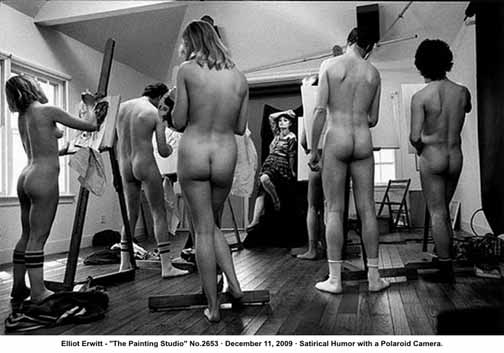
 Afterwards I got to look in on an art class and I was quite impressed with their methodology:  you can't really paint a nude model unless you are nude yourself.  I tried to join them but they wouldn't allow me to keep my cowboy hat on.

"For everything you will gain you will lose something, and for everything you lose you will gain something."
—BBB with all his clothes still on


Running From The Machines

September 1, 2015
   Every day machines move closer to usurping the artist's wheelhouse and every day I try to move away from what a machine can do.

  Daily Whip Out: "Running From The Machines."

"Of course I destroy my old paintings. Do you keep all your old hats?"
—Georgia O'Keeffe

"Well, actually I do keep all my old hats."
—BBB