Thursday, July 20, 2017

The German Humor Museum Is A Laugh Riot Even When It's Closed

July 20, 2017
   Do I want to go to a castle today? Or, a German market? Or, a rare, national treasure? No contest.


Daily Whip Out: "Time to Go to The German Humor Museum

  I know this is going to sound snotty and condescending, but I just flipped out hearing that there was a German Humor Museum. A British Humor Museum, well, of course. A Holland Humor Museum, yes, perhaps. A Portuguese Humor Museum, weird, but it might work. But a German Humor Museum? That seems like a leap that I absolutely must take. The first thing I did, to bone up on the German Humor Zeitgeist, is to do a Google search of German humor. And here's what I discovered:

Most German humor is base on the incorrect usage of German grammar. True, that is rather insular, but, well, okay, I can get into that. The rest can be categorized as follows:

Anti-Frisian Jokes: In the northwestern corner of Germany there are folks known as Frisians who are, by my reading, sort of the Rednecks of the Strudel set. Here is a typical Frisian joke: "How many Frisians does it take to screw i a lightbulb? Five! One to hold the light bulb and four to turn the table."

Pedestrian? Yes, but don't judge. Perhaps it's funny if you you've had a hit of crack or lived under a bridge for a year.

Antiwitz Humor: Germans are crazy for the anti-joke. "Two thick feet are crossing the street. Says one thick foot to the other thick foot, 'Hello!'"

I guess you had to be there. On the street where it happened.

Bauernregein-witze Humor (farmer jokes): "If a farmer lies dead in a room, he lives no more." I realize this is very close to the antiwitz—anti-joke, but here is another one: "If by Waltrude the cuckoo is not heard, it is probably frozen and dead."

Somehow, picturing Goebbels telling this joke makes it funnier, at least to me.

Schudderdeutsch: a form of dubbing. The Germans seem the most creative when it comes to dubbing foreign films. For example, in the British film "Monty Python And The Holy Grail" there is a line, "Hey there ! Who rides so late through night and wind?" This is evidently from a Goethe poem Der Erikonig, but the Germans dubbed this as, "I taught angling to the Saxons, and they've been called Anglo-Saxons ever since." This has nothing to do with the scene or the movie, but it evidently kills in German households who rent the tape. My favorite example is, the Germans took a failed American TV show, "The Arrivals" and turned it into a hit show, changing ALL the scenes to fit the jokes they wanted to tell.

We left Wiesbaden at two and got to the location of the German Humor Museum at 2:30, but it was closed down with weeds growing in the parking lot. I asked a woman at a bus stop if it was expected to open any time soon and she told me she has never seen it open—ever. So, right there is a great joke—on us, the crazy Americans. We all started to laugh at the absurdity of it all, and, as we looked around, everything we saw made us laugh, like these crazy elves in the courtyard.


Elves On The Patio

So we soaked it up and looked around.


Signs In The Patio

We laughed at signs we couldn't even read.


Humor! Gott Bose?!

And, at the end of the day, everything was funny to us.


   We Americans are so easily entertained. Turns out the German government likes to make us laugh at every exit on every road and even the parking lots, like this sign in Wiesbaden, Germany. Yes, we laugh every time. I know, so low, so crude and so predictable. Sorry, still funny though.

Bonus German Joke:

Leading a convoy, my driver shook me awake: "Sir, I think we're lost. We've passed the town of Ausfarht three times!"
—Thanks to Doug Hocking

"Germans are unable to speak the German language."
—Hans Georg Stengel, being so witty we can't even get the joke.


Tuesday, July 18, 2017

The Rise And Fall of Royal French Erections

July 18, 2017
   It never ceases to amaze me that the truth is stranger than any fiction you, or I, could ever make up. Bring France into the equation and the craziness goes off the charts.

   The big takeaway of the French Revolution, at least for me, is that old paradigms break hard. The longer a system is in place, the more violently it comes apart. In the French case, the divine monarchy had been in place for 800 years and when it started rotting from the inside in the late 1700s, it went down hard. Based on a series of flukes, the Louis dynasty basically ended with the coronation of a fifteen-year-old king, Louis XVI (his dad died and then his older brother died, leaving an ill-equipped teenager to rule the mightiest nation on earth at the time). The divine right of Kings was being tested all over the place.

   Creating an heir was a big deal in France and in addition to being the new, teenage King (The Twit King?), Louis was immediately married off to a fourteen-year-old Austrian bride (politics), who he met only two days before the wedding. Marie Antoinette was probably pre-pubescent, but, regardless, the court and the nation expected the two to GET EET ON, PRONTO! (as the Americans like to say with a blended French-Mexican accent)

   Well, it took seven years for the young newlyweds to finally have a kid and the tabloids (at that time called libelles) had a field day, printing broadsides with headlines, like, "THE KING CAN'T DO IT!" And you thought today's press was hostile.

   You have to trust me here, but it gets even more ridiculous.

   For years historians speculated as to why the two could not have successful sex with some pontificating that the Twit King suffered from Phimosis, a congenital narrowing of the foreskin that made sex painful.

   Recently, the historian Simone Bertiere, uncovered a rather shocking letter from Austria's Joseph II (he was the brother of Ms. Antoinette) who reported to the family, "[Louis] had a well-conditioned strong erection, introduced his member and stayed there for two minutes without moving, withdrew without ejaculation, then, still erect, wished his wife good night."


Daily Whip Out: "Louis XVI's Monitored Erections"

   Her brother then added, as only a brother-in-law can, "He should be whipped like a donkey, to make him discharge in anger."

   So, if you think our modern politics are somehow out of control, take a look at our shared past. It has always been this demented, it's just that no one had the nerve to tell you, until now.

"Those are my kind of people."
—Wonderful Russ, former president of the Wickenburg Clown Club


Monday, July 17, 2017

Mooning Over The Mona Lisa

July 17, 2017
   I took my son and daughter-in-law to the Louvre last Saturday because Amy wanted to see the most famous painting in the world. I warned her the girl is a rock star and we probably would not be able to get very close to her because of the crush of people crammed in to see her. Sure enough, when we got to the floor of the exhibit hall where she hangs, there were hundreds of people jostling to get a view, iPhones and selfie sticks in every hand. Even at that distance, Amy cried when she saw it. 


Daily Whip Out: "One Crazy Amazing Smile"

    Or, is it a smile? One art theory is that Da Vinci painted the Mona Lisa with two different expressions: a frown and a smile and it is the juxtaposition, or enigma, of the two opposing symbols, that gives the painting its power. However he did it, the painting has an enduring intrigue that is hard to fathom or explain. And, as my son noted, there is a painting on an adjacent wall that shows a young, topless woman, which Tomas gave this caption: "Hey, guys, I'm showing my breasts here and I can't even get your attention?"

    "Is that a pistol in your pocket, or are you just happy to see me?"
—Mae West

Friday, July 14, 2017

The President And I Help The French Celebrate Bastille Day

July 14, 2017
   "Happy Bastille Day?" I asked the pretty young lass at the front desk at a Left Bank Hotel (not the name of the hotel, but where it's located). She told me I was a crazy American, because the French do not say this to each other. That's funny, I told her, "We say, Happy Fourth of July all day long in my country." Okay, it was about half true, but then, so is everything else you are about to read beyond this point.

Celebrating The French Fourth of July
  The president and I flew in on the same day. He on Air Force One, myself on American Airlines, flight 786. We both landed at Charles de Gaulle Airport and exchanged pleasantries with the locals. We took separate conveyances into the city. He in a armored caravan, myself in a Senegal Cab company who ripped me off for 148 euros for a ride to my hotel. To the criminal Senegal company's credit, the driver showed me all the back street, which I had never seen.


The Humor Magazine Charlie Hebdoe and its take on Trump and Macron
together on Bastille Day, "Make 14 July Great Again"

   Like most Americans I don't know jack about French history. Here is a primer: in the late 1700s the French, who had helped us gain our independence in 1776—mainly because they hated the English‚ and wanted to stick it to them—came to their own day of reckoning. The French were the center of the civilized world at the time, but because of increasing income disparity between the rich and poor (sound familiar?) and a clueless elite (ditto), the poor rose up and attacked a fort north of our hotel (The Bastille), which was at that time a prison for invalides (a nice way of saying, the insane). The Bastille was erected as a fort to defend against the English (see above), but by this time housed a couple of idiots and the Marques de Sade (yes the guy who sadism is named for), but he was transferred out ten days before this happened. With really nobody to defend the place, the commander, the Marquis de Launay, surrendered to avoid any more bloodshed. In appreciation for this, the mob marched him down the street, beating the crap out of him all the way. He finally got tired of this and kicked a guy standing next to him, in the nuts, saying at the same time, "Enough! Let me die!" So they stabbed him to death and sawed off his head and put it on a pike and paraded it around town, gloating at killing a guy who had surrendered to avoid bloodshed.

   So then the rioters dismantled the entire Bastille, brick by brick, and sent the bricks out to all the french provinces so they could build little replica Bastilles to honor killing the guy who kicked the guy in the nuts.

   And that is what we were celebrating today all over Paris.

"Let them eat cake."
—A poor choice of words by Mary Antoinette

Tuesday, July 11, 2017

Heading to France Wearing Underpants

July 12, 2017
   Flying all day today to meet up with my son Thomas, his wife Amy and my granddaughter Harper in the City of Lights.


Daily Whip Out: "Brigitte Bard-Oatman"

"I see Paris, I see France, I see Cathy Cannonball's underpants."
—My only cultural reference to Paris when I was growing up in Kingman

The Cecil B. DeMille Effect

July 11, 2017
   Still scorching hot (108 for the high). Big clouds yesterday afternoon. Whenever we get sun rays shafting down through the clouds, I always refer to it as the "Cecil B. DeMille effect," after the legendary film director who was known for his epic scale and cinematic showmanship. 


The Cecil B. DeMille effect


   DeMille did 70 films, including "Samson and Delila" (1949), and "The Ten Commandments" Dai

(1956). He was born two months before the Gunfight at the O.K. Corral in 1881.

Prepping to leave tomorrow for a meeting with half my family. Kathy is in Germany, my son and his family are in Thailand and were all meeting in Paris for Bastille Day.


Daily Whip Out: "Le Gran Western"

"Dancing on the edge—as usual."
—Paul Andrew Hutton, when I asked him if these latest gals were too sexy?


Monday, July 10, 2017

A Trump thunderhead?

July 10, 2017
   My mother saw all kinds of things in clouds. I thought of her on my drive home from Phoenix this afternoon as I made my way back out to Cave Creek. I watched with some interest a mushrooming cloud on the horizon. 


Is it just me, or is that a Trump Thunderhead?

"Hey, you, get off my cloud!"
—The Rolling Stones, 1965

Don't Touch My Hat!

July 10, 2017
   Working on a feature for the magazine on one of my favorite topics. I want to capture just the right attitude and angst of a real life puncher. 


Daily Whip Out: Don't Touch My Hat! No. 1"


Daily Whip Outs: "Don't Touch My Hat! No. 2 and 3"

"When the student is ready the teacher appears. When the student is truly ready, the teacher disappears."
—Lao Tzu


Sunday, July 09, 2017

Face Painters, Hat Fanatics And Red Light Behavior

July 9, 2017
   Trying to finish a big sketchbook before I leave on Wednesday for France. I'm taking along a smaller sketchbook on the trip for compactness and maneuverability, so I've got to do 16 pages of sketches in three days to finish the big sketchbook. Here's six of them. 


Daily Whip Out: "The Sentry And The Butcher"
(yes, that's Jim Hatzell at left).

That guy on the right is a Mojave In-din with the vertical red line down the center of his face, with the bottom half of his face painted black. Whipple's crew commented on this ferocious face paint on the Mojaves when they came through in the 1850s. It must have scared anyone who met them in the night, or the day.

Took another swing at the Hatzell pose, channeling my inner van Gogh.


Daily Whip Out: "Hatzell On The Lookout"

And, likewise, took another swing at a Mojave with the racing stripe:


Daily Whip Out: "The Mojave Face Painter"

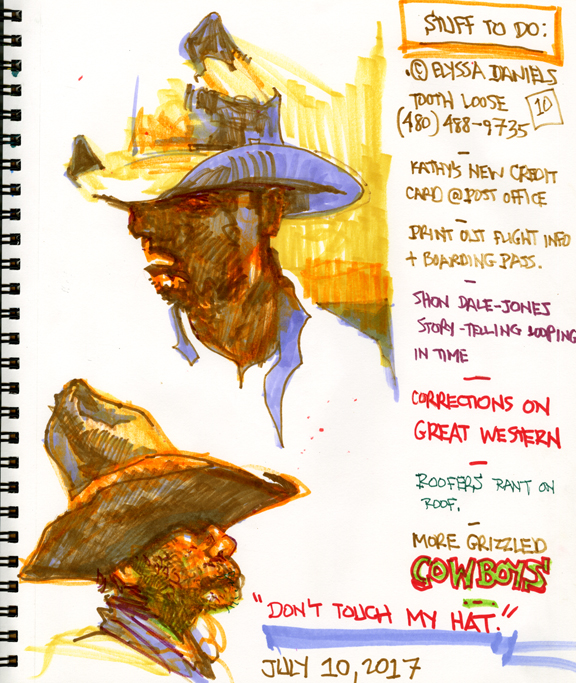
I've also been noodling grizzled old cowboys who don't like their hats messed with.


Daily Whip Out: "Don't Touch My Hat"

And here's a more Tom Mix approach:


Daily Whip Out: "Tom Mix Mixed Reactions"

   And, finally, I was amused by the critique of a Wyoming cowboy who came into The True West World Headquarters several years ago. When I showed him a True West cover featuring Jane Russell holding a pistol from the movie "The Outlaw" and asked him what he thought of it, he dismissed it with a chin wag, adding, "Might as well put a red light on it."


Daily Whip Outs: "Red Light Behavior"

"The wicked flee when no man pursueth, but they make better time when the sheriff is after them."
—Old Vaquero Saying


Saturday, July 08, 2017

Spaghetti Sexy & The Heat Goes On

July 8, 2017
Sometimes I get real picky about authentic gear in a Western, and then, other times, I really don't care. This is one of those times.


Elsa Martinelli in promotional photos for "The Belle Starr Story," 1968. She passed today.

   Satan called. He wants his weather back. It was a scorching 118 degrees here in the Valley yesterday and the overnight low was 84, which was what it was when I got out on the road for my daily walk this morning.


Daily Whip Out: "Life On The Line"

Speaking of heat, I have been noodling some mood pieces.


Daily Whip Out: "Ecstacy"

"Nothing in the world hears as many silly things said as a picture in a museum."
—Old French Saying

Bonus Quote:

"How about some landscape respect, Hollywood? How would you like it if they had filmed Sunset Boulevard in Sabine Pass?"
—Stephen Harrigan, complaining about a Texas based story being filmed in New Mexico

Friday, July 07, 2017

The Cavalry to The Rescue

July 7, 2017
   We Boomers have been conditioned at an early age to believe that when we hear the bugle call, we know the cavalry is coming to save the day.


Here they come to save the day


Well armed, mounted and moving fast to, no doubt, rescue some besieged pioneers.

   When I was researching the Oatman Massacre, I ran across the account of "Dr. Bugs," who got into it with Major Heintzelman the commander at Fort Yuma. LeConte had run across the forlorn Oatmans and later, when LeConte arrived at Fort Yuma he urged the major to send out a unit, but the commander refused to commit any troops because the Oatman incident happened in Mexico, which was out of his jurisdiction. Well, technically true, they were slaughtered on the south side of the Gila River (this is before the addition of the Gadsen Purchase), but since the fort was specifically placed at the confluence of the Gila and Colorado Rivers to help guard and assist travelers on the Gila Trail, it seemed like a rather thin excuse.

  You can read about this in more detail right here: The Strange Case of Dr. Bugs

   When Dr. Bugs got angry and insisted the major send out a force, Heintzelman claimed he didn't have any mounts for the troopers to ride, and, finally, relenting to LeConte's badgering, the major borrowed two mules for two troopers to ride out and investigate. They, of course, found the slaughtered family and came back to report it. 

   I think it's safe to say, there was no bugle call.

"Illegal aliens have always been a problem in the United States. Ask any Indian."
—Robert Orben

Thursday, July 06, 2017

A Two Gun Man vs. A Four Gun Man

July 6, 2017
   Some armchair historians like to poo-poo the Two-Gun Man as portrayed in early day Westerns. The two-gun toting movie stars included William S. Hart, Hopalong Cassidy,  Roy Rogers, The Lone Ranger and others. The Armchair Boys claim that most gunfighters only carried one pistol as a rule and that the two-gun man is a Hollywood myth.

  So it comes as somewhat of a giggle that there was perhaps a time when frontiersmen may have actually carried as many as four pistols. Check out this image of Capt. Francis Marion 'Dave' Poole (1837-1899) of Missouri. 


Dave Poole: A Four-Gun Man
Photo courtesy of the William J. Stier Collection.

The Real Reason for The Two-Gun Man
   The two-gun controversy has more to do with cap and ball pistols being difficult to reload—it was a slow and time consuming process—and in a skirmish, someone armed with four loaded pistols could do a lot of damage without having to stop and reload. And as some civil war buffs have pointed out to me, those old guerilla fighters often had even more pistols hanging off their saddles. 

  And it is true that Hopalong and the two-gunners on the Silver Screen carried later model pistols, which gives a grain of truth to the complaint about Hollywood building up the two-gun man, when in fact, the later gunfighters, Hardin, the Earps, etc. only tended to carry one pistol.

   But enough about that. Let's get back to Dave Poole and what his obits had to say about him:

The Arizona Republic, May 31, 1899
   Francis Marion Poole, better known as Captain Dave Poole died at 1:30 yesterday morning at his residence five and one half miles northeast of the city after a prolonged illness. His funeral was conducted by the Rev. E. McCreary and took place at the residence. He was a noted character in the days of the war. He early joined Quantrill's band and participated in all the stirring events which made that organization famous among its friends and notorious among its enemies. He was among the foremost in the Lawrence raid. Those that knew him said that he was a quiet man except in times when action was required. Major John Edwards in his book: "Quantrill and His Men" gives Capt. Pool a conspicuous place. At the close of the war, with many other members of the band, he settled down to peaceful pursuits. He was possessed of considerable wealth, most of which was lost by reverses while he was living in Texas.

   End of obit. 


   The portrait shown, above, was presumably taken in Sherman, Texas, on Christmas Day 1863. It's a little ironic to me that Sherman is where Olive Oatman ended up after her ordeal in Arizona. Dave Poole went the other way, ending up in Phoenix, Arizona after the war.

   My incomparable tracker, Gay Mathis, has unearthed another, longer obit that ran in the Weekly Phoenix Herald on June 1, 1899 and provides more details on this fascinating frontiersman. Selected quotes are as follows: 

   "He has been sick for several weeks, his illness developing into dropsy of the bowels which disease terminated fatally."

   "Mr. Poole leaves a wife and two children and one or two children by a former marriage. . ."

   "He was born in Missouri about 61 years ago.  When the civil war broke out he was yet little more than a boy but in those days and in that region, there were no youths. Those who were no longer children became at once men and women."

   "Though perhaps misguided [he led the "Guerilla charge at Centralia" and was prominent in the Lawrence, Kansas massacre], he was no coward and the work assigned to him was always accomplished or efforts exhausted in that direction."

   "After the war he returned to peaceful pursuits unlike some of his companions [The James and Youngers, for example], and later moved to Texas, where he engaged in stock raising and where it was said he became very wealthy. Reverses overtook him, and some years ago he came to this valley [Phoenix, Arizona] settling west of town, but later moved on the ranch where he lived at the time of his death."

   End of quotes. If his ranch was five-and-a-half miles northeast of downtown Phoenix in 1899, that would probably put it at about Northern Ave, somewhere east of seventh Street.

"Is it a bigger crime to rob a bank or to open one?"
—Ted Allan

This just in: Gay Mathis found these 1897 quotes from Frank James on the two pistol question:

"Each guerrilla carried two to four pistols. I nearly always carried two. I was small and slender and more than that number was too many for me."

"The stories about guerrillas riding with the reins of the horses between their teeth and firing with pistols in both hands is simply dime novel stuff."

"We always held our horses with one hand and the pistol with another."
—Frank James

"

Wednesday, July 05, 2017

Scorching Sunlight & Olive In Shadow

July 5, 2017
   My goal at this time of year is to get out on the road for my morning walk by 5:30, 5:40 at the latest, because once the sun peeks over Continental Mountain it's—game over. We have a thermometer in the kitchen window, facing the direct sun. When I left this morning it was clocking at 77 degrees and when I got back it was 96. That's how intense it gets when the rays hit the fan.


Sunrise Over Ratcliff Ridge.

   We're wrapping up our coverage of The Great Western for the September issue of True West which goes out the door tomorrow. Shifting gears backward and forward, picking up on Olive Oatman (which is slated for the October issue now) and jamming on a certain book I have been working on, since, well, 1995. You know, it's about this guy:

The Illustrated Life & Times of ???

   Went home for lunch today and finished a scratchboard I have been noodling on for a couple weeks.

Daily Whip Out: Olive In Shadow"

   Love this quote about "The simple life" that so many of us wish we could return to, from time to time (especially when things get stressful).

"The real drawback to 'the simple' life is that it is not simple. If you are living it, you positively can do nothing else. There is not time."
—Katharine Fullerton Gerould

Tuesday, July 04, 2017

Fourth of July Manifesto

July 4, 2017
   This is the most surreal time I have ever lived through. With that in mind, I thought I'd write down a few things I'd like to remind myself on this, the 70th Independence Day I have been around for.


Daily Whip Out: "Fourth of July Manifesto

"Stop worrying about the younger generation: they too will grow up, get married, and start worrying about the younger generation."
—Old Vaquero Saying

Monday, July 03, 2017

The Final Bitchin' Push On The Great Western

July 3, 2017
   I put the finishing touches on several big ideas this morning. Worked all weekend on The Great Western. Left the house only once, to have brunch with Wonderful Russ down at Mimi's. Came back and bailed in. Goes to press a week from today. Want it to be bitchin'.


Daily Whip Out: "The Great Western & Her Second Artillery Cap"

   Thanks to John Langellier for the details on Sarah's campaign cap and insignia. Meanwhile, the Top Secret Writer prefers this painting for the splash page opening:


Daily Whip Out: "The Great Western Splash Page Option, No. 1"

   Everyone likes the color on this one, but as I mentioned earlier, this gal is too svelte for the six foot plus Sarah Bowman. That's why I took another crack at her.


Daily Whip Out: "The Great Western Splash Page Option, No. 2"

And, because someone told me she looked too "Butch" in this pass, I took a third pass at the idea:


Daily Whip Out: "The Great Western Splash Page Option, No. 3"

And then, to attack the idea from a completely different direction, I did this study:


Daily Whip Out: "The Great Western Portrait"

   The problem, from the very beginning, stems from there being no known photograph of Sarah Bowman.

"I don't have a photograph, but you can have my footprints. They're upstairs in my socks."
—Grouch Marx


Sunday, July 02, 2017

Seeking Second Artillery Insignia & Big Boned Women

July 2, 2017
   Finishing up a couple takes on The Great Western for the splash page opening that will run in the next issue of True West.


Daily Whip Out: "The Great Western at Yuma Crossing, Version One"


   The problem with the above version is that she is too thin. Full disclosure, I modeled her after the photo of an actress in the Broadway play "Hamilton." I liked the costume, but I didn't put enough extra pounds on her and she is too svelte. Sarah Bowman was a big boned girl. More like this:


Daily Whip Out: "The Big Boned Great Western"

   One of the most enjoyable aspects of being in the history biz is knowing the right people to contact in order to get to the bottom of things. Yesterday I found some great reference on the style of various campaign hats that the Great Western might have worn, but one detail eluded me. I sent this inquiry to The Top Secret Writer:

Paul,
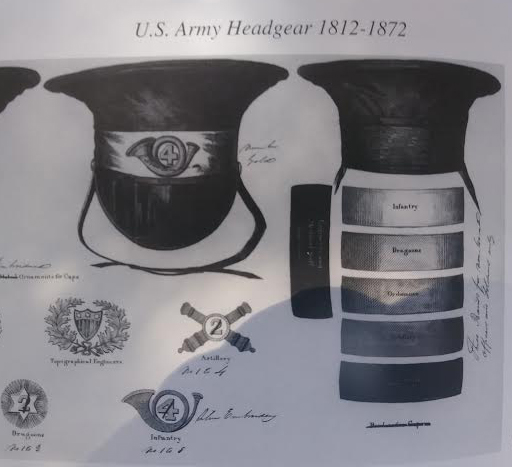
    Hey, I'm trying to portray Sarah's headgear from the Mexican War era, and that quote from a soldier who saw her, has her wearing a "a gold laced cap of the Second Artillery."

   Jeff Pechtel told me the Dragoons wore a star on their caps and the Mounted Rifles wore a golden eagle on theirs. What might an artillery unit wear on theirs? A cannon perhaps? And where exactly do you picture the "gold lace" on the cap?

BBB

   The Distinguished professor had a three word response:

"Langellier will know."

   So I emailed the U.S. Army historian, John Langellier, and thanks to him, this morning I got the specifics I needed on the insignia.


U.S. Army Headgear, 1812-1872

So crossed cannon barrels with the number two in the middle. Dang cool beans! Now for the gold band. Sent this down to John:


Daily Whip Out: "The Great Western's Second Artillery Insignia"

   I still had one more version to finish and on this one I went for a little more of a sepia look, and, of course, my obsession with "swirling gunsmoke" showed up unannounced. A friend looked at this one and said, "She's a little butch, don't you think?" To which I said, "If you were six foot six and in the Mexican War and saw action, and then you were on the American frontier in Yuma, in those years, you would HAVE to be more than a little butch."


Daily Whip Out: "The Great Western Looms Large"

   I've worked hard and I'mm so buggy, I can't decide which one is going to work best for the piece.

"If my father had hugged me once, I'd be an accountant right now."
—Ray Romano, standup comedian, on the nature of comedy


Saturday, July 01, 2017

Sarah Brava and The Citizen Cap

July 1, 2017
   Thanks to Stuart Rosebrook who sent me a link to some old 1840s photographs, I did a sketch of one of them and realized it could be Sarah Brava [this is my graphic novel name for The Great Western] Love those old style ringlets! They don't do that anymore, do they?


Daily Whip Out: "Big Girls Don't Cry"

Thanks to some Facebook friends, Jeff Prechtel, primarily, I have been getting an education on so-called Wheel Caps, although Jeff is suspicious of the term, having been told by a historian it's a modern term to describe these caps from the early 1840s. Check out these beauties.


A Dragoon in The Mexican-American War

   The Dragoons wore the star on their caps, while the Mounted Rifles wore gold embroidered eagles on theirs.


A Mounted Rifles U.S. soldier from the Mexican War period. 

Check out this classic shot of what appears to be a group of tradesmen:


Citizen caps galore.

   And check out this bad boy:


Citizen Cap & Ball & Blade

   So, I have some great reference and I've been noodling a few of these to see how they might work with a certain wild woman of the Wild West.


Daily Whip Outs: "Citizen Cap Studies for Sarah Brava"

   Here's the quote that led me to the cap:

"She slew a Mexican who cut her across the cheek with his saber. She boasts a large scar on her cheek from this wound. She appears here modest and womanly not withstanding her great size and attire. She has on a crimson velvet waist, a pretty riding skirt and her head is surmounted by a gold laced cap of the Second Artillery. She is carrying pistols and a rifle. She reminds me of Joan of Arc and the days of chivalry."
—Sylvester W. Matson, a soldier at Fort Webster, 1852