Wednesday, July 15, 2015

109 Cracks! at The O.K. Corral

July 15, 2015
   Let's be perfectly clear here: I don't buy the argument that John Flood made up anecdotes and events to pad out the Wyatt Earp manuscript. He stretched anecdotes and exaggerated like crazy (see yesterday's post on Wyatt waking up before the gunfight), but all with Earp's blessing. The very idea that Wyatt was somehow duped or out of the loop is laughable. This is Wyatt's story as he and Sadie wanted it to be told. Granted, there's a ton of BS in here (Wyatt claims he bagged John Ringo for example) and Sadie altered quite a bit of landscape to keep herself out of the picture, but the basic premise of every chapter and every event covered in the 348 pages comes straight from the horse's mouth. That is my opinion.

 Daily Whip Out: "Wyatt Earp Gets To Fighting (As Ike Heads for The Exit)"

   That said, it's hard to believe Wyatt Earp could tell the story of the gunfight in Tombstone and get so much of it wrong. For one thing, Wyatt drew a map of the location of the fight (which is printed in the manuscript) and where everyone stood. Incredibly, Wyatt has the fight taking place in the rear of the O.K. Corral! As we reported in True West magazine recently, that map of the wrong location recently sold at auction for $380,000! Now THAT is ironic.

   As I have previously reported there are tons of CRACK! (in my book, "The Illustrated Life & Times of Wyatt Earp," published in 1993 and revised in 1996, I have the number of "Crack!" mentions at 101, but upon closer inspection (thanks to Mark Boardman for letting spend some quality time with his copy), I have accounted for 109 CRACK! mentiones and one BANG!, as in bullets fired by the participants!). The newspapers from back in the day lists the number of shots being fired at approximately 30, which is plenty. I can easily see that this could be Earp and Flood, acting on the advice of William S. Hart, or Tom Mix, or perhaps a screenwriter who tried to help out with the project: "Trust me, the people who love Westerns love to see the word CRACK! You can't put too many in your narrative. Load it up."

   Here's how Wyatt describes Doc pulling both triggers on the Wells Fargo shotgun:

   "'Doc Holliday and his popgun!' he was furious with the ridicule that was in his mind [Wyatt is assuming Doc will be ridiculed for missing with a shotgun], and raising the weapon above his head, he flung it far across the street."

   And here are a couple of scanned pages to prove to you that I am not exaggerating on the number of CRACK! mentions:

Let's Get Crackin'!


 I count 16 on this page.

   And even more cracks:

And a staggering 26 on this page.

   As if the massive amounts of CRACK! needed justification, Wyatt and Flood add this detail: "So rapid were the flashes that the heat of the metal extended back into the butts of the forty-fives until the palms of the gunners began to burn."

   Then, perhaps because Earp and Flood think we may be tiring of the CRACK!, they switch to this:

   "ing! ing! ing! "Look out Morg, look out! you're gettin' it in the back!" shouted Wyatt Earp as streaks of fire commenced flashing from Clayboure's gun through the front window of the photograph gallery."

   If I had to guess, I would say the ing! is a ricochet? And, by the way, no capital letter there, it's "ing! ing!" as in, confus-ing!

   I believe Sadie read the manuscript over and over and I also have a strong hunch she read it aloud to Wyatt and you might make the claim he didn't care what it said, but I think that is wrong. Here again, is the preamble to the book:

   "He has tried to tell the facts and incidents as they were lived and fought; nothing has been exaggerated. As dictated, personally, by Mr. Earp to the author, the story is told, almost, with exactitude: in many instances, the vocabulary representing his precise words. . .Truth, correctness and vindication constitute the purpose of this narrative."
—John Flood

And all I can add to that with exactitude, is "Crack!"

Tuesday, July 14, 2015

Major Cracks at The O.K. Corral

July 14, 2015
   Today is the anniversary of Billy the Kid's death and if it wasn't for Pancho Villa and Walter Noble Burns, nobody would give a damn. Here's why: if the Mexican Revolutionary general hadn't attacked Columbus, New Mexico, a news reporter from Chicago, wouldn't have gotten the assignment to travel to New Mexico and cover the story. And if the reporter, Walter Noble Burns, hadn't followed up his reporting in Columbus with another report in El Paso, he wouldn't have gone into The Coney Island Saloon. And if Burns hadn't gone into the Coney Island he wouldn't have seen the pistol over the bar that killed Billy the Kid. And if he hadn't talked to the owner about it, Tom Powers, Burns probably wouldn't have written "The Saga of Billy the Kid." And if Burns hadn't written that book none of us would care, because that best-seller raised the Kid from obscurity and launched his legend for all time. And, if Burns hadn't hit it out of the park with that book he wouldn't have gone looking for someone else to write about, which ended up to be "Tombstone An Iliad of The Southwest." and if Burns hadn't written that book we wouldn't have this paragraph to marvel at:

The Lion of Tombstone


   "So hail and farewell to the lion of Tombstone. Strong, bold, powerful, picturesque was this fighter of the old frontier. Someething epic about him. Fashioned in Homereric mold. In his way, a hero. Whatever else he may have been, he was brave. Not even his enemies have sought to deny his splendid courage. The problems of his dangerous and difficult situation, he solved, whether wisely or foolishly, with largeness of soul and utter fearlessness. No halo is for this rugged, storm-beaten head. He was a hard man among hard men in a hard environment. What he did, he did. The record stands. But, weighed in the balance, he will not be found wanting. Judged by the circumstances of his career, the verdict in his case is clear—Wyatt Earp was a man."

   But we're getting ahead of the legend, as we know it. Before Burns, there was Flood, hand picked by Wyatt and Sadie Earp to be the writer of the book on Wyatt's life that would make them all rich. They worked hard on it. They fought over sections and revised others. In the end they had a real door stopper: it clocked in at 348 pages and they were mighty enthused and hopeful.

   Unfortunately, everyone they sent it to, sent it back with a "no thanks." The Saturday Evening Post said it was "Florid." They were being nice. It is beyond florid. It is horrid. How horrid?

   The heart of the manuscript is the Gunfight in Tombstone. Even Flood knows it's Earp's defining moment, and so we begin Chapter XXXII, like this:

"Hello Wyatt!" "Hello Wyatt!" Knock! Knock! Knock! "Hello Wyatt!" But the only response was an echo of sounds along the corridor where the early riser stood before the door.

   Away at the end, a ray of light struggled in beneath the partly drawn shade—the early flush of awakening day: while the moisture on the pane indicated a lowering of the temperature outside.

   [To summarize: It's cold outside and Wyatt doesn't want to get up. But Flood's not done with this scene.]

   For a bare thirty seconds, there was silence as the alarmist listened, with his ear towards the closed entrance of the room. Then he tried again.

   "Knock! Knock! Knock! Knock! "Wyatt!" "Wyatt!" still no response, and he took hold of the knob of the door and shook it violently.

   "Don't that beat the band!" he exclaimed aloud. "Damn it all!" "Wyatt!" "Wyatt!" "Get up!" "Get up!" and he fairly shook the building as he pounded on the door with his fists.

[Okay, we get the picture. Wyatt Earp doesn't want to get up and it does beat the band. Certainly, we can move on to the action?]

   Whether it was the vociferous superlatives of the last remarks or his impatient pounding on the door, was never explained by the sleeper within who now showed signs of life. This time, there was a faint stretching of springs as if some one had raised up suddenly in bed:

   "Huh?" "What is it?" came the half conscious tones of a sleepy voice on the inside.

   "Is that you Wyatt!"

   "Yes, u-h-m-m, yes, what is it?" "Me?" "Yes, all right." and then there was the sound of a heavy tread upon the door, and a fumbling with the lock, and the door opened.

   "Wyatt, hurry and put on your clothes: the two McLowerys [sic] and the Clantons are in town, and Billy the Kid and they're armed for a fight!"

   End of quotes from the opening of the Tombstone gunfight in Flood's florid hand. Notice that we have come full circle and that Earp-Flood are trying to lean on Billy the Kid being in on the action. Yes, Billy Claiborne was known as Billy the Kid, but still, this has an extra tinge of cheesy to it, like they're trying to cash in on the Burns book.

   But just wait until we get to the main action, where the cowboys and the Earps exchange 110 shots (actually 109 CRACKs! and one BANG!) and Wyatt draws a map, that places the fight in the wrong place.

"Well, we won't put them to all that trouble, we'll go down," declared the deputy, and he and his brothers, Virgil and Morgan, buckled on their forty-fives."
—Wyatt Earp, as quoted by Flood, acknowledging they wore gunbelts, although in the Spicer Hearing he puts his pistol in his coat pocket.

Wyatt Wary As A Cat

July 14, 2015
   When Wyatt Earp and Bat Masterson were hired as policemen in Dodge City, they mostly worked nights where they walked the "Deadline," a dangerous corridor full of drunk, Texas cowboys who, by and large, despised Yankees.

 Daily Whip Out: "Wyatt Wary As A Cat."

"That feller Hamlet sure was a talkative man. He wouldn't have lasted long in Kansas."
—Wyatt Earp, after he and Tom Mix decided to get "culture" and read Shakespeare

Monday, July 13, 2015

Did Wyatt Earp Have A Sense of Humor?

July 13, 2015
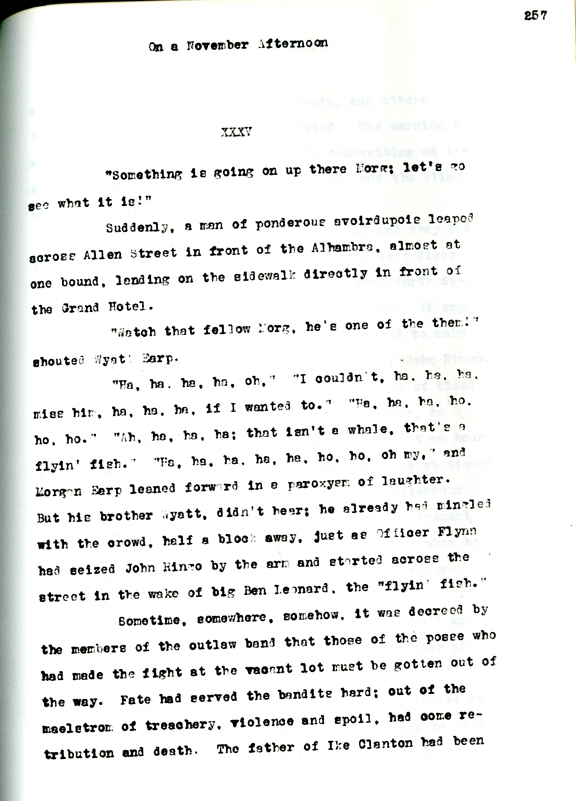
   In the Flood manuscript there is one section where it appears that Flood and Earp are trying to be funny. Here it is:

   "Something is going on up there Morg; let's go see what it is!"

   Suddenly, a man of ponderous avoirdupois leaped across Allen Street in front of the Alhambra, almost at one bound, landing on the sidewalk directly in front of the Grand Hotel.

   "Watch that fellow Morg, he's one of them!" shouted Wyatt Earp.

   "Ha, ha, ha, ha, oh," I couldn't, ha, ha, ha miss him, ha, ha, ha, if I wanted to." "Ha, ha, ha, ho, ho, ho." "Ah, ha, ha, ha; that isn't a whale, that's a flyin' fish." "Ha, ha, ha, ha, ha, ho, ho, oh my," and Morgan Earp leaned foward in a paroxyem of laughter.

   But his brother Wyatt, didn't hear; he already had mingled with the crowd, half a block away, just as officer Flynn had seized John Ringo by the arm and started across the street in the wake of big Ben Leonard, the "flyin' fish."

End of Flood's florid quotes from Chapter XXXV "On A November Afternoon." And, if you think I'm taking liberties with the above text, here is a scan of the page:


 Flood's Forid Flip Out: "Ha, ha, ha, ha, oh"


   It appears Wyatt is making fun of "big Ben Leonard" for being fat and looking like a fish out of water. I'm not sure, but given Morgan's guffawing that is my interpretation. That it is totally obtuse and unclear is a hallmark of Flood's writing.

   The incident barely being described here is the amazing showdown that happend a couple weeks after the O.K. Corral fight, when the cowboys who should have been at the first fight, showed up for the second: Curly Bill and John Ringo. They, and a gaggle of cowboy cronies squared off on Allen Street in front of the Grand Hotel with the cowboys on the south side of the street and Wyatt, Morg and Doc Holliday on the north side of the street. After some taunting by Ringo, a Tombstone police officer, Jim Flynn, took in the scene and arrested the prinicpals, including Wyatt Earp, and the event ended without a shot being fired. The irony is THIS is how the first showdown should have ended, but for the fact that Doc Holliday mucked up the arrest attempt and opened the ball with his "pea shooter" (the term Wyatt gives the Wells Fargo shotgun in the O.K. narrative). None of this is in the Flood chapter and, in fact, if you didn't know the outcome, you wouldn't know what was going on here.

  "Tragedy is when I cut my finger, comedy is when you fall into an open sewer and die."
—Mel Brooks


Sadie Lays Down The Law

July 13, 2015
   Thanks to Gay Mathis, we now know why Wyatt Earp was a two-gun man during his stint as a policeman in Wichita.


Daily Whip Out: "Wyatt In Wichita."

   And thanks to Mark Boardman, who lent me his copy of the Flood manuscript, we now know just how bad Flood's writing is. Reading between the lines we can also see something else:

Daily Whip Out: "Sadie Lays Down The Law"

   Poor Flood—poor Wyatt! Sadie gives John Flood his marching orders: nothing about Wyatt being married in Tombstone and nothing about the whereabouts of his current wife. Oh, my that woman had something to hide, and how. Coming tomorrow, a painful round-up and review of the chapter ominously entitled: "1881, October The 26th."

"Truth, correctness and vindication constitute the purpose of his narrative."
—John Flood, Jr. in the preamble to the manuscript
 

When Eyesores Become Icons

July 13, 2015
   Researching the era when Wyatt Earp was in Hollywood and what was happening around him. Here's something he had to have seen numerous times:

Daily Whip Out: "When An Eyesore Becomes An Icon"


The Hollywood Sign History
    The original Hollywood sign was erected in 1923 for $21,000 and spelled out Hollywoodland as an advertisement for a local real estate development. The wood, 45-foot-tall letters were made of wood and sheet metal and were only intended to be up for a year and a half, but with the rise of American cinema, the cheesy sign took on a new significance. In the 1940s a drunk driver (actually the sign’s caretaker) ran off the road and destroyed the H and caretaker's 1928 For Model A. In 1949 the  Hollywood chamber of commerce took over the sign and took off the “land.” But by the 1970s the sign was in bad shape with several letters falling down completely. In 1978 a public campaign led by Hugh Heffner, set out to restore the landmark. Nine donors gave $27,000-and-change each to sponsor replacement letters. Gene Autry bought one of the letters as did Alice Cooper who bought an O for Groucho Marx, while joking he would also donate an “O” from his last name. 

   Interesting that almost the exact same thing happened in Paris, France over the Eiffel Tower. Public outrage over the very idea of such a proposed monstrosity being built in the historic city of lights was unthinkable to most Parisians. A compromise was finally reached and accepted that as soon as the fair was over, that eyesore had to come down. Last time I was there (2010) they still hadn't taken it down.

   Same thing with those ten Cadillacs half-buried nose-deep in the ground outside Amarillo, Texas. It's known as Cadillac Ranch today and the hippies who were part of the Ant Farm collective who thought it up had to fight public opinion for the longest time. It too, was deemed an eyesore, and the towns' fathers screamed to the heavens to take it down once the sixties were over.

   Funny how certain eyesores become icons. Wonder what the lesson is?

"Don't be kind of bold. Be bold."
—William Zinsser

Sunday, July 12, 2015

The Two-Gun Mystery Solved

July 12, 2015
   Leave it to Gay Mathis to answer the question: Was Wyatt Earp A Two-Gun Man? Got this from her this morning:

BBB, I will send you the complete Masterson newspaper story through e-mail, if it helps..

Few Scraps Bat Masterson the Old Plainsman, in a Mood for Talk, Chats of some of the "Plan, Ordinary Men--July 17, 1910--Idaho Statesman Newspaper (Originally published in New York Herald Newspaper 1910)

Here are a couple of excerpts: 

"The first gun we had out there was the old cap and ball six shooter. There was a little steel ramrod fastened alongside the barrel and aligned with the chambers of the cylinder. It was necessary to pour in the powder, then the ball, and then ram down the charge. Some were pretty quick at it, but, naturally, it was slow work at best."

"It was partly on this account that many of us carried two guns. Later when the modern cartridge came in, the "two gun man" was generally a bad man, as those who shocked the not too sensitive virtue of the country were called, but in those earlier days the two guns were a necessity. We could use two guns at once, shooting equally well with either hand. The caliber of those old guns was .36 and .44. The modern 45 colt didn't come in till about 1870, when the cavalry introduced it - just when it was needed. The first Colt .45 was of the single action type."

—Gay Mathis


Policemen Bat Masterson and Wyatt Earp at Dodge City, Kansas


   Thanks Gay. This helps explain a bit how a two-gun lawman in the 1870s would be a necessity. HIckok is appointed marshal of Abilene, Kanas in 1871. Wyatt Earp is in Wichita in 1874 and then on to Dodge City in 1876 and a demand by the mayor that his policemen carry two pistols makes much more sense in light of Masterson's explanation. 


"Wyatt Earp, who was on our police force last summer, is in town again. We hope he will accept a position on the force once more. He had a quiet way of taking the most desperate characters into custody which invariably gave one the impression that the city was able to enforce or mandate and preserve her dignity. It wasn't considered policy to draw a gun on Wyatt unless you got the drop and meant to burn powder without any preliminary talk."

—The Dodge City Times, July 7, 1877

Was Wyatt Earp A Two-Gun Man?

July 11, 205
   I'm on page 248 of the Flood manuscript—100 to go. It's hard work. Sometimes I have to read a page several times to try and figure out what he's even talking about. And, of course, the real trick is trying to figure out how much is Wyatt and how much is Flood padding out the text by poaching from the pulps, and other sources. Here's an intriguing anectdote on page 45, in the chapter "A New Officer":

"Now Earp, you're a full fledged officer; all you need is a brace of guns; go down to the store and tell them I sent you."

"Guns, Earp!" "Two guns!" thundered the Mayor [of Wichita] only minutes later. "Go back and get another; my men need two guns." "They need them and you will too." The [cut off in the gutter of page] wanted him to have it, and he wanted it more than the mayor or anyone else knew."

   End of Flood. Later in Tombstone, Flood has Morgan wearing two guns as well. Which brings up a good question: was Wyatt Earp a two-gun man?

Daily Whip Out: "A Two-Gun Man"


   We know, in the thirties and forties, the movie portrayals featured two-guns on Wyatt, although I believe Henry Fonda portrayed him as only carrying one gun in "My Darling Clementine." And, obviously Hugh O'Brian wore two guns portraying Earp in "The Life & Legend of Wyatt Earp." Later portrayals revert to Wyatt only wearing one gun: Kevin Costner in "Wyatt Earp" and Kurt Russell in "Tombstone," and I believe James Garner as well in "Hour of the Gun". Which is correct? And why the change? Why did the early movies have Earp wearing two-guns and then the scaling back to only one? I sent this inquiry to one of the foremost experts on Wyatt Earp and got this response:

Bob,

What follows is my OPINION. Or, maybe, reasoned conclusion. It is not something I can base on fact.

From reading the Flood, I suspect that John Flood interviewed Earp, got a few facts and anecdotes, then filled in a whole lot of blanks. He used Bechdolt; he used stories from pulp Westerns and Dime Novels; he used whatever he found. Such stories as the two-gun story are so weird that it is hard to imagine it being real.

In the Flood, Bob Paul changes seats with the driver before the Benson stage robbery. In Lake, there is no change. In the Lake notes, there is a point where Lake writes with emphasis that the driver did not change seats. It appears that came from an interview with Wyatt.

So I am not comfortable that every word in the Flood came from Wyatt. We know how Lake described him as being taciturn and not good at elaborating. We know that in Burns's notes, Wyatt's description of the Johnny-Behind-The-Deuce incident is very understated.

I suspect that Flood, perhaps exasperated by Earp's blandness, tried to goose up the story by adding phony anecdotes from other sources.

As to the two-gun, one-gun issue, I suspect that more recent writers have looked at pictures of the old-time gun handlers. If I am not mistaken, most of the pictures show them carrying one gun. Those guns were pretty heavy, and it would be hard to keep your belt up with two guns. When I put on my grandfather's gunbelt, I can only imagine how hard it would be to constantly walk around with two guns instead of one. He was an officer in the 1920s and '30s, and he wore one gun.

I should probably dig out some of the True West Best Picture issues to see what they show, but that is my guess.
—Casey Tefertiller 

   Of course, Wild Bill Hickok is the model for the two-gun law man and I suspect Wyatt emulated him, perhaps after the fact (he wanted to come off like Hickok in the manuscript so he perhaps added the story to amp up his firepower). There are numerous photos of Hickok with two pistols and he was the prototype of the cowtown lawman and he was doing his work just down the road from Wichita and Dodge, so it's not hard for me to imagine that all the cowtowns wanted a marshal who carried two guns. Remember, Hickok's two-gun visage was illustrated in the pulps of that day so I imagine everyone in the Kansas cowtowns, at least, wanted to be like Wild Bill in the 1870s. That seems accurate, to me.

   My guess is that photo scholarship in the mid-twentieth century, did erode the two-gun image, and that the two-gun celluloid marshal started to seem ostentatious and exaggerated, so the later portrayals reverted to the more modest one-gun Wyatt Earp. What's especially interesting to me is that we are all picking and choosing which portions of the Flood manuscript (and Burns and Lake) to believe and which to discard. If we don't like something, we blame Flood and Burns and Lake. If we concur, we say smugly, "Well, at least he got that right. He must have listened to Wyatt."

   The anecdotes in the Flood manuscript are so meager and vague I have a hard time believing Flood even looked up anything. When Wyatt is in the posse chasing the Benson stage robbers he says they came through the "Ragoon" mountains. There are no Ragoon mountains in Arizona. Perhaps the Dragoon mountains or the Rincon mountains? So, either Wyatt's memory is terrible, or, Flood's research is shabby (choose your poison). 

   When Flood writes about Morgan getting the drop on Pony Deal and other Cowboys he says it took place in "Safford," between "Bisbee and Charleston on the San Pedro River." Excuse me, but Safford is way north of both bergs, on the Gila River, not the San Pedro. Was he thinking of Hereford, perhaps, which is on the San Pedro between Bisbee and Charleston? And, it's here he mentions Morgan pulling two pistols. I don't know, but It has a ring of truth in it, to me, he said, throwing out the bad geography and retaining the one "fact" he wants to believe.

   As I read the manuscript I'm trying to picture the two men sitting at the kitchen table and Flood trying to draw Wyatt out (and Sadie yelling at the two of them at every turn). Thanks to her, Flood has Wyatt and Virgil coming into Tombstone—just the two of them as bachelors on horseback. We know why she insisted on that falsehood, because they actually came in wagons with their wives. And Sadie could not allow that.

    Anyway, I have to believe the bare bones (and they are bare!) of the stories are Wyatt's. Flood respected him too much to make up stuff out of whole cloth. That's my OPINION.

   And, of course, Flood's idea of helping is to lard up the narrative with ridiculous expository bullshit.

   Anyway, fun to speculate on, and although it is all absurd and maddening to even try and find the truth about Wyatt Earp, still we try to get it right. And, besides, some of the quotes are hilarious in their awfulness:

"We are not afraid and we're fully capable of handling the situation; we're sanguine that we'll win."
—Wyatt Earp, as quoted by John Flood in the run up to the O.K. Corral fight

Friday, July 10, 2015

Was Wyatt Earp A Damaged Man?

July 10, 2015
   Do words matter? Yes.

Daily Whip Out: "A Damaged Man"

   Yesterday, I posted a Daily Whip Out of Sadie Marcus Earp and I made a few snide comments about what a, ahem, difficult person she was and I got the following comment:

"Josie was neither a saint nor a whore on the line. She was a spoiled brat, a foolish young woman, an experienced older one who took a lover or three, the common law wife of a silent, damaged man who was unfaithful but loved her in his way and finally a pathetic, lonely old lady whose dementia made her difficult and sometimes obnoxious. Who among us would like being summed up by our sex lives at 19?"
—Mary Doria Russell, author of the new book "Epitaph"

This haunted me all day yesterday and this morning I whipped out the above study. Shifting gears I did a quick study of the "damaged" lad when he was in Kansas during the Red Decade:
Daily Whip Out: "Wyatt In Wichita"

   Tom Waits was asked what his greatest strength is. He replied:

That I don't know what I'm doing.
—Tom Waits

Thursday, July 09, 2015

Whores In The Rearview

July 9, 2015
   Our monsoon season is early this year with big clouds piling up every day. Finished a painting this morning, inspired by our current weather.

Daily Whip Out: "Storm Riders Series #23"

   Sadie Marcus did everything in her power to erase her Tombstone past, but the old vauqeros have a saying (see below).

Daily Whip Out: "Sadie Marcus In Tombstone—
Whore On The Line, or, Saint On The Lamb?"

"You get what you resist."
—Old Vaquero Saying

Wednesday, July 08, 2015

Shady Shade Hat Brim Study

July 8, 2015
   Took another crack at hat brim shade this morning before I came into work.

 Daily Whip Out: "Shady Shade."

"As painters we must always remember that the spirit is more important than the fact."
—Harold Von Schmidt

Tuesday, July 07, 2015

The Walkdown

July 7, 2015
   Last week (June 28) I taped a segment of a new BBC show shooting in 3-D. The director walked me into the O.K. Corral to see about where to shoot the segment, but he didn't like the mannequins, or the space (it's fenced off) on the actual spot, so I suggested we start at Hafford's Corner and walk the actual route the Earps and Holliday took to the fight. Here I am with the host Tony as we began our journey up Fourth Street from Hafford's Corner.

Telling Tony the story of The Walkdown in Tombstone

   Sir Tony Robinson is a big fan of the rock band Genesis and provided sleeve notes for the reissue of the album The Lamb Lies Down on Broadway as part of the Genesis 1970–1975 box set.
It came as quite a shock to many when Robinson was knighted in the 2013 Birthday Honours for public and political service. He and I are the same age, 68, so we compared notes: when I said I was the class of '65 Tony said, "we don't do it that way in England. I am the class of '57. We count it from your first year." 

   Evidently, in Britain, they count their class from middle school (He said he was 11 when he started), because so many go off to trade school, or other education institutions and the end may be staggered? That is my take on it. May be wrong but they DO NOT count their class from the graduation year. So that was educational, for me.

   Tony also has the opinion that the English Invasion fizzled when The Byrds and The Band came on the scene. In his mind, the Americans won at that point, which is kind of crazy to me since the Stones are still probably the biggest band in the world, with U2 right behind. So, I'm not sure what he means by that, this crazy Brit from the class of '57.

   The Brit crew shot the segment like a movie and we did the Walkdown about seven times, with various camera angles. By the way, Tony does about 30 travel shows a year. He was a smooth pro and lobbed me juicy questions. A very likeable bloke.

Tony and I pretending not to see the camera right in front of us
 as we angle into the street and make the turn onto Fremont Street.

   I told the story of the Earps and Holliday making the turn and going into the center of the street, where they spread out and walked abreast for a ways. This is the classic iconic moment with four men walking side by side to confront their enemies.

Daily Whip Out: "The Walkdown"

As the quartet passed the rear entrance of the O.K. Corral, they returned to the sidewalk and when they passed the front door of Bauer's Meat Market, a woman inside overheard one of the party say, "Let them have it!"

Daily Whip Out: "Let 'Em Have It!"

   Historians believe Morgan Earp and Doc Holliday were in the rear and it was Morgan who said "Let them have it." He did.

   Working on sketches for the Walkdown. It's the legs that are difficult. The subtle lifting of the leg and the swinging of the arms gives the walk its intention. 

 Daily Whip Outs: "Walkdown Studies"

Give the leg too much kick and it looks like a gimp leg (above, left), make the front foot too big and it looks like a club foot. Also, a lowered head can portray aggression, or, as it appears here (at left), a crotchety old man with stooped shoulders. Give the hand too much swing, at right, and it looks like he's picking his ass. What I'm saying is, it's hard to draw four men, walking side by side and give it the subtle sway and swing and the intent and the anatomical accuracy it needs.

"By trying to grab it all, we retain nothing."
—Old Vaquero Saying


Monday, July 06, 2015

It May Be Rainin' But There's a Rainbow Right Above You

July 5, 2015
   Sprinkling again this morning. We've had rain several days in a row now. The humidity is oppresive but the good news is, I captured a rainbow going right into my studio.


A rainbow arcing right into the crow's nest of my studio.


"It may be rainin' but there's a rainbow above you
 

You better let somebody love you
 

You better let somebody love you before it's too late."
—The Eagles, "Desperado" 

  Sometimes capturing a rainbow is easier than capturing a scene in my head. Spent the weekend trying to get a scene from the Flood manuscript down on paper. But I couldn't match the perfect image in my head. 

Daily Whip Out: "Frontier Fire Marshal #1"

Daily Whip Out: "Frontier Fire Marshal #2"


Daily Whip Out: "Frontier Fire Marshal #3"

    I often talk to myself when I draw or paint, and this is what I invariably say: "I flippin' hate being so mediocre!"

"In order to go on living, one must try to escape the death involved in perfection."
—Hannah Arendt


Sunday, July 05, 2015

My Agent and O.K. Corral Writing

July 4, 2015
   Went to a Fourth of July party at the Rosebrooks. Here I am with my "agent." This is a joke. Back in 2002, Jeb suggested to the lead dude at the Westerns Channel that they hire me to do True West Moments and they took the bait and ever since, he has called me his agent, as a joke. Jeb wrote "Junior Bonner" and "Black Hole." Ironic, no?


My "agent" Jeb Rosebrook at his front gate in Scottsdale, AZ

      Speaking of writing well, our summer intern, Cameron Douglas, left for San Diego and a Masters program, but before he left he gifted me a book on writing.

I am thoroughly enjoying  William Zinsser's "On Writing Well." I think I've learned more about writing in the last three days than in the last 40 years! Ha. Just a couple of my favorites:

"There is a kind of writing that might be called Journalese, and it's the death of freshness in anybody's style."

"The adverb 'good" should be left as the exclusive property of Ernest Hemingway."

"'myself' is the refuge of idiots taught early that 'me' is a dirty word."
—Red Smith

And my absolute favorite: "'Most,' as in 'most everyone' was scorned as 'cute farmer talk' by Isaac Asinov. . ."

Okay, one more for my O.K. Corral amigos:

"Katherine Ann Porter called 'O.K.' a 'detestable vulgarity' and claimed she had never spoken the word in her life."
—Notes on writing, by William Zinsser


Saturday, July 04, 2015

The Prescott Rodeo Parade Gives Me Hope

July 3, 2015
   Left the house at six this morning, to make the annual drive to Prescott for the Rodeo Parade. Out on the Carefree Highway I encountered 10 hot air balloons launching in the early morning light.


My nephew EJ works on one of these hot air balloon crews. Wonder which one is his?

Got to the parade staging area, east of the plaza, at eight and met one of our honored guests:

Honored guest and True West marcher Lance Corporal Cody McCarrol, 19, of the U.S. Marine Corp. His father was one of the stars of our Emmy award winning TV doc "Outrageous Arizona."

   Huge ovations whenever I announced him walking with us. Very touching. He is going to be deployed in January.

   People ask me all the time if there is a future for old west history and I always say, if you can show me some kids getting into it, we have a chance. This is Gabriel (8), and Tristan (12) at the Prescott Rodeo Parade this morning. There is hope.


Gabriel and Tristan of Prescott Valley

And, of course, it doesn't hurt to have Pancho Villa in your parade entourage:


Pancho Villa (Gilberto Zaragoza, aka "El Pistolero")

   This year, Matt Grace, the owner of the stretch Checker cab outfitted the rig with a PA system. This was great because thistime I could talk back to the announcers and the audience and it was fantastic. Lots of laughs. Woke up plenty of drowsy parade watchers. Ha.

"I think a sentence is a fine thing to put a preposition at the end of."
—William Zinsser, "On Writing Well"


Friday, July 03, 2015

Big Brim Cowboy Hats & Dopple-gangers Galore

July 3, 2015
   When I was in Tombstone last weekend I spied a cool photograph at the Rose Tree Inn of two cowboys at a branding. I believe the year is 1883. I was just talking about how Wyatt Earp doesn't look authentic in big brimmed hats. Perhaps it's because it makes him look like a wannabe cowboy and you can say a lot of things about the old gunfighter, but Earp never claimed to be a cowboy. Check out these big brims:


Cochise County Cowboys

   Got out for my walk this morning at 5:30 and it was cloudy which made it cooler (low eighties), coming back it started to rain and I had to seek shelter on Bev's patio. Kindah fun. Rain is so rare out here.


Seeking refuge on Bev's patio this morning at six a.m.

Did Wyatt Earp Really Rescue Two Women From A Tombstone Fire?
   I thought the chapter in the Flood manuscript where Wyatt Earp rescues not one, but two women (one an invalid!) from the Tombstone fire of 1881, was suspect, but here's an intriguing counter view from the record:

"Wyatt was made secretary of the Tombstone fire brigade after the big blaze, so maybe there's some truth to this story?"
—Mary Doria Russell, author of "Epitaph"

   Very interesting. It does make sense that Wyatt would be protective of the safe in the Oriental Saloon, since he had a part interest in the place and the fire started three doors east of there, so that rings true. Saving the invalid woman though, seems a bit too rich, for my experience at reading the record, but dammit, Mary Doria, you make a good case for it being possible and, in the end, that's all we have to go on, is the meager record and our gut.


   I'm trying to make connections, connect the dots during the twenties when the Western was about to absorb a new story line into the old west playbook. It appears to me the gangster film influenced the Western, or lent it a new genre of storyline that had not been present from 1896 to 1929. A feud (it was known as the Earp-Clanton Feud in the press) turned into a law and order fable.

   I asked one of my best researchers to find me a Western in the above time period that had Tombstone and Wyatt Earp as a theme, or, in the title. Gay Mathis found, of course, 1923's Wild Bill Hickok which has Wyatt Earp, Doc Holliday and Bat Masterson as characters but the movie takes place in the cowtowns of Kansas and not Tombstone. She couldn't find a single film listed with Tombstone in the title. That doesn't mean Tombstone wasn't a setting or alluded to, but I still think it's incredible that Tombstone is not a staple of movie plots until the 1930s when gangster movies finally made it okay for armed gangs to confront each other. But, Gay did find this, as it relates to the conflating of gangster movies and Westerns:

Toronto Star Weekly--November 6, 1920

"Now the States had a Wild West. It was as good as the movies portray. It had faro, dice, wide-open towns, bad Injuns, red eye, gamblers in frock coats, Bill Hart bad men, discriminate and indiscriminate killings, and all the jolly features."

"The Wild West hasn’t disappeared. It has only moved. Just at present it is located at the southwestern end of Lake Michigan, and the range that the bad men ride is that enormous smoky jungle of buildings they call Chicago."

—Ernest Hemingway 

Thursday, July 02, 2015

Where There's Smoke There's Conflagration

July 2, 2015
   There is one chapter in the Flood manuscript that doesn't appear in Burns or Lake and smells like something Sadie Earp would cook up. The chapter is called "A Conflagration." Although no date is given, it is about our hero saving two women from a roaring fire which was started by a leaking "from the bulging side of a big, round barrel that lay lengthwise and close to the front of the establishment." This must be the June 22, 1881 fire that started in Alexander and Thompson's Arcade, three doors east of the Oriental Saloon. A condemned barrel of whiskey exploded while being tapped by an employee who was lighting a cigar.

   As the fire spreads, Flood (with Sadie over his shoulder) picks up the action. Someone yells "Fire!" and Earp begins gathering up the money [$10,000] "while the smoke poured in at the front and the paint on the wainscoting peeled clean from the heat of the conflagration next door." Everyone flees except our hero who goes into the back office to save the money. We might assume this was the Oriental Saloon where Wyatt had an interest, but no one says this, or gives any other location throughout the long and belabored action.

   His brothers are there and they are worried about Wyatt: "Those who had seen him last reported that he had disappeared in the smoke in an effort to get to the safe. Virgil and Morgan Earp were almost beside themselves as the flames commenced to dart from the upper part of the building."

Daily Whip Out: "Tombstone Fire #2"

   Morgan and Virgil strip off their coats and get down on their hands and knees to go inside and try to find their brother. "The building was burning like tinder and the top was a pillar of flame. Embers began to fly aloft; the breeze picked them up and carried them on. Another wall of smoke belched through the doorway; it shot out into the throng and made them press back. Then as it lifted, the two Earps stumbled out into the air." This reads surprisingly better than anything else in the manuscript and seems lifted from somewhere else, perhaps a story from a book Sadie brought to the table?

   Wyatt, of course, makes it out alive and now we go to another set piece that was so popular around the turn of the century: "A new danger now arose. . ." As the fire spreads to the next block a cry is heard: "Help!" "Help!" "Won't some one help me!" [Flood insists on these quotes within quotes and then has an exclamation instead of a question mark. He does this all the way through the manuscript.] Everyone stands around helpless, but Wyatt Earp "plunges through an open doorway" and to the rescue of not one, but two women. He had to go in twice, "How Earp got back to the second story again, he never knew." When he gets them safely outside, "some one threw her arms around his neck and kissed him. Beyond that, the thread of the story seems to have been lost. If that were the beginning of a romance, Earp has been careful to guard the secret all these years."

   End of the "Confragration" chapter and on to "Johnny Behind the Deuce."

    Sadie Earp nixed the title Stuart Lake wanted for the book: "Frontier Gunfighter." She demanded it be changed to "Frontier Marshal." She complained bitterly about all the gun play in Lake's book and thought the chapter on Wyatt saving two women from a burning building was more important than all the gun play. I have a hunch she might have approved this title:


 Daily Whip Out: "Fabio Earp Saves The Day"

Daily Whip Out: Cover Study "Frontier Fire Marshal"

   Someone asked me recently if my drawings ever talk to me. Yes they do. I was waxing pathetically on the June 17th sketchbook page and this drawing appeared at the bottom:


"Writing is hard work. A clear sentence is no accident."
—William Zinsser, "On Writing Well"

Wednesday, July 01, 2015

Embarrassing Self-revelations Scattered Between Panel Art Studies

July 1, 2015
   Catching up on my Daily Whip Outs in my sketchbook. Going through a panel phase. Stems from my background in comics, no doubt. Somehow consecutive panels speak to me. Feels organic.


Daily Whip Outs: "Panel Studies #1"
 
Here I am aping the painter John Nieto (clipping, middle right). The quote is from the Woody Allen movie "Magic In The Moonlight" which I was watching when I drew this.


Daily Whip Outs: "Panel Studies #2"

   A nice caricature of old Wyatt at bottom. Clipped a good pencil rendering by a master, taping it on the page for inspiration. The barn notation refers to early Tombstone movies where the corral wasn't yet iconic and screen writers thought a barn was good enough, or even better than the O.K. Corral. Imagine?!


Daily Whip Outs: "Panel Studies #3"

This is the punchline to my feature on "Wyatt Earp In Hollywood: The Untold Story." How the rise of gangster films made room for the Earp-Tombstone story in the Western. To my knowledge, no one has made this connection, perhaps with good reason.


Daily Whip Outs: "Panel Studies #4
"
 Oh, this is embarrassing. I often scribble down whatever is on my mind as I am drawing, going back and forth. This is me whining about having to go to Tombstone! I had a great time. Pay no mind to that spoiled, only child who peeks out from time to time.

Daily Whip Outs: "Panel Studies #5"

   More navel gazing, although extremely honest, at least for me. Sorry for the writing, but the artwork ain't bad.

"The people who run our cities don't understand graffiti because they think nothing has the right to exist unless it makes a profit. The people who truly deface our neighborhoods are the companies that scrawl giant slogans across buildings and buses trying to make us feel inadequate unless we buy
their stuff."
—Banksy