Friday, June 19, 2015

Jerimiah Was A Bullfrog

June 19, 2015
   Got up this morning and worked on a couple images. In the mid-1920s a sports writer from Chicago named Walter Noble Burns, sought out an old, part-time lawman, and featured him in a book "Tombstone: An Iliad of The Southwest." From that point on, the nation became both enamored and disgusted with Wyatt Earp.

Daily Whip Out: "The Lightning Rod"

The old gunfighter had his share of fans, including President Teddy Roosevelt, who invited several Old West characters to the White House including Pat Garrett, Bat Masterson and Geronimo. One of Teddy's young aids remarked, "Why does he like killers?"

Daily Whip Out: "Into The Eyes of A Killer"
 
    I was attacked earlier this week in the pool by a frog. He jumped out of the return slot, right onto my arm as I was sitting on the steps after swimming laps. I think he was looking for a leverage out of the pool. Well, I jumped so high, I think I cleared the water and then I couldn't get to him as he dove to the bottom (the pool skimmer is broken).

   When our good neighbor Tom came up to exchange newspapers this morning, he helped me get the big boy out of the pool. Tom claims he is a bonified frog and how he got to our pool is anybody's guess. We put him in the corner by the ironwood tree. Here he is:

Jerimiah Was A Bullfrog. He was A Good Friend of Mine.

   According to Carole Glenn, they eat bugs, so I need to set him up near a light tonight so he can grab the bug buffet.

"I never understood a single word he said, but I helped him drink his wine."
—Three Dog Night, "Joy to The World"


Thursday, June 18, 2015

Eternal Anger at The O.K. Corral

June 18, 2015
   The Tombstone story has always brought out severe animosity from both sides of the equation. "Same story. Different loyalties." Sometimes it's hard to see clearly. Went home for lunch and executed this study.

 "Daily Whip Out: "Wyatt Earp Smoke Screen."

   Of course, I don't mean the smoke screen was created by Wyatt himself (although he could be misleading when it served him—buffalo hunting in 1872? That's a joke. He was arrested twice on a floating bagnio—a whore house on water—in Peoria, Illinois in 1872). Perhaps a better title would be "When The Smoke Clears." On second thought, the first title stands.

Eternal Anger at The O.K. Corral
    And speaking of Frontier Marshal, Casey Tefertiller is fed up with the lies (that means you O'Reilly) and the fabricated fantasies of "The Icon," and all the other con men masquerading as writers (full disclosure: I am a cartoonist masquerading as a writer). Casey has finished writing a new book about separating the factions from the fiction.  He is also writing a piece for True West on this subject and it will, at the very least, stir the blood, and probably fry a few brains. I guarantee it.

"If the solution to a problem of absolute disagreement extends to a call for bloodshed, then neither party has demonstrated the intelligence to formulate the question properly."
—John Steinbeck

The Final Verdict—What Goes Around. . .

June 18, 2015
   This day is an interesting place to be in the scheme of things—how the history of my time (the 1950s and 1960s) is being remembered and exploited for literary gain. Greg Hays, of Arizona West Gallery in Scottsdale, told me last week that, according to his teenaged kid, "Hippies are hip again. Big time." At first I found this amusing, and it makes some perverted sense (the new TV show "Aquarius" cross-pollinates Raymond Chandler and Charlie Manson). For a while it seemed as if the Happy Days syndrome went in ten year cycles: "American Grafiti" came out in 1972 and celebrated the car culture of 1962. Then it seemed to go in 20-year cycles, and then 30-year cycles: "The Wolf of Wall Street" sending up the coke-fueled eighties. What's clear is that what goes around, comes around. Or, as Mark Twain famously put it: "History doesn't repeat itself, but it does rhyme." 

   Which, of course, led me back to the pivotal year of 1929, when the Roaring Twenties came to a skidding halt and a certain old lawman cashed out without making a damn penny on his life story.

   With his 81st birthday in sight, in many ways, the past must have seemed like a distant mirage to the grizzled old man. The worst part is, he really didn't have much to show for any of it.

 Daily Whip Out: "Suppose It's All B.S."

   All Wyatt Earp claimed he wanted was to be vindicated for his Tombstone travails. He didn't live to see the vindication, but after the gravy train got rolling, some five years after his death, one can imagine him declaring, "Enough already. I never said I was a saint!"

"Pretty much all the honest truth telling there is in the world is done by children."
—Oliver Wendell Holmes

Wednesday, June 17, 2015

Wyatt Has to Wear Shades

June 17, 2015
   Sometimes my library stuns me. I am often amazed at what I actually have (I just can't find it half the time). I'm working on researching Westerns from 1896 to 1929, to get an idea of what was going on in the film business before and during the time Wyatt Earp was trying to get his story told. Of course, after he died, his story took off and we look back at the 35 plus films based on his life and assume the story of Tombstone and Wyatt Earp was always there.

   I must have 35 books on Westerns and at least a dozen on the history of Westerns. For the past several days I have been looking through them all trying to find a Western, before 1930 that deals with Wyatt and Doc and the Tombstone story we all know so well. Now granted, both Doc and Wyatt are minor characters in William S. Hart's 1923 film "Wild Bill Hickok" but even here I believe the story concentrates on Kansas and the plains. So it is an exception, but a minor one. Like Vincent van Gogh selling one painting.

Daily Whip Out: "The Future Is So Bright Wyatt Has to Wear Shades"

  All during the teens (1913-1919) countless Westerns were being produced, mostly one-reelers (about 9 minutes) with flimsy plots and goofy titles, like, "The Golden Thought" (Tom Mix, 1916), "Alkali Ike's Misfortune" (1913), "Broncho Billy's Conscience" (1915), "The Conversion of Frosty Blake" (W.S. Hart, 1915) and, I kid you not, "The Aryan" (W.S. Hart, 1916),

   My theory is that the Tombstone story came late to the dance. If you know of any exceptions to this I want to know about it.

"I ask for your indulgence when I march out quotations. This is the double syndrome of men who write for a living and men who are over forty. The young smoke pot, we inhale from our Bartlett's."
—Rod Serling

Tuesday, June 16, 2015

Was Wyatt Earp Stupid?

June 16, 2015
   First day in the pool yesterday. Got attacked by a giant toad after I swam laps. Came out of a return duct and jumped on my arm. I think I cleared the water getting out of there. Pool skimmer is broken so I couldn't get under him (he dove to the bottom) to get him out of there. The bastard is still in there. I'll deal with him this afternoon.

  Recently, I thought I heard an author make the claim that Wyatt Earp wasn't all that smart. This shocked me, more than I am comfortable with admitting. So I attended a book signing and asked the author point-blank exactly what she said and here is the quote: "Ike and Wyatt had a great deal in common. They were the same age. They both had fathers who were considered unusually brutal, even in a time when beating the hell out of small children was considered good parenting. Neither of them was well-educated and frankly, I don't believe that either Ike or Wyatt was working with a triple-digit IQ."

   This is from Mary Doria Russell. Her new book "Epitaph" is an excellent read. She elaborates: "If they'd lived in the 1950s when IQ testing was common, they'd have come in a little below average, is my guess. I'm not saying that Wyatt was stupid, I'm just saying he wasn't a great intellect. He does seem to have been rather rigid in his thinking and when you see the world in black and white, you can be vulnerable to manipulation by those who are more agile intellectually. Johnny Behan, for example."


 Daily Whip Out: "Was Wyatt Earp Stupid?"

    The question forces us—okay, at least me—to examine why this claim upsets us. Is it because, in spite of Wyatt's many flaws he was a man of action and resolve and we naturally think of him as superior both physically and mentally to his enemies? I think so. And to be lumped in with that frontier idiot Ike Clanton. Really?! But, to the degree that we get upset, I think it reflects how invested we are in the character. The more the upset, the more likely there is some truth to it: "I think thou dost protest too much."

   And speaking of the Bard, I love Wyatt's line, when Tom Mix suggested that he and Wyatt read Shakespeare to gain some culture:

"He sure was a talkative guy. He wouldn't have lasted long in Kansas."
—Wyatt Earp

Monday, June 15, 2015

Wyatt Looms Large On The Colorado

June 15, 2015
   The Kingman Junior High Bobcats were on their way to play Poston on the Colorado River. A second-string guard fell asleep on the bus somewhere south of Needles and when he awoke he saw a strange apparition: a giant Wyatt Earp figure, taller than the bus, looming in the twilight.

The Kingman Junior High Bobcats. The sleeping guard is standing, second from right .

   The cheap wooden sculpture, long since gone, was a tourist trap novelty-come-on at the Drennan Store (Earp). The little guard scoffed at the absurdity of Wyatt Earp being out there in the middle of nowhere. He religiously watched the TV show on Wyatt starring Hugh O'Brian and knew the frontier marshal was famous in Dodge City and Tombstone, but out here in the Colorado River bottom boonies? Ridiculous.

   I thought about this early impression as I studied Wyatt's last years when he was desperately trying to get Hollywood to tell his story. From about 1905 to 1927, Wyatt and Sadie summered in Los Angeles and then headed out to their Happy Days mining claims, via wagon, when it got cool. Evidently Earp had a little mining shack at Drennan and a camp out at the mines and a third dwelling in Vidal, near Vidal Junction, several miles to the west of the river. Earp roamed all over the Colorado River basin, with numerous stops in Parker, Yuma, Needles and the mining camps of Oatman, Goldroad, Mineral Park, Chloride and White Hills. Think about this: Wyatt Earp spent 22 months in Tombstone and he spent 22 winters along the Colorado River.


 Daily Whip Out: "Wyatt Earp Looms Large On The Colorado"

   "It has all the exciting qualities of a dime novel, the added value of authentic history, and the curious virtue that it might be used as a Sunday School text or a Hollywood scenario."
—Lewis Gannett's review of Frontier Marshal in the New York Tribune

Saturday, June 13, 2015

Show Biz Is High School With Money

June 13, 2015
   Studying why some people never manage to succeed with their life story. Writer Chuck Klosterman has a theory: "All information is legend, and experience is show biz."


Daily Whip Out: "Wyatt Hates Show Biz."

   Wyatt Earp was a bit of a conundrum: he claimed to hate notoriety—and by extension media and Show Biz—yet he sold his story to the San Francisco Examiner in 1896 and spent years working with John Flood to get his version of events in print. His sister-in-law Allie, who was married to Wyatt's brother Virgil, claimed she didn't hate him (as she was portrayed in Frank Waters' book, "The Earp Brothers of Tombstone") but she did think he was "a bit of a show off and took all of the credit for things" Virgil actually did.

   It took a sports writer, Walter Noble Burns, to give Earp's story some juice and heft because Burns understood something about human nature and myth-making that Wyatt did not. Earp had a great story, he just wasn't telling it right: he didn't get the Show Biz part.

"Imagined history can be more persuasive than fact."
—Old Vaquero Saying

Friday, June 12, 2015

Tombstone vs. Los Angeles

June 13, 2015
   Got up this morning and broke out my scratchboard supplies and gave them a go before I came into work:

Daily Scratch Out: "Wyatt In The Shadows"
  

   I'm also studying early day cinema and I have to say, the early days were much earlier than I thought.

July 17, 1894
   Senator Bradley forbids the projection of "The Serpentine Dance," an Edison film, because the dancer Carmencita shows her undergarments. This is the first case of censorship in the moving pictures industry.

 Daily Whip Out: "Carmencita Hides The Goods"

October 16, 1894
   An open air rodeo scene is filmed by W.K. Laurie Dickson utilizing Buffalo Bill's troupe of cowboys who just happened to be in the area (New Jersey, I believe the report said).

Daily Whip Out: "Cowboy Fun"

Lawyer: I would like to ask you to state your observation of those times and tell us what the condition of this community [Tombstone] was for law and order?"

Wyatt Earp: "It was not half as bad as Los Angeles."

Thursday, June 11, 2015

A Good Clean Story, With Pep

June 11, 2015
   Went home for lunch today to try my hand at a portrait of a certain lawman in the sunset of his years. Unfortunately, he ended up looking more like a cross between Lute Olson and Ben Traywick.

Daily Whip Out: "Some Ol' Bird Who Looks More Like Ben Traywick"

And yes, the date is wrong on the drawing (one day too early). This morning, before I came into work, I was studying old cartoons, looking for line work style to lift from and saw an old school kitchen and started copying. One thing led to another and the balloon wrote itself:

Daily Whip Out: "Wyatt Earp Writes A Grocery List"

   When Wyatt left Tombstone as a fugitive, in 1882, he left behind two years of investments and was able to divest himself of only a few, while many of his investments were sold off for taxes and he, and his brothers, lost everything.

   Wyatt almost cashed in when he and Sadie were in San Diego. He sold saloons and gambling halls like crazy (he allegedly had four at one time), but in the end it all crashed and they left for another boom town. As Allen Barra points out in his excellent book, "Inventing Wyatt Earp" ". . .the more money Wyatt made the more he gave it to friends or invested in oddball schemes. Wyatt may have been a capitalist, but he was never a businessman."

   Studying his life it seems a long way from "Law And Order," (1932) the first movie supposedly inspired by the events in his life, to hit theaters after his death that featured him as the main character.

"The art of progress is to preserve order amid change and to preserve change amid order."
—Alfred North Whitehead


Wednesday, June 10, 2015

The Deadliest Foe

June 10, 2015
   Working on the ridiculousness of Hollywood and how you get from this guy:

Daily Whip Out: "Wyatt Befuddled"

And, of course, this led directly to the legend of this guy:

Daily Whip Out: "Say Hello To My Little Wells Fargo Friend!"
 

The Deadliest Foe
   As dangerous as the Wild West was, all the battles and armed conflicts paled when compared to the deadly foe of smallpox. An airborne scourge for centuries, smallpox arrived in the New World with the Spanish in 1509 and spread from the Caribbean to the North American Native American population where it decimated entire tribes. In the Lincoln County War, both John Tunstall and Cattle King John Chisum came down with the disease (both survived). Although vaccination campaigns began in the early 1800s, the disease was not eradicated until the 1970s.


Daily Whip Out: "The Deadliest Foe—Smallpox"

   In the Lincoln County War, both John Tunstall and John Chisum came down with the disease. In his diary, Tunstall described the daily misery he suffered from the insidious disease. Cholera was another big killer on the frontier. My grandfather, Bob Guess, contracted it when he was riding in the Guadalupes east of Crow Flat, New Mexico. He barely made it home, but his two younger sisters, Sadie and Pearl contracted the airborne disease and died of it. They are buried in the Orange Cemetery, northeast of Orange, Texas. When my grandfather married and had his first daughter, he named her Sadie Pearl.

Mr. and Mrs. Guess with their first daughter Sadie Pearl.

   "History would be a wonderful thing, if it were only true."
—Old Vaquero Saying


Tuesday, June 09, 2015

Guys Lke Me Were The Bane of His Life

June 9, 2015
   Our next issue goes out the door on Thursday. Meanwhile, I'm shifting gears to concentrate on this guy:

Daily Whip Out: "Wyatt Earp In The Last Boomtown"


Wyatt Earp tried and tried to get his version of events published but he felt burned by all the writers he met, especially Walter Noble Burns. He described writers—like me and my friends—as "the bane of my life." After feeling used and abused by Burns he wrote, perhaps "my health will be back to normal when this story business is all done with." He was wrong twice. Less than a month later, in January of 1929, The Lion of Tombstone would be dead. And, as for the story telling, it was just beginning.

"Notoriety has been the bane of my life. I detest it, and I never have put forth any effort to check the tales that have been published in which my brothers and I are supposed to have been the principal participants. Not one of them is correct."
—Wyatt Earp

Monday, June 08, 2015

Hindsight is 10% to 20%

June 8, 2015
   Back from Pasadena. Got a TV taping tonight at Channel 8 for Horizon. Three historians—two Marshalls and me, BBB. I've been grappling with a statement I read recently from a venture capitalist tycoon who admitted that, when all is said and done, "90% of what I do is a waste of time." The trick, he went on to say, is figuring out what isn't a waste of time. What is that 10% that we SHOULD be doing?


Daily Whip Out: "Old Vaquero Contemplates The 10%"

"May you have the hindsight to know where you've been, the foresight to know where you are going, and the insight to know when you have gone too far."
—Old Vaquero Saying

Saturday, June 06, 2015

Grandpa Patience

June 6, 2015
   When we were babysitting Weston in Pasadena we took him to the Norton Simon Museum. When he saw a van Gogh painting he pointed and said, "Grandpa?" So we bought him a print of van Gogh's "Portrait of Patience Escalier," so he can see G Pa Ha Ha in his room every day:

G Paw Ha Ha on the shelf with Green Eggs And Ham

   Before we went to the airport, Weston's mom took us and him to the Arboretum where Weston three sticks at the ducks and turtles:

Duck you ducks!

   Oh, and one more thing, Linda Stewart gifted Weston a proud rocking horse pony and the boy likes it close at hand, especially at night:


This cowpoke likes to keep his caballo in his crib.


"Logic will get you from A to B. Imagination will take you everywhere."
—Albert Einstein

Thursday, June 04, 2015

Nitpicking O'Reilly & Last Full Day In Pasadena

June 4, 2015
   It's our last full day babysitting in Pasadena. Actually kind of cold here, can't wait to get back to the heat, but I will miss this guy:

Last fully day in Pasadena. Check out those matching shirts!

   Yesterday I ran the comments about the famous historian defending Bill O'Reilly and David Fisher's "Legends & Lies." With that in mind, here are a few nitpicks from the book:


Killing The Fact Checker
   Given the sheer number of topics the authors have taken on—Jesus, Patton, Kennedy, Lincoln and now a dozen Old West icons—it's a wonder they get as much right, as they do, but there are still plenty of errors. Here is just a taste:

• Sometimes events and passages are true, but in the wrong order: Custer observes the Indian village on the Little Big Horn River from the Crow’s Nest, so he sends a note to Benteen “commanding a nearby battalion” to “be quick!”

• In the Billy the Kid chapter, Tunstall was not found dead "next to his buckboard," The Kid did not learn of the killing later, he was on the scene.

• Pat Garrett and his posse brought Billy and crew in to Las Vegas in deep snow. The book runs a painting of the posse arriving, with dust flying. The captain says, "This 1880 photograph shows the posse arriving in Santa Fe with its captives." Wrong twice, it's not a photo and they are not arriving in Santa Fe.

• Even when they are right, they often end up being wrong: a caption on a spurious Billy the Kid Wanted Poster ($5,000) mentions the fact that "most of them were created to take advantage of his fame after his death." This is spot on—the one pictured is from the 1970s. Then the authors step in it by adding "The facts here are accurate." No, his actual $500 reward "poster" was published in the Santa Fe New Mexican, not the Las Vegas Gazette as cited in the caption.

 • We get the tired, and untrue, chestnut that Billy told the judge in Mesilla, "You can go to hell, hell, hell."

   Which is where the editors at Henry Holt, should be sent for not hiring a competent fact checker.

"You've really got to start hitting the books because it's no joke out here."
—Spike Lee


Wednesday, June 03, 2015

Art and Inappropriate Fondling

June 3, 2015
   I've seen some good art while I've been here in Pasadena. Took in "Whistler's Mother," and "Blue Boy," and a gaggle of Degas and two van Goghs, and this curious apparition.


Is it my imagination, or does the flying cherub
 have his left hand in an innapropriate place?

   "The way out of trouble is never as simple as the way in.
—Edgar Watson Howe

The Autry and The O'Reilly

June 3, 2015
   Day six of babysitting this guy:

Weston helping G Ma wash dishes. If you ever need
anyone to dump things out, this is your guy.

Yesterday morning I drove over to the Autry and had a meeting with these guys:

Rob Word, Victor Phillips and I discussed possible joint projects
that would benefit both the Autry and True West magazine. Good guys.

O'Reilly Feedback
   We've been polling our editors to get reaction on the new Bill O'Reilly series "Legends & Lies" especially the book. While we have gathered quite a few negative comments about errors and falsehoods, here is an interesting response because it's from someone who is very prominent in the history world, but doesn't want his name used:

   "The success of the book is nothing short of remarkable and it is a great boon to western history despite its flaws (and the tv show is worse--the Billy episode was embarrassing and Custer last night made me cringe). The whole enterprise reminds me of all the great picture books on the West by James Horan and others that I devoured as a kid. They were full of errors but they helped spark my life-long love affair with the West. So I say hurrah for Bill O'Reilly and David Fisher!"

"To look at everything, trying to see what is behind it, to see it in its right light, requires divine illumination, a spiritual outlook on life. And this outlook is attained by the increase of compassion. The more compassion one has in one's heart, the more the world will begin to look different."
—Hazrat Inayat Khan


Sunday, May 31, 2015

Westies First Time On A Bus

May 31, 2015
   I'm in Pasadena where I go on a daily "suitcase walk' with this guy. He's almost two and has opinions on where and how to walk around town. G Pa goes with the flow, although I must say that suitcase is worthless for carrying anything practical.


Headin' out with my plasteic, rolling suitcase.


Sometimes on these walks I just sit down and stare at big white trucks
 for fifteen minutes because when you get right down to it, I am easily entertained.


I don't know why but I am just mesmerized by the sculptures of Rodin.


 I've never ridden a bus and Grandma Ha Ha thinks it's a good idea.

Now that I'm on a bus, I'm not so sure I want to be on a bus.

"Is that Mistress Mouse?"
—Weston pointing at his favorite character from "Richard Scarry's Cars and Trucks and Things That Go." 


Friday, May 29, 2015

Ghost Riders In The Sky Inspiration

May 29, 2015
   Got up this morning and took a stab at the inspiration for a classic Western tune. As the story goes, a 9-year-old boy and an old cowpoke were oiling a windmill when a big storm roared in and little Stan Jones was afraid. The cowpoke, Capp Watts, told the boy, "Don't be afraid, it's only the clouds stampeding and the ghost riders will get them rounded up. . ."

    Daily Whip Out: "Ghost Riders In The Sky Inspiration (that I love)"

      The problem is ol' Stan told a different story every time he was asked where the inspiration came from. This is from a new book on "The Life of Stan Jones: The Singing Ranger—Ghost Riders In The Sky" by Michael K. Ward. Interesting cat. I recommend the book, published by Rio Nuevo. Sometimes ol' Capp is on a ridge and Stan rides up to him, another time, well, here's a good example:

"Well, the idea for 'Riders in the Sky' came from an old Indian Legend which was first told to me when I was about, oh, twelve years old."
—Stan Jones on the radio being interviewed by Lloyd Perryman of the Sons of the Pioneers in 1950


Thursday, May 28, 2015

Short Goes Long

May 28, 2015
   Went home for lunch and took another crack at Mr. Short.  At least he's reaching for a pistol, instead of his, well, you know.

 Daily Whip Out: "Luke Short Draws Iron In Front of The Oriental Saloon In Tombstone"

"The deeper we search, the more we find there is to know, and as long as human life exists I believe that it will always be so."
—Albert Einstein

Crossing The Line (If You Can Find it)

May 28, 2015
   Had a history talk last night at Cartwrights, next door. Full house, sold out. Did a slide show on "Wyatt Earp In Hollywood: The Untold Story." This time the slide presentation worked!  Sold 15 books. We all had fun.

   Got up this morning and took another pass at Luke Short before I came into the office. Unfortunately, I wandered into the Land-of-Unintended-Consequences:

Daily Whip Out: "Luke Short Pulls Iron" or "Luke Short Zips Up"

Heading for Pasadena tomorrow to do research on this guy:

  Charles Lummis, 1888

Crossing The Line
"I think it's the duty of the comedian to find out where the line is drawn and cross it deliberately."—George Carlin

"There’s a line somewhere that should never be crossed, but nobody knows where it is."
—Stephen Harrigan in his review of "Texas Rising" in Texas Monthly magazine

Wednesday, May 27, 2015

A Whip Out Too Far

May 27, 2015
   Spent the last couple of mornings trying to do two things: capture a good drawing of the windmill Stan Jones allegedly was on when he got the inspiration—from the ol' cowpoke Capp Watts—to write "Ghost Riders In The Sky" and a good likeness of Luke Short.

Daily Whip Outs: "Stan Jones and Capp Watts Atop A Douglas, Arizona Windmill"

Daily Whip Outs: "More Windmills & Luke Short & Friend"

Tried to do a color version, which failed:

Daily Whip Out: "Luke Short Ends Up As Piece of Crap"

Did another one before I came into work this morning, but overworked it, as well:

Daily Whip Out: "Luke Short Draws Iron No. 1"

   I'm also studying the films of William Surrey Hart, as part of my history talk tonight at Cartwrights, next door. If you've ever seen W.S. Hart flicks, you know he overacts to the point of absurdity. Hard to believe he was a big star, but he was.

Mister Subtle—William S. Hart (center)

Although he was a huge star and tried to be realistic in his portrayals, here is a quote from a review of his first movie, "His Hour of Manhood" (1914)

"[the film] is weakened by a mess of melodramatic happenings that are absolutely uninteresting."
—Movie Picture World, July, 1914


Tuesday, May 26, 2015

The Battle of The Bulls

May 26, 2015
   Working today on a new True West Moment:

The Battle of The Bulls
In November of 1846, the so-called Mormon Battalion encountered wild cattle along the banks of the San Pedro River at a place called "The Narrows." Aroused by the invaders, several bulls charged the column, tipping over wagons and killing two mules and injuring two soldiers. Stunned by the aggressive nature of the beasts, the soldiers loaded their rifles and charged the chargers, killing between 10 and 15 of the wild cattle. The soldiers sarcastically named the encounter the "Battle of the Bulls."

Daily Whip Out: "Bulls Attack No. 1"


Daily Whip Out: "Bulls Attack No. 2"

Of course, drawing these vicious bulls reminds me of our 2008 trip to Peru to visit Tommy Bell in the Peace Corp. He took us to a Peruvian bull fight, where we saw a very unique version of bull fighting:


In the high country of Peru the bulls fight each other (as it should be).

"Possibilities are numerous once we decide to act."
—George Bernard Shaw

Monday, May 25, 2015

Judging Art & Other Blasphemies

May 25, 2015
  Spent the weekend in Prescott for the 41st annual Phippen Art Show & Festival. On Saturday I was on the jury to name the top three winners in seven catagories and also best of show. Fortunately, I got to share the burden with a sculptor—Ken Rowe—and this guy:

Edmundo Mell and his wife Rose Marie at the Phippen banquet

   The night before, on Friday, we roamed Whiskey Row, having a drink at the Jersey Lilly, above the Palace,  and then catching a co-op art show, where some very talented kids kicked out the jams for tips.

Jammin' for tips on Whiskey Row

   I threw in a five in the tip jar and when we got outside, I asked Kathy what she threw in and she said, "A ten." I had to laugh. It was either the drink we had at the Jersey Lilly, or we both have a soft spot for kids who are out there trying.

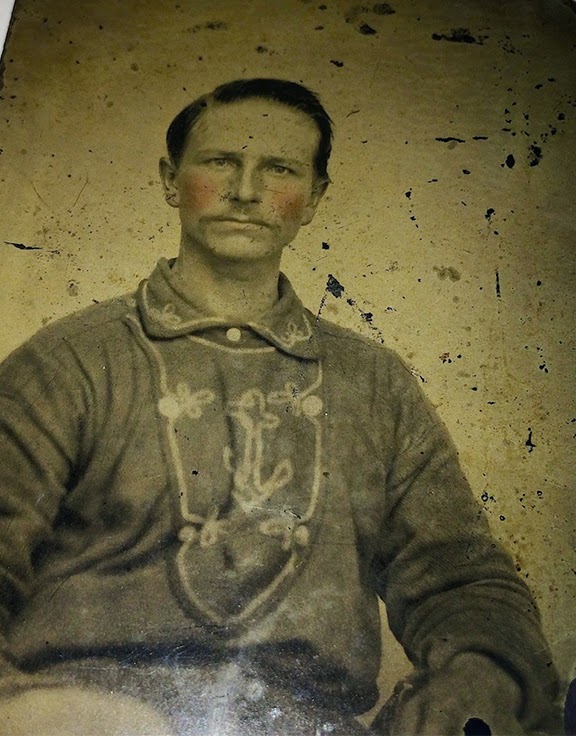
   Mark Lee Gardner just shared with me a photo he found online that is pretty amazing if you have ever wondered what Billy the Kid's bibbed shirt with the anchor on it, looks like:

Anchors Away!


"Judge not, lest ye be judged."
—Old bible saying

Friday, May 22, 2015

Sam Peckinpah's Pancho Villa

May 22, 2015
   One of the wonderful perks of my gig is to have contact information on most of the prime authors and researchers in our field. When I mentioned in a recent blog post that Sam Peckinpah was co-credited with the screenplay for "Villa Rides" (1968) I wondered about the rest of the story.

A sneak peek at our Pancho In Pictures splash page in the next issue of True West.


So I contacted Paul Seydor. We ran an excerpt from Paul's new book "The Authentic Death & Contentious Afterlife of Pat Garrett and Billy the Kid: The Untold Story of Peckinpah's Last Western Film." So I asked him and here is his reply:

"Sam wrote an early version of the script; Brynner read it and said Peckinpah knew nothing about Mexico (!) and demanded Peckinpah be replaced. End of Sam’s involvement, though a lot of his research thereafter informed The Wild Bunch screenplay, which he turned to next. That was the silver lining in this particular cloud and I have always been glad Brynner had him removed. If this hadn’t happened, there would likely be no Wild Bunch, and that would have been a true tragedy—an incalculable loss."
—Paul Seydor

The Bandit General Meets Texas Rising

May 22, 2015
   Still working on faces of Division del Norte, the boys of the Pancho Corp:

Daily Whip Out: "Pancho's Compadres #33"

Daily Whip Out: "Pancho's Compadres #34"

   Made a note to myself something that Toulouse Lautrec said to the effect, when drawing, you must keep your pen moving, and if you stop, the drawing dies. I guess I would call this the "Degas Effect" or, draw like you Don't Give A Shit.

   Something I do care about is the portrayal of history and with all the controversy about Bill O'Reilly's new show "Legends & Lies" (Brushy Bill? Really?) I had to laugh out loud at Stephen Harrigan's review of the new History Channel series, Texas Rising, in Texas Monthly:


"How about some landscape respect, Hollywood? How would you like it if they had filmed Sunset Boulevard in Sabine Pass?"
—Stephen Harrigan